Searching for Thomas Cromwell’s Quilts

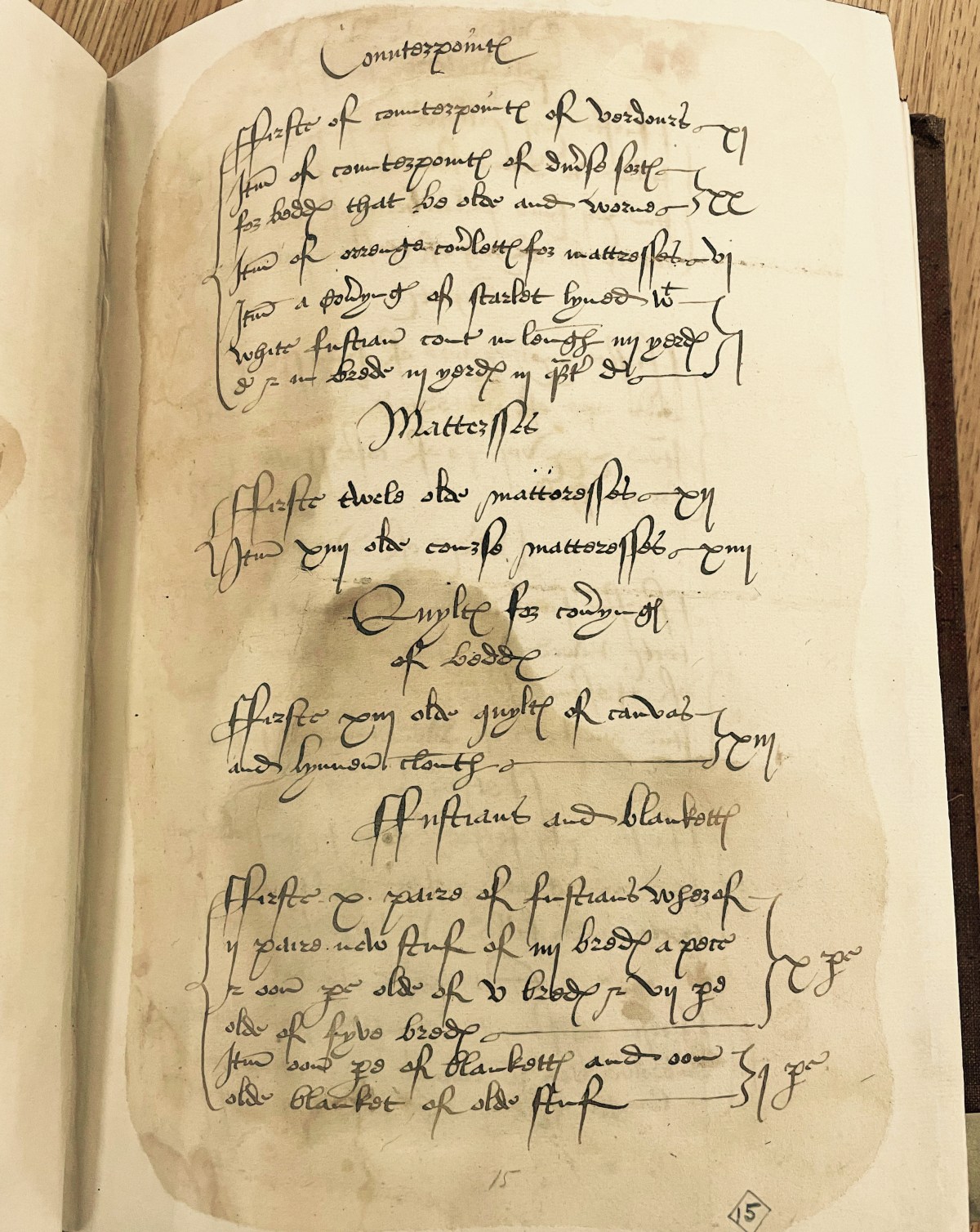
A parchment document, pasted into book form, written in black ink in 16th century hand. The word “Quylte” is visible two thirds of the way down. This is an inventory, or list, of mostly textile items.
Cardinal Wolsey’s Quyltes

I have been searching for Thomas Cromwell’s quylte of yelow Turquye Saten for some years now. What I mean is, of course, that I’ve been looking for any traces of it in anything other than Cromwell’s will (and of course in Hilary Mantel’s Cromwell Trilogy). I don’t expect to find the actual object – it is highly likely to be long gone, such is the nature of old textiles.

But I have become a bit obsessed by knowing what happened to this high value item. In his 1529 will, Cromwell left his yellow quilt to his son Gregory. However, many of Cromwell’s possessions were seized after his arrest and execution in 1540: so whether Gregory ended up with the quilt is questionable. I’ve started to look into documents relating to the King’s Wardrobe, and note that some of Cromwell’s textiles were listed there – does this include the yellow quilt? I will be taking a closer look in the coming weeks.

A few days ago, I was reading a 1527 inventory of Cromwell’s possessions, and noted a reference to a second quilt- a “yerdure coverlid” or “detailed green quilt” (as listed in Caroline Angus: My Hearty Commendations: The Transcribed Letters and Remembrances of Thomas Cromwell). And a closer look at Cromwell’s 1529 will indicates a bequest of another coverlet or quilt to be left to “Elizabeth Gregory, sometime my servant”.

My quilt search has given me the perfect excuse to spend some very pleasurable days at the National Archives looking at Sixteenth Century documents. I have seen beautiful things, been frustrated by tightly rolled layers, learned to read a little bit of Secretary Hand – and cursed my lack of Latin. So far I haven’t come across any references to Cromwell’s quilts but I am loving the process of looking.

And I was delighted to recognise the word Quylte when I finally saw it – even thought it was a quilt belonging to someone else. In an inventory of Cardinal Wolsey’s goods taken at Cawood in about 1530, there is a “Quylte for covyring of bedde” and “another very old Quylte”.

Of course that inventory sent me straight back to the Cromwell Trilogy. In Wolf Hall, Hilary Mantel imagined George Cavendish, Wolsey’s Gentleman Usher, telling Cromwell about Wolsey’s arrest at Cawood in November 1530 – the context in which this real inventory, including its quilts, would have been taken.

In Mantel’s version, at Austin Friars, Cromwell’s city house, Cavendish has to recount the event in detail, he has to tell someone, he has to tell Cromwell everything:

‘George, make this story short, I cannot bear it.’ But George must have his say…

Hilary Mantel, Wolf Hall, Entirely Beloved Cromwell

Cromwell cannot bear it. He turns away, so he does not have to witness Cavendish’s grief – and to hide his own: “He looks at the wall, at the panelling, at his new linen fold panelling, and runs its fingers across its grooves.” This is the moment when he knows he will take revenge on all those who brought down his master.

And right now in 2023, I’m energised by the shock of seeing Wolsey’s quilts inventoried nearly 500 years ago. I shall carry on looking.

The Weepers – Anne and Grace Cromwell

CW: This post contains references to the deaths of children.

Thomas Cromwell’s daughters, Anne and Grace, are included in the Weepers series; and I felt that, as children, they should share a panel rather than be placed alone.

We know that Anne and Grace were once alive; they are both mentioned in the will Cromwell’s made in 1529. But Cromwell had to cross out the references to ‘my littill Doughters Anne and Grace’. They both died, young, later that same year. He had planned to leave them both money, to be passed to them when they reached ‘lawfull age or be maryed’. Poignantly, his will anticipated their deaths – the sweating sickness, the recent death of his wife Elizabeth, and high rates of child mortality being perhaps on Cromwell’s mind. The will therefore makes provision for the bequests to be passed on to his son Gregory, should his daughters be already dead at the time of his death.*

Hilary Mantel fictionalised Anne and Grace in the Cromwell Trilogy, and in so doing, she left a moving picture of Cromwell as father. In Mantel’s version, Anne is ‘a tough little girl […] she is no respecter of persons and her eyes, small and steady as her father’s, fall coldly on those who cross her.’ (Wolf Hall: An Occult History of Britain).

We learn that Anne has no interest in stitching, and that when she ‘applies to her needle, beads of blood decorate her work’. (The Mirror and the Light: The Bleach Fields). Anne is more interested in learning Greek, studying Latin, working with numbers. After her death, Cromwell would like her to be buried with the copybook in which she has written her name – Anne Cromwell, Anne Cromwell – over and over, but ‘the priest has never heard of such a thing. [Cromwell] is too tired and angry to fight.’ (Wolf Hall: An Occult History of Britain).

Grace’s wings made of peacock feathers

Because we are seeing events through Cromwell’s eyes, we know less about little Grace. When she dies, he thinks ‘I never knew her. I never knew I had her.’ (Wolf Hall: An Occult History of Britain).

Grace is a beautiful child, leading Cromwell to wonder whether she is actually his – after immersing himself in the flirtations and accusations of adultery at Court, he speculates that Lizzie, now dead, might have been with another man. Lizzie’s sister says no – Grace was his child. ‘But he cannot escape the feeling that Grace has slipped further from him. She was dead before she could be painted or drawn.’ (Bring Up the Bodies: Spoils).

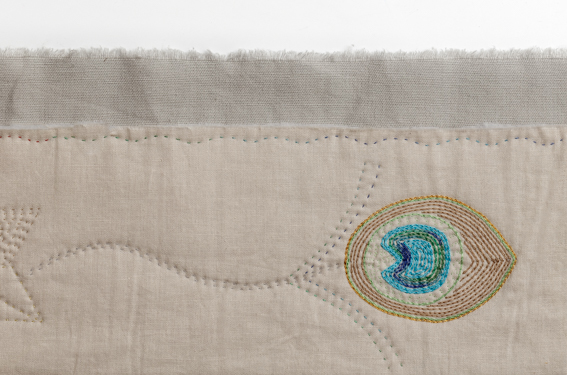
But during her short life, he makes wings out of peacock feathers for Grace to wear during the parish Christmas play, and she loves them. She doesn’t want to take them off, and he watches her, standing glittering in the firelight. And Cromwell keeps the wings for ten years after she has died, until they become ‘shabby, as if nibbled, and the glowing eyes dulled.’ (Bring Up the Bodies: Spoils).

An embroidered and quilted peacock feather on cream fabric
Peacock feather on the first Wolf Hall Quilt.
Photography: ©Michael Wicks

And when Cromwell reads his dead wife’s prayer book, it is the dead Grace’s hand he can see, reaching out to touch it. In life, she liked to look at the pictures; in death she does the same. As he turns a page, ‘Grace, silent and small, turns the page with him’. (Wolf Hall: Make or Mar).

A quilted hand reaching for blue letters that read Matins, Lauds, Prime, Sext, None, Vespers, representing the canonical hours,
Anne’s hand reaches for her mother’s book of hours

I realise now that I included references to Grace twice in the first Wolf Hall quilt – her peacock feather and her hand reaching for her mother’s prayer book – but there is no representation of Anne. Anne has the stronger personality on the page, we hear the noise of her feet, admire her determination, watch her assertive intelligence. Her family wonder ‘what London will be like when our Anne becomes Lord Mayor’. (Wolf Hall: An Occult History of Britain.

Anne’s omission from the first quilt now feels like a mistake. I can only explain it as a response to the grief in the text: listening to parts of An Occult History of Britain and Make or Mar while making the quilt was so painful that I had to move on from them. I expect I intended to return to them and add Anne at a later point. And now perhaps Anne’s absence from the quilt now represents her absence from Cromwell’s life.

Anne is now presented as a weeper, wearing the cap with seed pearls that she liked to take off. Grace has not been painted or drawn, but she has been now stitched. Wearing her peacock feather wings.

* Cromwell’s will, including notes of the deletions, can be read in Life and Letters of Thomas Cromwell by Roger Bigelow Merriman, in two volumes, first published in 1902.