The Weepers – Anne and Grace Cromwell

CW: This post contains references to the deaths of children.

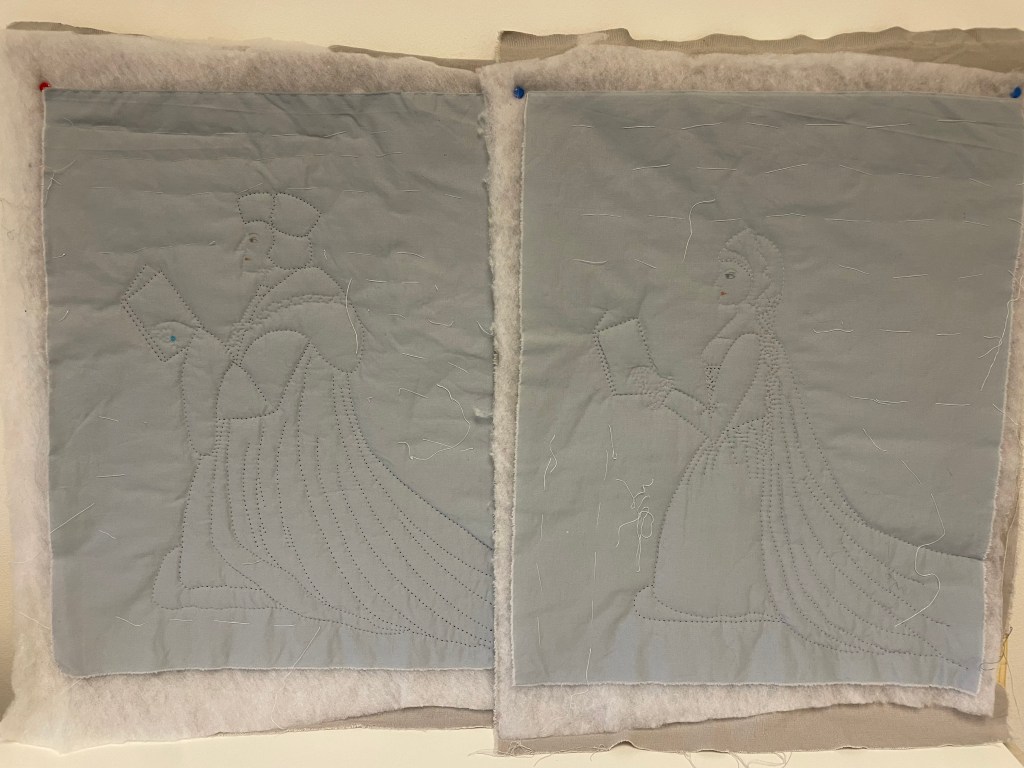
Thomas Cromwell’s daughters, Anne and Grace, are included in the Weepers series; and I felt that, as children, they should share a panel rather than be placed alone.

We know that Anne and Grace were once alive; they are both mentioned in the will Cromwell’s made in 1529. But Cromwell had to cross out the references to ‘my littill Doughters Anne and Grace’. They both died, young, later that same year. He had planned to leave them both money, to be passed to them when they reached ‘lawfull age or be maryed’. Poignantly, his will anticipated their deaths – the sweating sickness, the recent death of his wife Elizabeth, and high rates of child mortality being perhaps on Cromwell’s mind. The will therefore makes provision for the bequests to be passed on to his son Gregory, should his daughters be already dead at the time of his death.*

Hilary Mantel fictionalised Anne and Grace in the Cromwell Trilogy, and in so doing, she left a moving picture of Cromwell as father. In Mantel’s version, Anne is ‘a tough little girl […] she is no respecter of persons and her eyes, small and steady as her father’s, fall coldly on those who cross her.’ (Wolf Hall: An Occult History of Britain).

We learn that Anne has no interest in stitching, and that when she ‘applies to her needle, beads of blood decorate her work’. (The Mirror and the Light: The Bleach Fields). Anne is more interested in learning Greek, studying Latin, working with numbers. After her death, Cromwell would like her to be buried with the copybook in which she has written her name – Anne Cromwell, Anne Cromwell – over and over, but ‘the priest has never heard of such a thing. [Cromwell] is too tired and angry to fight.’ (Wolf Hall: An Occult History of Britain).

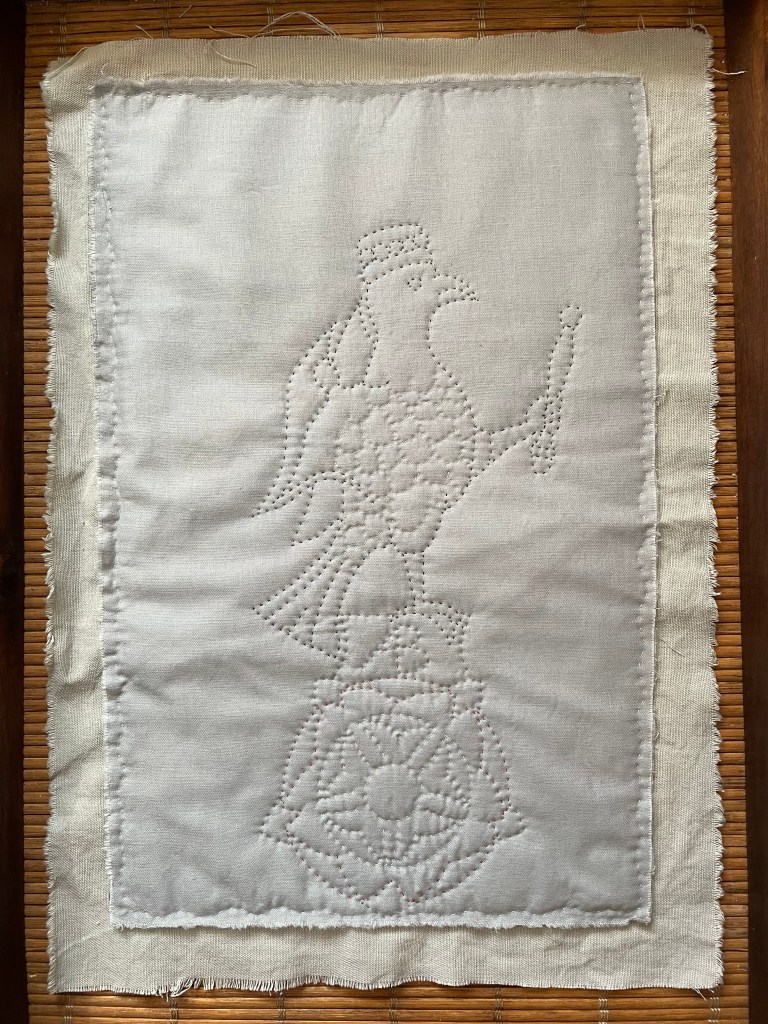
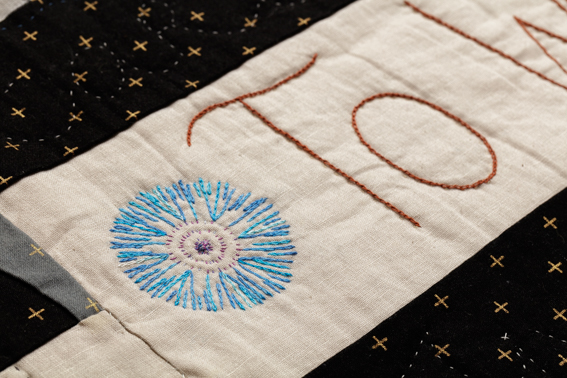
Grace’s wings made of peacock feathers

Because we are seeing events through Cromwell’s eyes, we know less about little Grace. When she dies, he thinks ‘I never knew her. I never knew I had her.’ (Wolf Hall: An Occult History of Britain).

Grace is a beautiful child, leading Cromwell to wonder whether she is actually his – after immersing himself in the flirtations and accusations of adultery at Court, he speculates that Lizzie, now dead, might have been with another man. Lizzie’s sister says no – Grace was his child. ‘But he cannot escape the feeling that Grace has slipped further from him. She was dead before she could be painted or drawn.’ (Bring Up the Bodies: Spoils).

But during her short life, he makes wings out of peacock feathers for Grace to wear during the parish Christmas play, and she loves them. She doesn’t want to take them off, and he watches her, standing glittering in the firelight. And Cromwell keeps the wings for ten years after she has died, until they become ‘shabby, as if nibbled, and the glowing eyes dulled.’ (Bring Up the Bodies: Spoils).
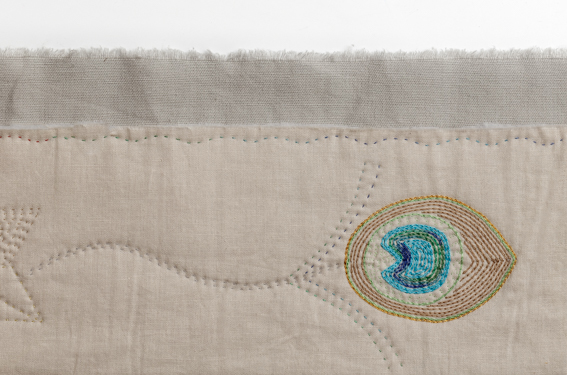
An embroidered and quilted peacock feather on cream fabric
Peacock feather on the first Wolf Hall Quilt.
Photography: ©Michael Wicks

And when Cromwell reads his dead wife’s prayer book, it is the dead Grace’s hand he can see, reaching out to touch it. In life, she liked to look at the pictures; in death she does the same. As he turns a page, ‘Grace, silent and small, turns the page with him’. (Wolf Hall: Make or Mar).

A quilted hand reaching for blue letters that read Matins, Lauds, Prime, Sext, None, Vespers, representing the canonical hours,
Anne’s hand reaches for her mother’s book of hours

I realise now that I included references to Grace twice in the first Wolf Hall quilt – her peacock feather and her hand reaching for her mother’s prayer book – but there is no representation of Anne. Anne has the stronger personality on the page, we hear the noise of her feet, admire her determination, watch her assertive intelligence. Her family wonder ‘what London will be like when our Anne becomes Lord Mayor’. (Wolf Hall: An Occult History of Britain.

Anne’s omission from the first quilt now feels like a mistake. I can only explain it as a response to the grief in the text: listening to parts of An Occult History of Britain and Make or Mar while making the quilt was so painful that I had to move on from them. I expect I intended to return to them and add Anne at a later point. And now perhaps Anne’s absence from the quilt now represents her absence from Cromwell’s life.

Anne is now presented as a weeper, wearing the cap with seed pearls that she liked to take off. Grace has not been painted or drawn, but she has been now stitched. Wearing her peacock feather wings.

* Cromwell’s will, including notes of the deletions, can be read in Life and Letters of Thomas Cromwell by Roger Bigelow Merriman, in two volumes, first published in 1902.

The Weepers – Elizabeth Wykys

Two quilted figures on grey fabric: one a man wearing long robes and a hat; the woman wearing a long dress and cloak. Both are kneeling and holding books
A stitched figure of a kneeling woman wearing a long cape and skirt, holding a book

Since my earlier post about commemorating the dead, and my explorations of weeper tombs, I have started stitching characters from Hilary Mantel’s Cromwell Trilogy who are to be included in my Weepers series. It’s quite an intense process: sketching out ideas, reminding myself of small details in the text, noting down some of their words, or what is said of them.

Once I get to the stitching stage, I start with outlines. Then I add a little detail. Then the figure sits for a while, waiting. Eventually, once I feel that the future is ready, I draw in a face. I am yet to add any text – and yet to decide exactly how I will do this; and I am still considering whether to also add objects relating to each figure. Maybe, maybe not.

Yesterday morning I finished the initial work on Cromwell’s wife Elizabeth Wykys. We know very little about the real Elizabeth Wykys, but in fiction, Hilary Mantel conjured a memorable character, and chose to give her great proficiency in textiles. In the Play Script, she wrote:

We know nothing about you, so we can only say, ‘women like you’. City wives were usually literate, numerate and businesslike, used to managing a household and a family business in cooperation with their husbands. In Wolf Hall, I make you a ‘silk woman’, with your own business.

Wolf Hall and Bring Up the Bodies. Adapted for the stage by Mike Poulton. From the novels by Hilary Mantel. (Notes on characters by Hilary Mantel)

My stitched Liz took a while to emerge. Although I quilted her outlines some weeks ago, she wasn’t fixed. For a while, I thought she might turn out to be Jenneke. I stitched another set of outlines, but my second attempt turned out – very definitely – to be Helen Barre. Liz was difficult to capture, as Cromwell himself finds after her death. He wishes Hans Holbein had painted her while she was alive, as in his memory:

even Liz’s face is a blurred oval beneath her cap.

Hilary Mantel, The Mirror and The Light: Augmentation, London, Autumn 1536

In the Cromwell Trilogy, Liz represents the happiness of Cromwell’s private life and domestic stability during his marriage. She and Thomas enjoy each others’ company, they relax together, and make each other laugh:

‘Men say’, Liz reaches for her scissors, ‘”I can’t endure it when women cry” – just as people say, “I can’t endure this wet weather.” As if it were nothing to do with the men at all, the crying. Just one of those things that happen.’

‘I’ve never made you cry, have I?’

‘Only with laughter,’ she says.

Hilary Mantel, Wolf Hall: An Occult History of Britain, 1521-1529

Liz plays another vital role in my reading of the Cromwell Trilogy: that of a very skilled maker. My analysis of the practice of stitching in the Trilogy indicates that she is the most proficient stitcher in terms of the number of techniques she uses. At various points in the novels, we observe her working with fabric and thread – she embroiders Gregory’s shirts with a black-work design (and I think it is reasonable to assume she has made said shirts); she makes costumes for the Christmas celebrations, using quilting and patchwork; professionally she is a silk woman, making braids, tassels, and net cauls. Less successfully, perhaps, she also teaches her daughter Anne to sew, but Anne struggles with a needle, asserting her own interests instead.

After her death, Cromwell finds a cushion she had started embroidering. She didn’t finish the piece but she left her needle in the fabric. Cromwell can feel the path Liz’s stitches would have taken, the bumps that have been left by her abandoned needle.

Like many experienced stitchers, Liz has the muscle memory to work without thinking. When Cromwell asks her to slow down so he can see how she spins loops of thread for a braid, she laughs.

“I can’t slow down, if I stopped to think how I was doing it I couldn’t do it at all”.

Hilary Mantel, Bring Up the Bodies: The Black Book, London, January-April 1536

While her work may be automatic, it is not without intention. Liz’s confidence in the tiny movements of textile work is brought about through long experience and repeated practice.

I hope my representation does justice to the character that Hilary created. Liz is now hanging up in my studio next to Cromwell himself, waiting to become part of a larger piece of work.

Two quilted figures on grey fabric: one a man wearing long robes and a hat; the woman wearing a long dress and cloak. Both are kneeling and holding books
Thomas and Elizabeth, hanging in my studio, awaiting further development

The Object and the Image

Cream fabric quilted with a motif of a Tudor rose combined with a pomegranate, leaves and a stem at the bottom. To the right of the motif is a quilted bird with large feet
The Pomegranate and the Tudor Rose combined
Photographer: © Michael Wicks

When I was working on the first Cromwell Trilogy Quilt back in 2020-2021, we were in lockdown in England, and all my research was home based. Museums were closed and I relied on online catalogues and images for both reference and inspiration.

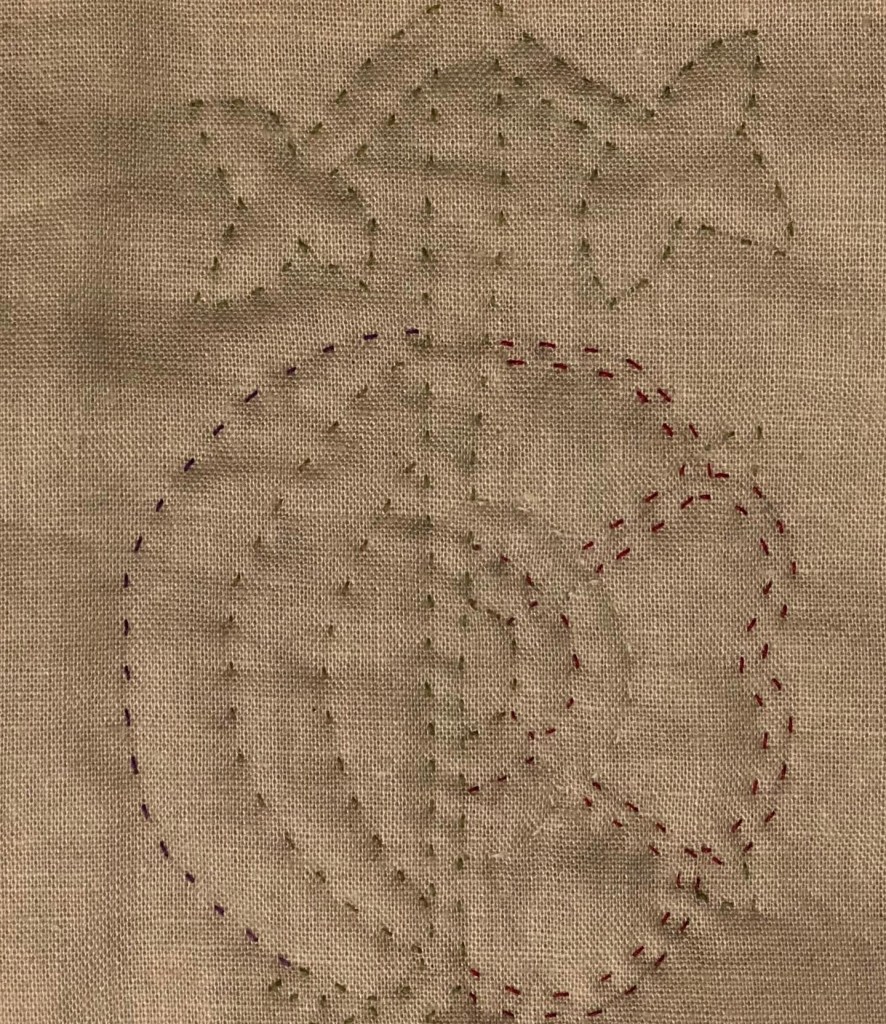
One of the first motifs I stitched into the quilt – in the Paternity section – was a symbol representing Katherine of Aragon, based on a livery badge held in the collection of the Museum of London. The badge represents a pomegranate (Katherine’s emblem) combined with the Tudor Rose.

A hand stitched image of a rose and pomegranate combined, the leaves at the bottom of the stem. The image is displayed in a rounded format.
Katherine of Aragon’s Livery Badge, stitched

At this stage in the project, I was still working out my approach, and I used this badge to start thinking about the way in which the emblems of Henry VIII’s queens needed replacing, a theme that Hilary Mantel returned to throughout the Cromwell trilogy, and which I have returned to repeatedly in my stitching.

Yesterday I had the opportunity to go into the Museum of London for the first time since lockdown (and the last time I will do so until the Museum reopens in its exciting new home in due course). In the Medieval Gallery, I found that the actual livery badge was on display – so I saw the real, tiny thing for the first time. And in its display case, it is presented the other way up to my interpretation, and indeed in the catalogue photograph.

Part of a display case featuring a dark grey rose and pomegranate design with the leaves and stem at the top of the object. In the case there is also a gold and silver belt buckle on a clear Perspex block, and a round object is also just visible.
The livery badge in its display case

So is it the “wrong” way up in my quilt? As an image, the leaves appear more natural sitting at the bottom like a flower; but as an object, could there be the remains of a clip, a pin, a fastener to indicate it was worn with the leaves at the top? Would I have approached it differently had I seen the object first, or not even looked at the online catalogue at all?

It’s one of those unanswerable questions that result from the first Cromwell Trilogy Quilt being made in a situation of restriction, with no access to actual objects. And access is still restricted for me personally: I am currently living with the after effects of Covid-19 – fatigue meant that I spent most of my visit sitting down whenever and wherever I could and reserving my energy for looking at this one object.

Whether the livery badge should have been worn this way or that, Wolf Hall describes the way in which Katherine and her supporters found themselves the “wrong” way up once their stability was upended by the rise of Anne Boleyn. So there is an additional layer of meaning in its representation in my quilt – however unintended it might have been when I picked up my needle.

The stitched rose and pomegranate motif again, this time the “wrong” way up with the leaves and stem at the top of the motif.
Upended

The Weepers

In recent weeks, my thoughts have turned to the remembering of the dead, to commemorations, and the marking of lives.

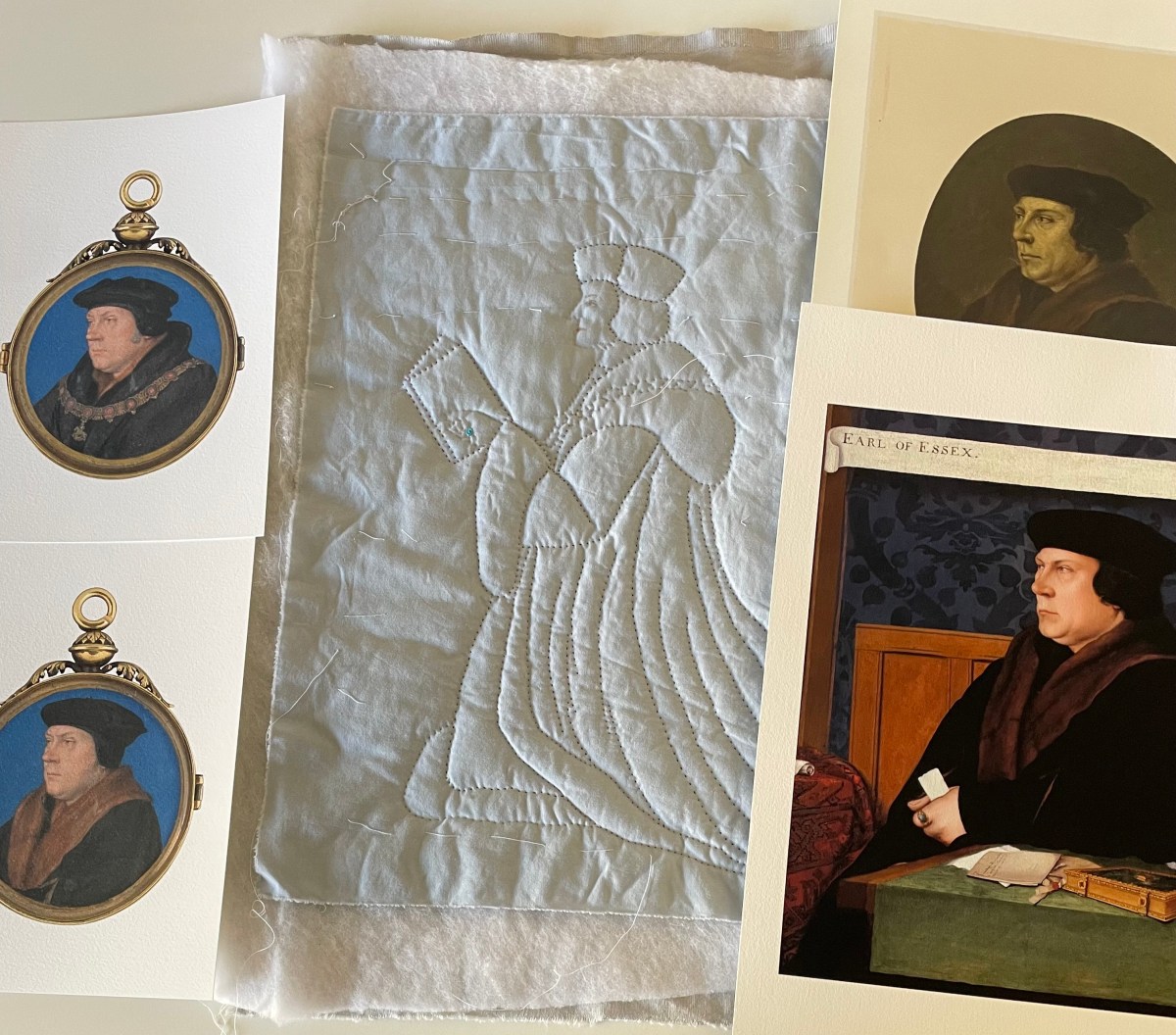
A quilted picture of a kneeling Thomas Cromwell, holding a book. He is surrounded by four painted portrait prints of differing sizes and styles.
Work in progress: Thomas Cromwell as weeper

In Hilary Mantel’s Bring Up the Bodies, Thomas Cromwell considers the tombs of the ancestors of the nobility:

men armoured cap à pie in plate and chain links, their gauntleted hands joined and perched stiffly on their surcoats, their mailed feet resting on stone lions, griffins, greyhounds … We think time cannot touch the dead, but it touches their monuments.

Hilary Mantel, Bring Up the Bodies: Falcons

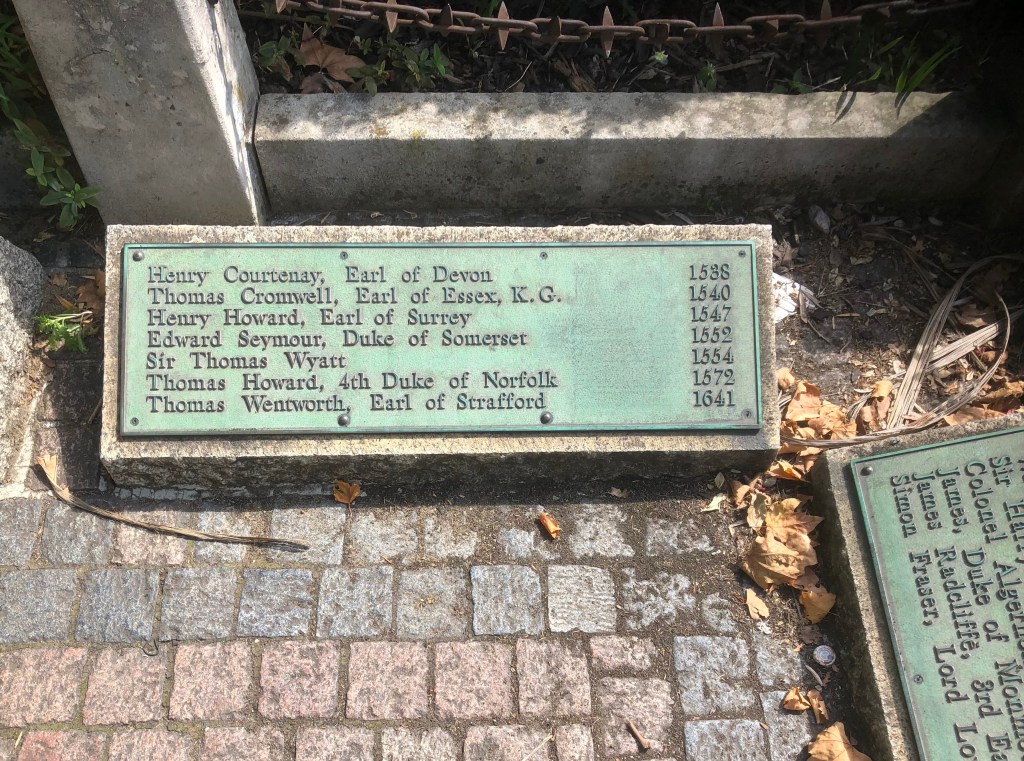
Coming from modest beginnings, Cromwell himself had no family tomb. And there was no elaborate tomb for him following his execution in 1540. His remains were buried in the Chapel Royal of St Peter ad Vincula, within the Tower of London, where there is a brass plaque that lists individuals “buried in this chapel”; and there is a plaque marking the site of his execution on Tower Hill.

A plaque containing a list of names of individuals executed on Tower Hill, including the name of Thomas Cromwell, Earl of Essex.

In the Cromwell trilogy, Mantel wrote of the tomb commissioned by Cardinal Wolsey – “the black marble, the bronze, the angels at his head and foot” (Wolf Hall, Entirely Beloved Cromwell). Wolsey was not buried in his tomb; in the trilogy, the King expresses a wish to be buried in the “sarcophagus of black touchstone, in which the cardinal never lay” (The Mirror and the Light, Wreckage II). But Henry was not buried in it either: the sarcophagus is now in St Paul’s Cathedral, and is part of the tomb of Admiral Lord Nelson. The Wolsey Angels, which never found their way to Wolsey’s tomb, are now in the collection of the Victoria and Albert Museum, after centuries of separation and misidentification.

Looking at the place of tombs in the three novels, I started to think about other memorials. My imagination was particularly captured by the idea of weeper tombs – those tombs that feature kneeling figures, praying for the soul of the departed.

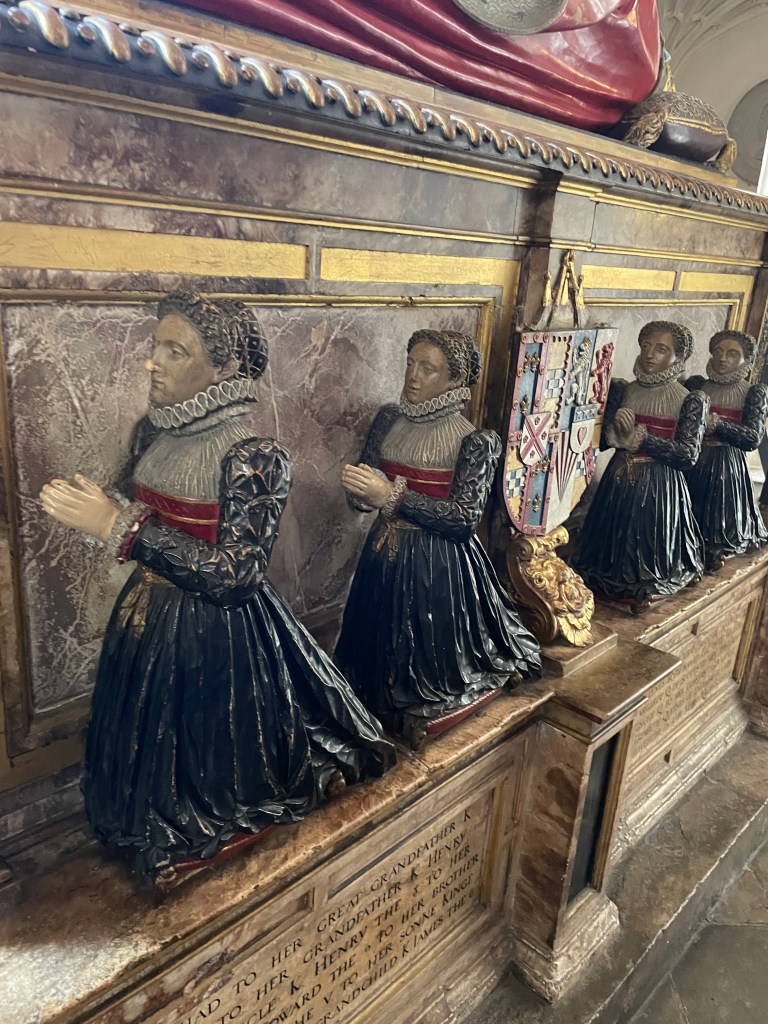
In Westminster Abbey, I visited the elaborate tomb of Margaret Douglas, Countess of Lennox (who plays a significant role in The Mirror and the Light), and looked at the weepers that represent her sons and daughters. And I started drafting out some weepers of my own.

An elaborate tomb, with the figure of a woman lying on the top, four kneeling figures decorate the sides: three male figures are fully visible in the picture, kneeling on red cushions and praying.
Four female figures dressed in black are shown on a tomb kneeling in prayer.
The tomb of Margaret Douglas in Westminster Abbey, London

Through a series of leaps and tangents, I started to muse on the identity of the characters in Mantel’s trilogy who might weep for Thomas Cromwell.

Nobody, he thinks, will ever cry for him.

Hilary Mantel, Wolf Hall, Across the Narrow Sea

I think Cromwell is wrong about this. What about Christophe? Rafe?

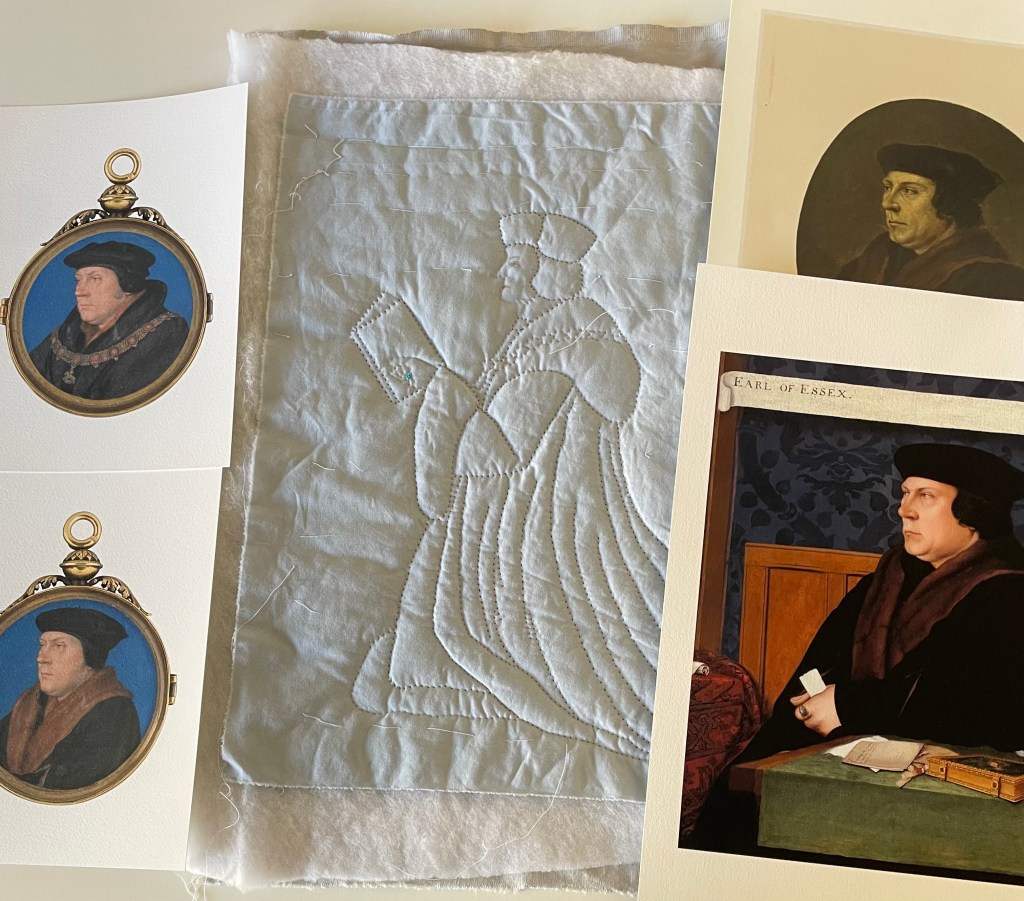
I have started to compile a list of weepers who are to be quilted, beginning with Cromwell himself. These weepers won’t be praying. They will be reading. And they will be reading Hilary Mantel’s Cromwell Trilogy.

A quilted picture of a kneeling Thomas Cromwell, holding a book. He is surrounded by painted portrait prints of differing sizes and styles.

Falcons

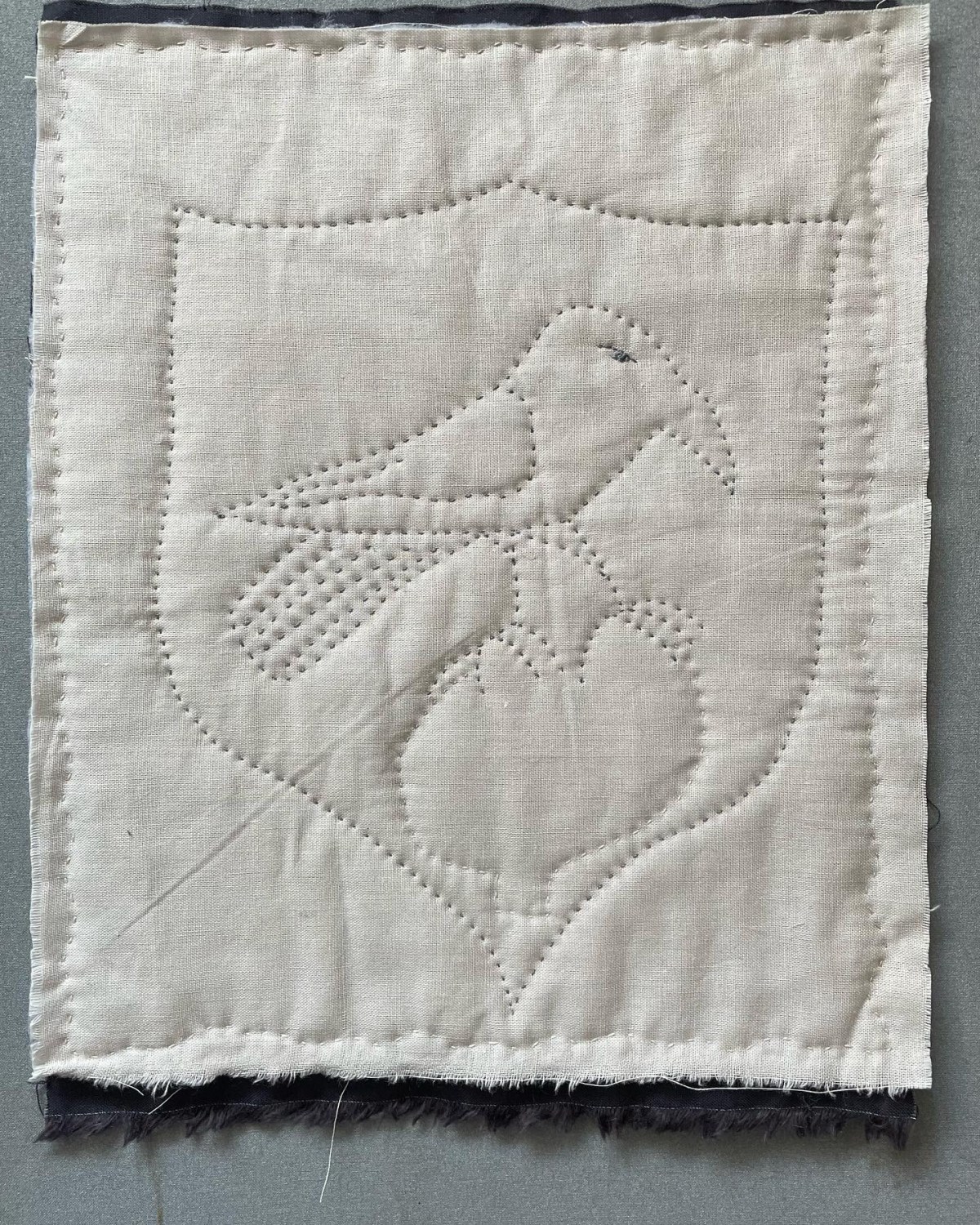
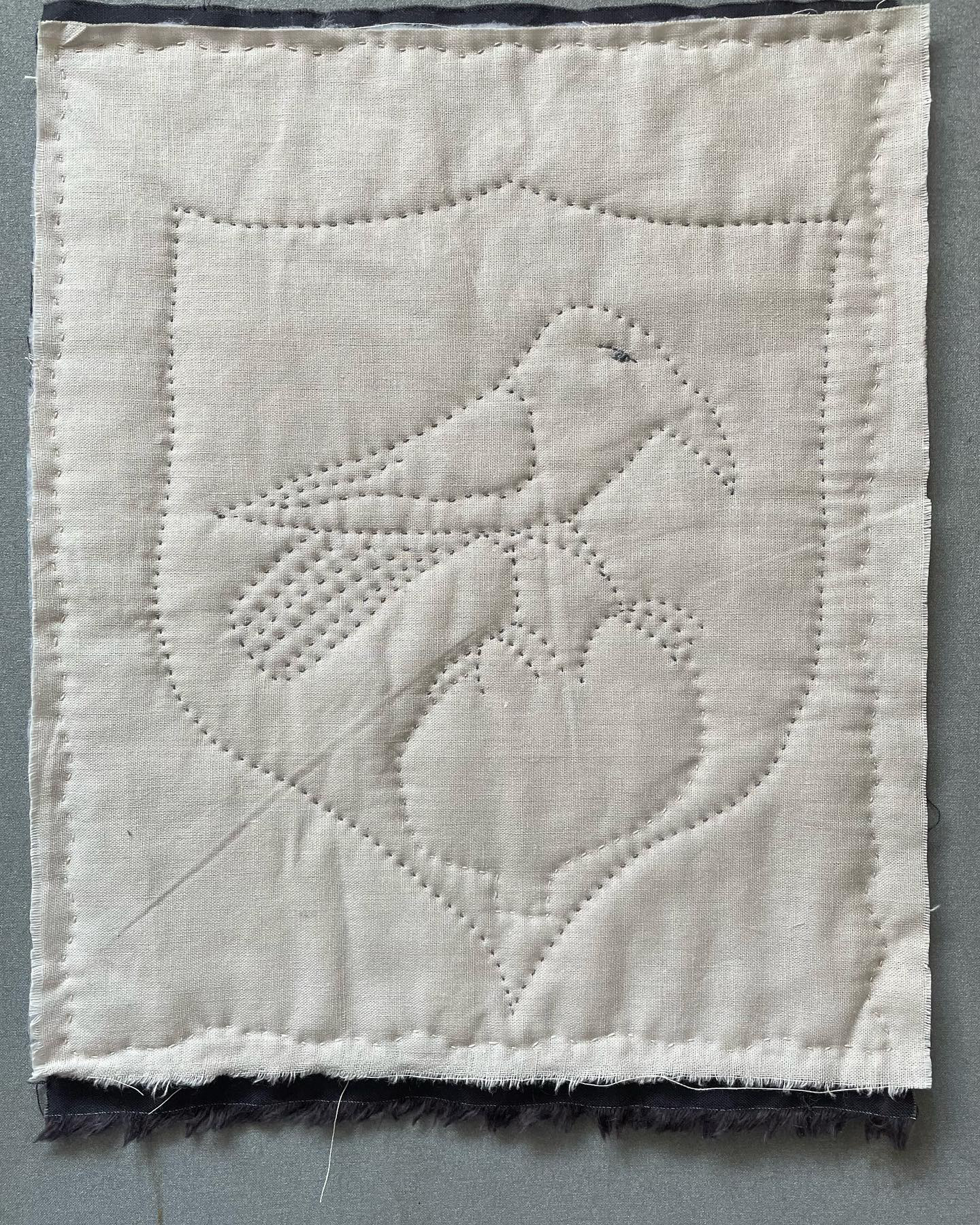
Quilted grey fabric depicting a bird presented within a shield shape
A grey quilted piece of a falcon, which is standing on top of a Tudor rose. The falcon is crowned and holds a sceptre in its claw.
A quilted representation of Anne Boleyn’s falcon symbol.

Since finishing the first Wolf Hall Quilt, I have been reflecting on the way in which I will continue this project, and over the last few months I have changed my approach. It hasn’t been an easy process; I have thought a lot about what worked in the first stage (the detail) and what didn’t work (the overall shape of the quilt unrolled), and how I restricted myself too much when working on the first piece. After various false starts and a period of being stuck, I now feel very clear about my direction of travel – and that’s partly because of my experience of making a couple of small falcon pieces. Falcons might be the name of the first chapter of the second book in the trilogy, Bring Up the Bodies, but the Falcon was also the symbol of Anne Boleyn and her family.

I have always been struck by the way in which Hilary Mantel writes about the symbols relating to the various Queens of England in the Cromwell Trilogy. Mantel writes a lot about the changing of symbols with the changing of Queens – from the pomegranate (Katherine of Aragon) to the falcon (Anne Boleyn) to the phoenix (Jane Seymour), how they have to be painted over, unpicked, or otherwise obliterated. Over the last few months I have been stitching representations of these symbols with a view to eventually putting them together into a Book of Queens. And that has meant stitching falcons.

Although Henry VIII wanted no reminders of Anne Boleyn and her symbols, nearly 500 years after her fall, falcons can still be spotted at Hampton Court, in the ceiling of what’s now known as the Anne Boleyn Gateway. In Bring Up the Bodies, Mantel’s Cromwell pictures himself “perched like a carved falcon over a doorway” – and, like him, these remaining falcons can now watch the comings and goings of those who enter the Great Hall and the chambers beyond.

And at the Tower of London, in the Beauchamp Tower, there is a rough falcon carving that might relate to Anne Boleyn. Historian Eric Ives, in The Life and Death of Anne Boleyn (Blackwell Publishing Ltd, 2004, p.364), wrote that this is Anne’s

“most poignant memorial… Which of her ‘lovers’ made it we do not know, but the image is unmistakable. The tree stump is there – the barren Henry – the Tudor rose bursting into life, the perching bird whose touch wrought the miracle. But there is one change to the badge which Anne had proudly flourished in the face of the world. This falcon is no longer a royal bird. It has no crown, no sceptre; it stands bareheaded, as did Anne in those last moments on Tower Green.”

Eric Ives, The Life and Death of Anne Boleyn, (Blackwell Publishing Ltd, 2004) p.364.
A crudely carved falcon on a stone wall, contained in a shield shape
The Beauchamp Tower falcon

The Tower’s own description, to be found on the wall nearby, is less definite and reads “Unknown. The shield is thought to be Anne Bolyen’s falcon carved by one of her supporters”. I’ve seen speculations that it might have been carved by Anne’s brother George, or by the poet Thomas Wyatt, both prisoners at the Tower, and probably the best known of Anne’s supporters, but really we cannot know who made it.

Does Mantel present a scene any of Anne’s alleged lovers (Henry Norris, William Brereton, Francis Weston, Mark Smeaton, brother George, or Thomas Wyatt) carving this uncrowned falcon? No. In Mantel’s telling in Bring Up the Bodies, George Boleyn is imprisoned “in his light circular room in the Martin Tower”. Thomas Wyatt is seen by Richard Cromwell “looking down from a grate in the Bell Tower”; and as Mantel notes in The Mirror and the Light, Wyatt’s own poetry references the Bell Tower. And the exact location of the other four prisoners is not present in the text.

In fact there is just one mention of the Beauchamp Tower in the trilogy, and that is by Cromwell himself. After his arrest, in The Mirror and the Light, he is held in the Queen’s Apartments, before being moved to the Bell Tower. “Can I not go to the Beauchamp Tower?” he asks, to be told that it is already occupied. 

Quilted grey fabric depicting a bird presented within a shield shape
A quilted representation of the Beauchamp Tower Falcon

While the trilogy does not mention this carving, The Mirror and the Light makes reference to “The Boleyn’s’ white falcon [hanging] like a sorry sparrow on a fence, while the Seymour phoenix is rising”, and that makes me think of this carving. And there’s something else for me to think about. To me, the “tree stump” on which the carved falcon is perched looks a little like a pomegranate; and my stitched adaptation deliberately plays on that. I wanted the now defeated and uncrowned falcon to still be determined to show dominance over the pomegranate, even in its final days.

Looking at these falcons, and their recurrence in the text throughout the trilogy has been invaluable in working out my approach to the next stage of my sewing project. Rather than taking the books individually, and working in order as I did with the Wolf Hall quilt, I am now working thematically across the three books. I’ve been thinking about snakes and eels, the river and the buildings. Last night I even dreamt that I was embroidering the food Cromwell eats. The Cromwell trilogy continues to captivate me and my stitching hands.

The First Wolf Hall Quilt: What have I made?

I have a very complex relationship with the first Wolf Hall quilt. Ten months after putting the last stitch in place, I am still not sure what I think of it. I think I am reaching the conclusion that it isn’t a discrete piece of work in its own right but it is a jumping off point for other work – and I am happy with that conclusion.

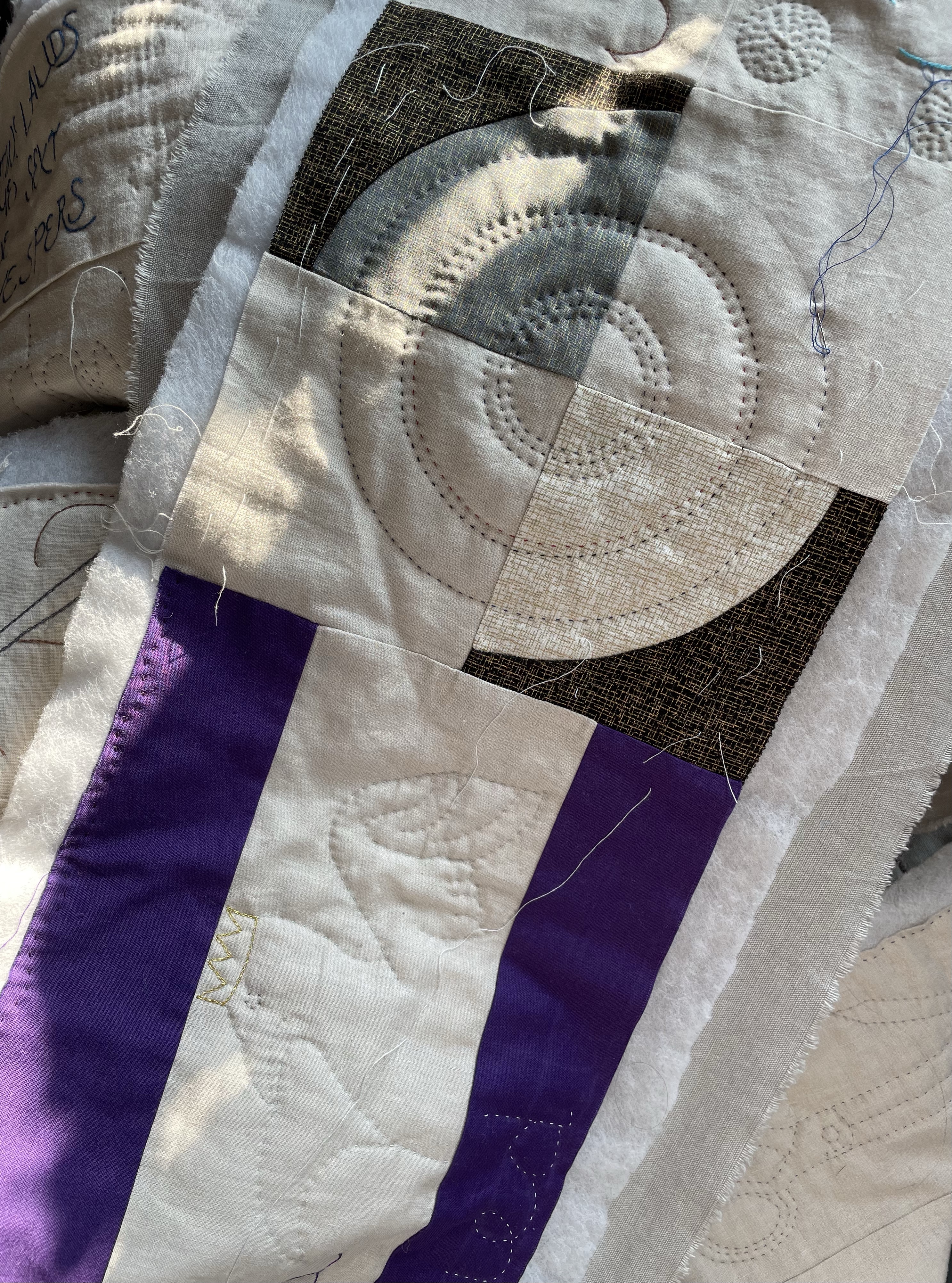
Quilted fabric strips, in cream, purple, black, and grey. A quilted falcon is visible, and a curved quilt block is being quilted with circles, a needle and thread are waiting to be stitched in.
The first Wolf Hall Quilt: at this point I didn’t know how it would turn out.

Because of lockdown restrictions in 2020 and 2021, no-one apart from me was in the same space as this piece until it was almost complete. I didn’t show the work in progress to anyone face to face; and I didn’t have the space to see the whole thing. In fact I didn’t actually see the piece as a whole myself until May 2022 when I was finally in a space that could accommodate the whole unrolled length of 46 feet.

Before that, the only way I could see the quilt in its entirety was to have it photographed.

Michael Wicks, the marvellous photographer who produced a great set of pictures of the work, did a great job in taking detail shots. Before we met, we talked about the shape of the project and its length; I drew him out a map of each section on index cards so he could match them up with the photographs I had commissioned. At his studio we tried to lay the piece out flat but it was actually too long, being longer than the width of the building, and so it ended up being folded back on itself. But within 24 hours of dropping it off, I had an image of how the first Wolf Hall quilt looked thanks to Michael’s photographic magic.

The piece didn’t look as I had expected, and I had some difficulty working out what I had made until a friend said it reminded her of a piece of code. The significance was in the detail.

And after a couple of weeks, when I looked at the full image again, I realised she was right. I started to view the quilt in that light – as a piece of code that represented my personal response to Wolf Hall; I have detailed notes, sketchbook diagrams, a colour coding system, and a key that unlocks each reference on the quilt, but without these, can the whole code be read? As Cromwell himself wonders, when reading some of Cardinal Wolsey’s letters to the rulers of Europe, could the encryption be more tricky?

In the same way that one can’t see the contents of a book all at once, I realised that one shouldn’t be able to see the whole quilt all at once. It’s meant to be rolled – in a nod to Cromwell being Master of the Rolls – only revealing part of its code at any one time. The encryption should indeed be tricky.

The first Wolf Hall Quilt – completed and rolled,
19 August 2021

When I finally unrolled the Wolf Hall quilt a couple of weeks ago, as the guest of a very welcoming quilting group, I was in a space large enough to accommodate it, and eight quilters held it up along its length. It was a very intense experience: even though I made it, I hadn’t appreciated the scale of it before that. I am still not sure what I think of it, but I have now been able to see what the entire piece looks like all at once.

And now, once again, it is rolled up, hiding its codes and its tricky encryption.

Forty Six Feet of Wolf Hall

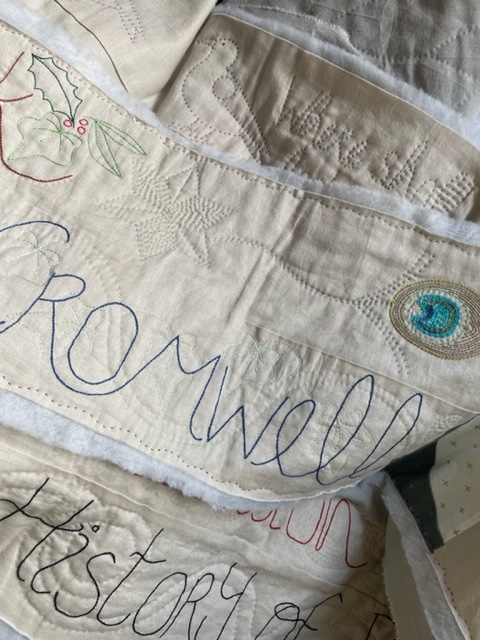
Quilted strips, showing words and images, including circles, a falcon, a needle and thread. Fabric in cream, grey, black and cream is visible.
Wrestling the Wolf Hall Quilt together

When I started working on the Cromwell Trilogy Quilt project, I had the intention of making one single piece to convey my interpretation of the whole of Hilary Mantel’s trilogy. But – best laid plans and all that – I didn’t realise how long the Wolf Hall section alone would turn out. Forty six feet of quilting later, and having faced the difficulties inherent in managing such a long textile piece, I have revised my plans.

Pieces of quilted and decorated textile in pieces, with a join ready to be made with some grey fabric.
Parts One and Two, still in separate sections, 14 August 2021

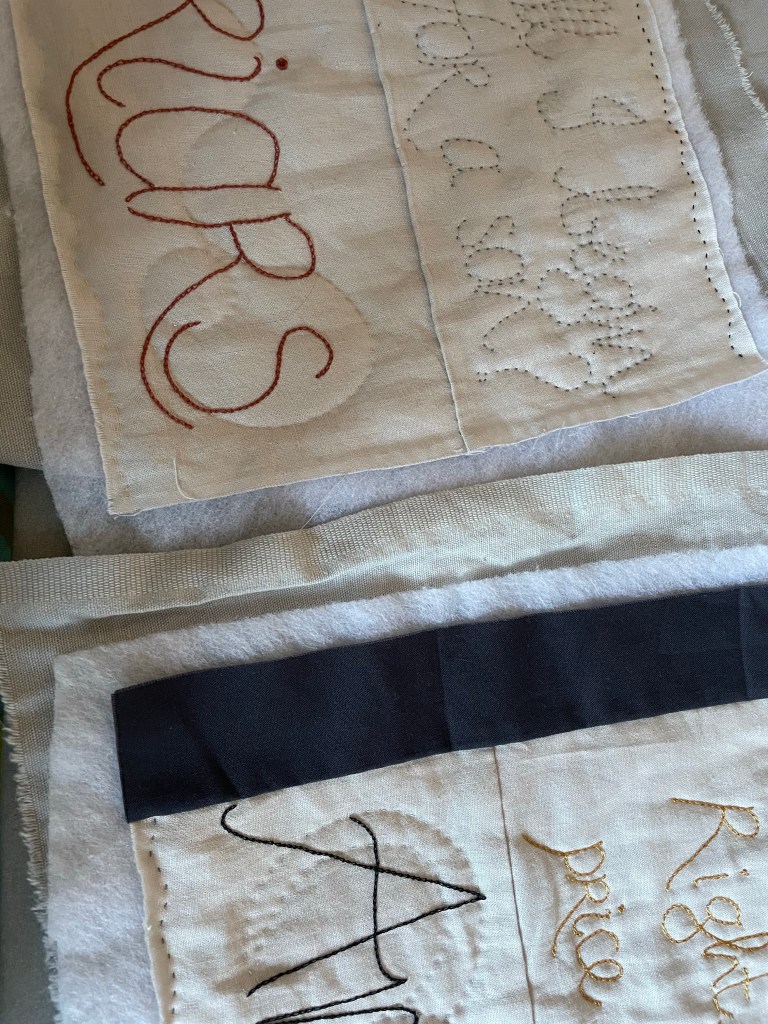
I stitched the Wolf Hall quilt in sections – one section for each of the six parts of the book. As each section was stitched, I drew myself a key to show the elements I had included. Once that was ready – at the very end of the making – I had the slightly nightmarish job of joining the sections together to make a single piece.

An open notebook containing a diagram showing chapter titles from Hilary Mantel’s Wolf Hall, and notes written in orange text, with scribbled sketches and words.
The Wolf Hall Quilt key – parts Five and Six

I joined each section with a placefinder bar, quilting the book title and part number at each join. As the piece got longer and longer and heavier and heavier, I found I was grappling with something that twisted and writhed like the snake that bit Cromwell in Italy. And as it grew, I became increasingly afraid to move in case I twisted it further.

The day that I finished the Wolf Hall quilt was odd. I was very tired, and my hands and wrists hurt from manipulating 46 feet of quilt. It had taken five days to join the sections together, and hours were spent just trimming off excess wadding. On the last day, I sat for hours ploughing on, which was very bad for the hands and the back. But finally, it was done.

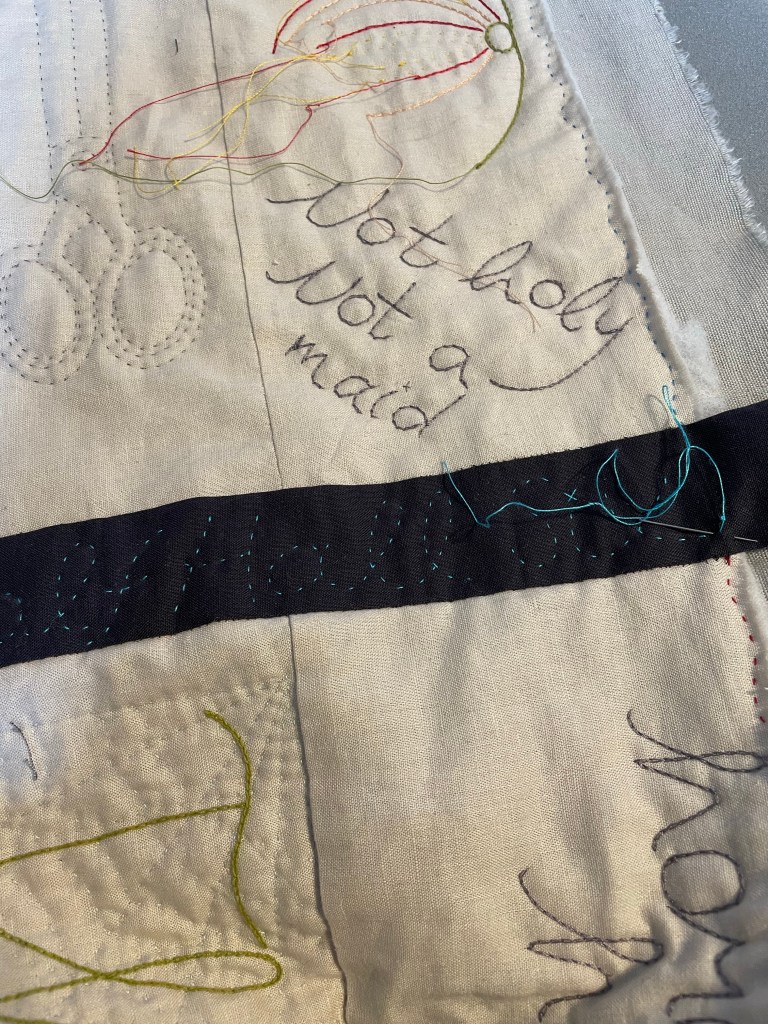
Pieces of quilted fabric in cream with decoration; a dark grey strip joining two pieces with blue text stitching and a needle and thread ready to set a stitch.
The very last stitch going in, 19 August 2021

I finished all the joins at 3 minutes past 1 on 19 August 2021. I was exhausted but also exhilarated as I rolled it up as one piece. This all-consuming project had reached a significant milestone – the first large piece was complete.

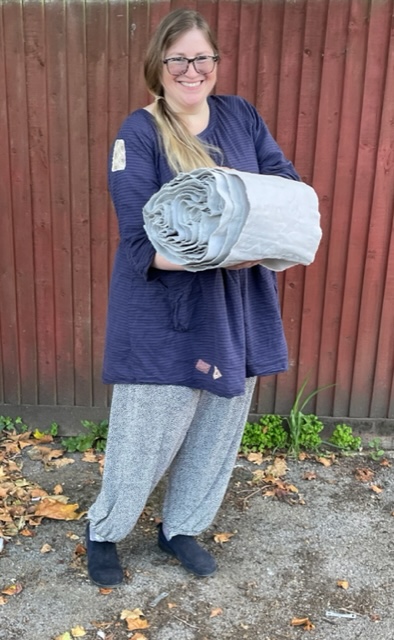
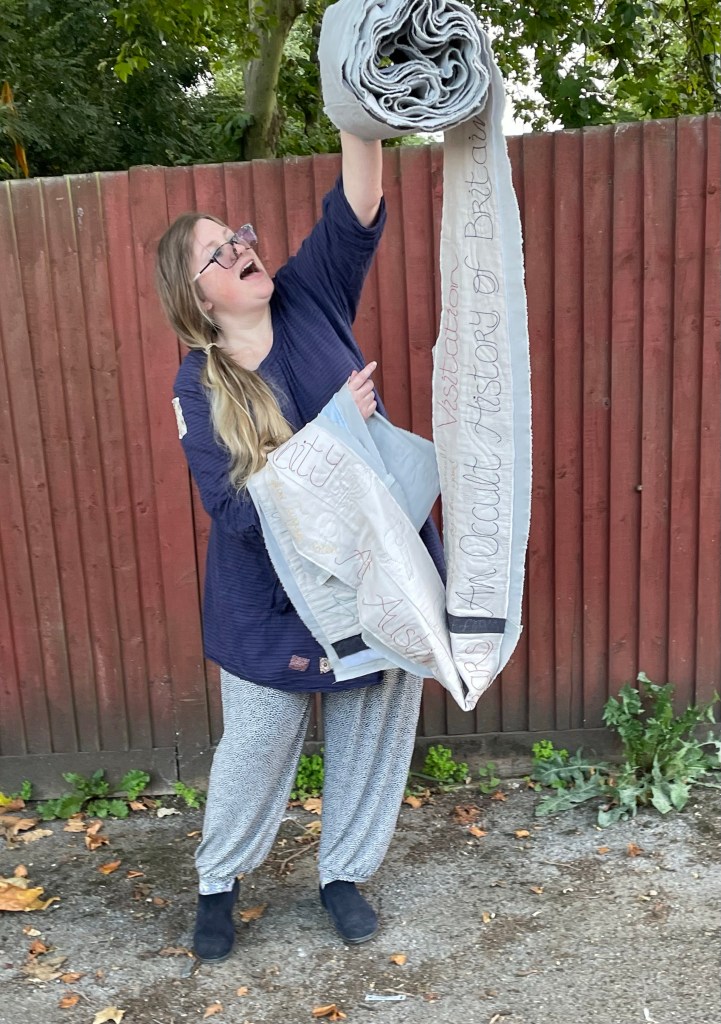
A woman in a blue dress and grey trousers holds up a long pieces of quilted work against a backdrop of a brown fence.
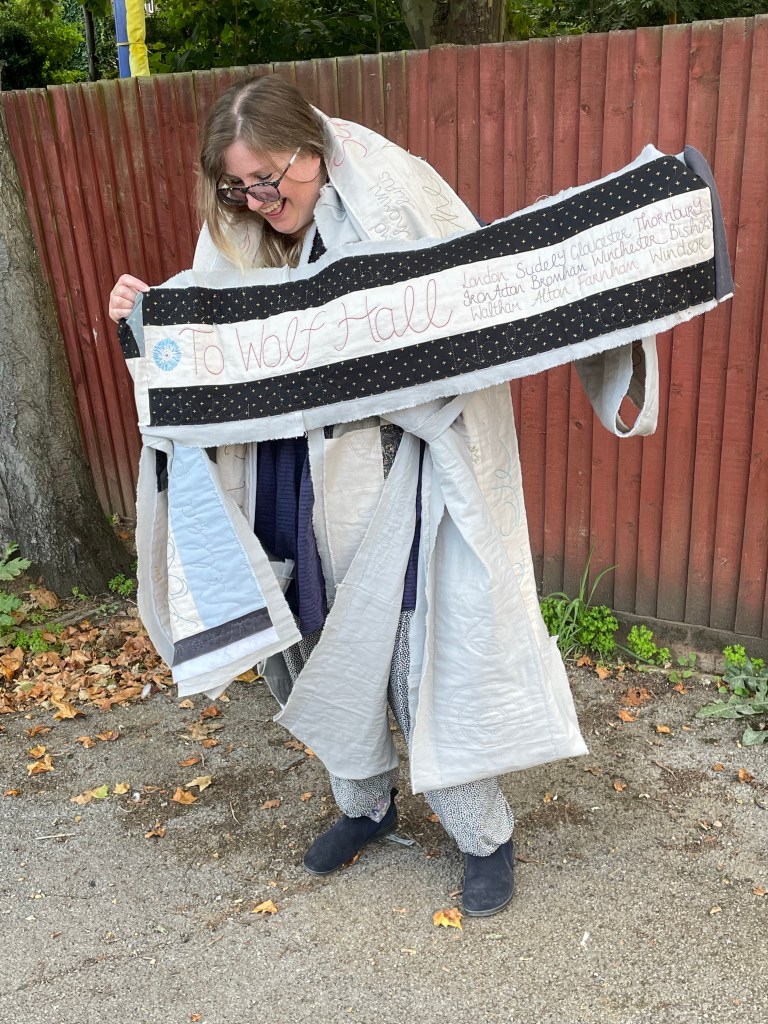
A woman in a blue dress and grey trousers holds up a long pieces of quilted work against a backdrop of a brown fence. The quilted lettering reads “To Wolf Hall”

Last week, for the first time in months, I unrolled all 46 feet of the Wolf Hall quilt. I was giving a talk about the project, and the audience of quilters was keen to see the stitching close up – and to experience the scale of this unwieldy textile piece. Given that I rarely get a chance to see the quilt in one go – its length makes it difficult to view – it was very exciting.

I had completely forgotten that I’d left an unfinished grey placefinder bar at the end – after “To Wolf Hall” – thus leaving my options open. In August 2021, I clearly intended to join similar quilted pieces interpreting Bring Up the Bodies and The Mirror and the Light to the Wolf Hall piece. But the challenges of 46 feet of quilting made me rethink this idea. Now I am pleased that the ending of the first Wolf Hall quilt is still open to further possibilities. As Hilary Mantel writes at the very end of Bring Up the Bodies:

There are no endings. If you think so you are deceived as to their nature. They are all beginnings. Here is one.

The Wolf Hall Quilt: Designing around the text

In the summer of 2020, when I started embroidering the chapter titles from Hilary Mantel’s Wolf Hall, Bring Up the Bodies, and The Mirror and the Light, there was a distinct absence of planning. Yes, I made sure there was some regularity about the lettering I stitched, but I didn’t have any sort of scheme for how the pieces would fit together or how they would be quilted. It is unsurprising therefore that once I got into working out the quilting design, this presented challenges.

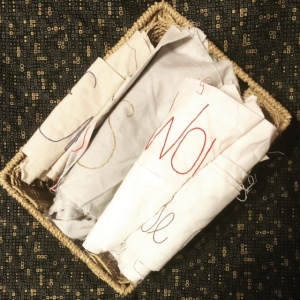
A rectangular rush basket full of embroidered wording
A basket of embroidered chapter titles waiting to be quilted

There were two main issues. Firstly, once I started putting the pieces together, I wondered why I hadn’t simply quilted the chapter titles from the start. I often quilt using chain stitch, so why had I chosen to embroider the words on to just one layer of fabric, thus necessitating a whole separate quilting exercise that ultimately led to a distortion of the lettering? The answer, of course, lay in the fact that I had never really intended to stitch all this text at all – I just intended to sew Mirror and Light but carried on stitching for five months until the chapter titles from the whole trilogy were done, and my left thumb ached from gripping the thread.

The second issue was one of design. Some of the trilogy’s chapter titles are short – Early Mass, Angels, Wreckage, Salvage – and the text, as it was sewn on to the fabric, provided space for prominent quilting designs before or after the words in question. Other chapter titles, however, were almost as long as the fabric strips on which they were stitched – An Occult History of Britain; Alas, What Shall I Do for Love?; The Image of the King – so adding very prominent quilting would have both confused the eye and detracted from the text.

Embroidered fabric with the words Anna Regina and a postcard of Anne Boleyn
A shorter title – Anna Regina – gives space for prominent quilting motifs

The trick with these longer titles was to come up with a quilting design that faded into the background while still conveying meaning. For An Occult History of Britain, for example, I spent hours studying pictures of snakes so I could design a serpent to sit behind the lettering, in homage to the snake that slithers through the trilogy (I picked up a snake in Italy) after biting Cromwell. I enjoy the appearances that snake makes on the page, so I wanted to add him to the quilt.

Embroidered fabric reading Entirely Beloved Cromwell, with a copy of the play script
Entirely Beloved Cromwell – Lettering takes up the entire length of the fabric

And for The Dead Complain of their Burial I was inspired by a description of Cromwell and George Cavendish watching Cardinal Wolsey’s possessions being ransacked at York Place:

“He and George Cavendish stood by as the chests were opened and the cardinal’s vestments taken out. The copes were sewn in gold and silver thread, with patterns of golden stars, with birds, fishes, harts, lions, angels, flowers and Catherine wheels.”

Hilary Mantel, Wolf Hall (London Fourth Estate, 2009), p.282.

That gave me my start. I designed fishes, stars, and a Catherine wheel; and for bird designs I consulted a book of sixteenth and seventeenth century sewing patterns: Richard Shorleyker’s A Schole House for the Needle. That book tells its readers to ‘compose its patterns into beautifull formes, as will be able to give content, both to the workers, and wearers of them’. So I quilted these background designs in silver and gold thread – subtle enough not to detract from the chapter title, but occasionally catching the light.

The unplanned nature of this project had ramifications for the overall design and look of the finished piece, and while I was sewing it, I had various thoughts along the lines of “If I were starting again, I wouldn’t start from here”. But I also reflected on the fact that the Cromwell Trilogy stitching project has its own history – it is a long term project started in lockdown. The finished Wolf Hall piece carries that timing with it. Now I am sewing other pieces inspired by Hilary Mantel’s trilogy, I’m working with less constraint. And I haven’t tried to do anything with the restrictive lockdown stitched chapter titles from Bring Up the Bodies and The Mirror and the Light. Yet.

Stitching Wolf Hall: Methods

Index cards with notes from Wolf Hall
Quilt planning on index cards

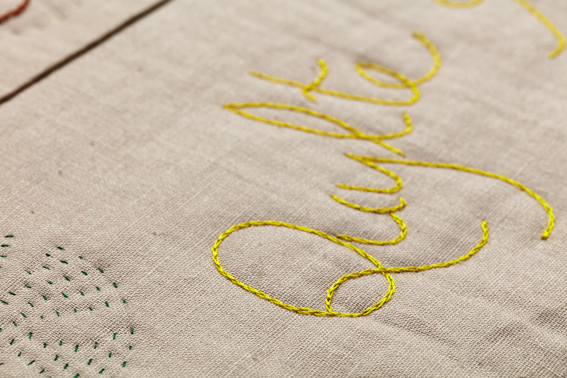
In 2020, I started stitching the chapter titles in Hilary Mantel’s Cromwell Trilogy with no coherent thought about what this stitching might become. It was just a way of passing some lockdown time and processing what I had read (I have written more about the origins of the project here). But as the pile of stitched chapter titles grew and grew, I knew I would ultimately want do something more purposeful with them. And given that I love handquilting, and I take great pleasure in sewing tiny stitches to make tightly controlled patterns, or lettering, or pictures, it made sense to make use of this technique.

A hand holding a pile of embroidered fabric
The embroidered chapter titles waiting to be quilted

I took some time deciding on a format for a quilted piece. There was no plan, no overall design in my head. I had embarked upon the stitched chapter titles with a vague idea that I might make a traditionally shaped quilt based on The Mirror and the Light. But I was never quite satisfied with that concept. I kept thinking there was something inappropriate about a bed-shaped item based on these novels: how could one sleep under the story of an execution?

The plan unfolded itself at an event for the Women’s Prize for Fiction that I watched online in September 2020. Mantel was interviewed, and said:

All of the stories are borne along on the River Thames and the river has its deeps and its mysteries, and although the book is pegged very firmly to the historical record, there are still subterranean depths within the hearts of the people whom the record concerns and we swim around below the surface.

Women’s Prize Live: Hilary Mantel and Angie Cruz on their writing inspirations, plus readings from Coral Pena and Ben Miles, The Women’s Prize for Fiction, 2020

I liked the idea of creating something long, snaking out like the river, in a single strip. I had visions of a deconstructed set of the novels, pages rearranged chronologically in a lengthy horizontal timeline. And so I started to think about working a quilt in the shape of a long strip. At that point, I didn’t know how big it would be. I had a vision of joining together multiple strips so that all three books would be represented in one long piece, starting and ending with So Now Get Up. Given that the Wolf Hall quilt alone ended up being 46 feet long, I have since revised this idea.

An ipad with the audio book of Wolf Hall and a section of quilting
Quilting and listening to Wolf Hall Part One, Chapter One: Across the Narrow Sea

When I decided to put all the embroidered chapter titles together into one handquilted piece, I knew that the quilting had to be approached in a considered way – partly because I knew it would be the most pleasurable part of the stitching, but mainly because I wanted the experience of quilting this piece to be as immersive as possible. That meant establishing a tight practice for working on each section of the quilt. I decided from the start of the quilting process that I would work incrementally, and sew each section in a strict order – I would not dot back and forwards throughout the Trilogy, and I wouldn’t piece the whole thing together in one go. I wanted to be very intentional about what I was doing, which meant reading and listening to the chapter I was stitching as I quilted it.

I worked out a process to support this way of working: although I know the three books very well, I wanted to reacquaint myself with the text before starting quilting each chapter title. So when a section was pressed and basted ready for quilting, the first step was to re-read the relevant chapter. I then made notes on index cards as prompts for the stitching. I drew up three sets of index cards: anything that might inspire me to draw a quilting motif, or phrases that might spark an image went onto white cards; I made a note of the colours that are prominent in the chapters on pink cards; and finally, references to anyone who actually engages in an act of stitching went onto green cards.

Index Cards with notes relating to An Occult History of Britain
Index Cards: An Occult History of Britain

I then started the quilting process. I listened to the audiobook of the relevant chapter as I worked, and the act of listening brought out other ideas, almost without me realising it. Hearing Mantel’s words sometimes highlighted an element to be sewn into to the quilt, so I usually listened to the chapter on repeat. Sometimes I listened to it in the German translation – I know the original English so well that I can follow it even though my German isn’t really up to it. I didn’t move forward with reading and listening to the book until each individual section was quilted.

The decision to work in this way had an impact on the way the quilt developed. I didn’t have an overall plan worked out for the entire piece, with each section evolving as I read and listened. And sometimes it was a difficult process; some chapters contained almost unbearable levels of loss and pain and I had particular problems when I came to An Occult History of Britain and Make or Mar when Cromwell’s grief overwhelms him. I actually had to leave part of that section unsewn as it was too distressing to continue, thereby breaking my own rules. And I foresee problems with this process once I approach the end of the Trilogy in The Mirror and the Light, but that’s a worry for another day.

This contrasts strongly with my stitching of the chapter titles in 2020. That was very unfocused, with no sense of a larger project to come. That presented some significant design challenges which I can see in the finished piece.

Green thread, a notebook, containing a sketch for a quilting design
Planning out a shattered emerald for Wolf Hall – Part One, Chapter Three: At Austin Friars

It’s interesting to reflect on how the first Wolf Hall quilt was made. A year on, looking back on the tight practice and the self imposed rules I put in place, I wonder how much these were a subconscious reflection of the restrictions of the pandemic. When I look at the finished piece, I can see how its rigid shape was influenced by the time in which it was made. As the project evolves into 2022, its form is rather more fluid – although the immersive reading and listening remains.