The Weepers – Elizabeth Wykys

Two quilted figures on grey fabric: one a man wearing long robes and a hat; the woman wearing a long dress and cloak. Both are kneeling and holding books
A stitched figure of a kneeling woman wearing a long cape and skirt, holding a book

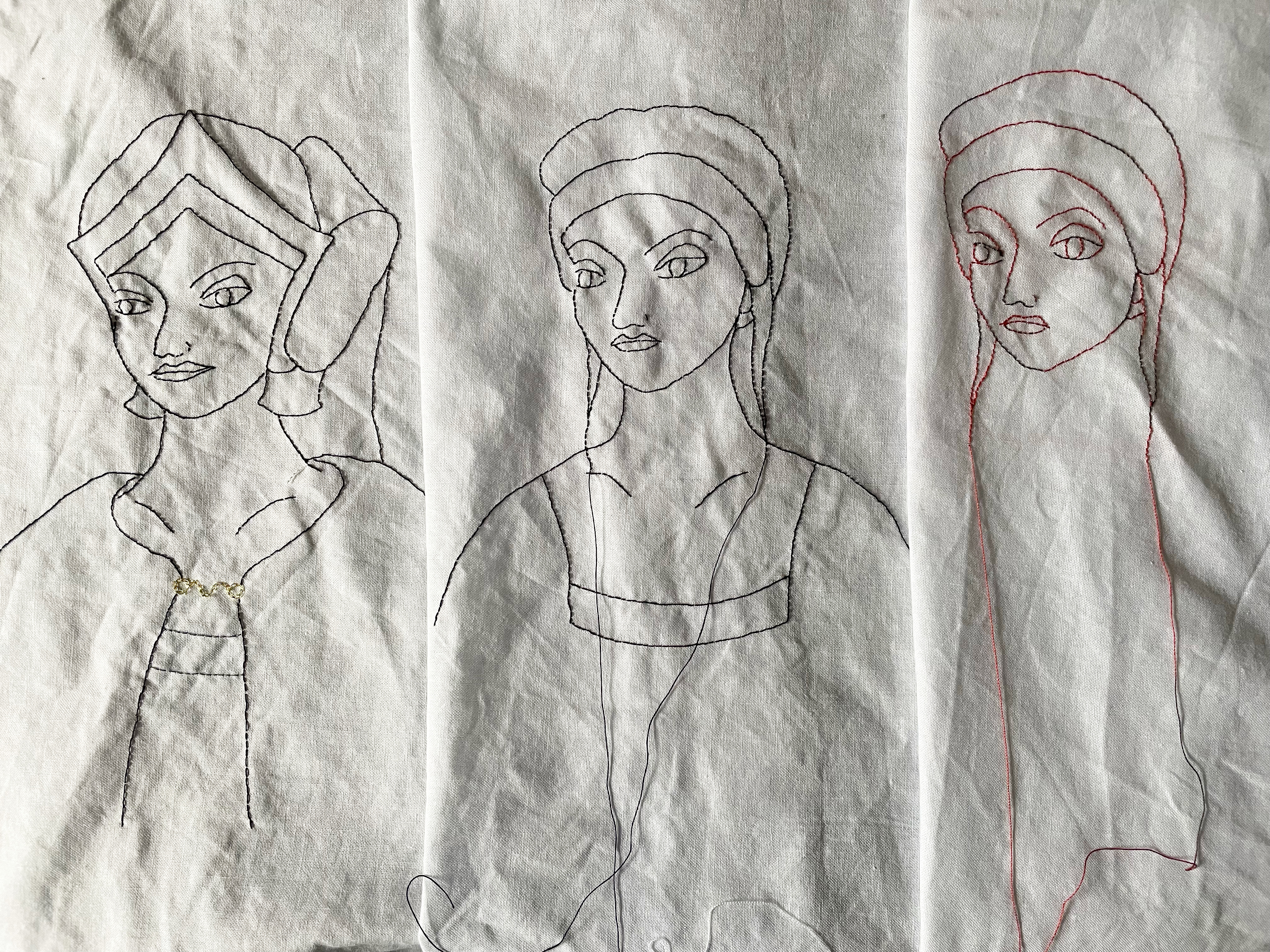
Since my earlier post about commemorating the dead, and my explorations of weeper tombs, I have started stitching characters from Hilary Mantel’s Cromwell Trilogy who are to be included in my Weepers series. It’s quite an intense process: sketching out ideas, reminding myself of small details in the text, noting down some of their words, or what is said of them.

Once I get to the stitching stage, I start with outlines. Then I add a little detail. Then the figure sits for a while, waiting. Eventually, once I feel that the future is ready, I draw in a face. I am yet to add any text – and yet to decide exactly how I will do this; and I am still considering whether to also add objects relating to each figure. Maybe, maybe not.

Yesterday morning I finished the initial work on Cromwell’s wife Elizabeth Wykys. We know very little about the real Elizabeth Wykys, but in fiction, Hilary Mantel conjured a memorable character, and chose to give her great proficiency in textiles. In the Play Script, she wrote:

We know nothing about you, so we can only say, ‘women like you’. City wives were usually literate, numerate and businesslike, used to managing a household and a family business in cooperation with their husbands. In Wolf Hall, I make you a ‘silk woman’, with your own business.

Wolf Hall and Bring Up the Bodies. Adapted for the stage by Mike Poulton. From the novels by Hilary Mantel. (Notes on characters by Hilary Mantel)

My stitched Liz took a while to emerge. Although I quilted her outlines some weeks ago, she wasn’t fixed. For a while, I thought she might turn out to be Jenneke. I stitched another set of outlines, but my second attempt turned out – very definitely – to be Helen Barre. Liz was difficult to capture, as Cromwell himself finds after her death. He wishes Hans Holbein had painted her while she was alive, as in his memory:

even Liz’s face is a blurred oval beneath her cap.

Hilary Mantel, The Mirror and The Light: Augmentation, London, Autumn 1536

In the Cromwell Trilogy, Liz represents the happiness of Cromwell’s private life and domestic stability during his marriage. She and Thomas enjoy each others’ company, they relax together, and make each other laugh:

‘Men say’, Liz reaches for her scissors, ‘”I can’t endure it when women cry” – just as people say, “I can’t endure this wet weather.” As if it were nothing to do with the men at all, the crying. Just one of those things that happen.’

‘I’ve never made you cry, have I?’

‘Only with laughter,’ she says.

Hilary Mantel, Wolf Hall: An Occult History of Britain, 1521-1529

Liz plays another vital role in my reading of the Cromwell Trilogy: that of a very skilled maker. My analysis of the practice of stitching in the Trilogy indicates that she is the most proficient stitcher in terms of the number of techniques she uses. At various points in the novels, we observe her working with fabric and thread – she embroiders Gregory’s shirts with a black-work design (and I think it is reasonable to assume she has made said shirts); she makes costumes for the Christmas celebrations, using quilting and patchwork; professionally she is a silk woman, making braids, tassels, and net cauls. Less successfully, perhaps, she also teaches her daughter Anne to sew, but Anne struggles with a needle, asserting her own interests instead.

After her death, Cromwell finds a cushion she had started embroidering. She didn’t finish the piece but she left her needle in the fabric. Cromwell can feel the path Liz’s stitches would have taken, the bumps that have been left by her abandoned needle.

Like many experienced stitchers, Liz has the muscle memory to work without thinking. When Cromwell asks her to slow down so he can see how she spins loops of thread for a braid, she laughs.

“I can’t slow down, if I stopped to think how I was doing it I couldn’t do it at all”.

Hilary Mantel, Bring Up the Bodies: The Black Book, London, January-April 1536

While her work may be automatic, it is not without intention. Liz’s confidence in the tiny movements of textile work is brought about through long experience and repeated practice.

I hope my representation does justice to the character that Hilary created. Liz is now hanging up in my studio next to Cromwell himself, waiting to become part of a larger piece of work.
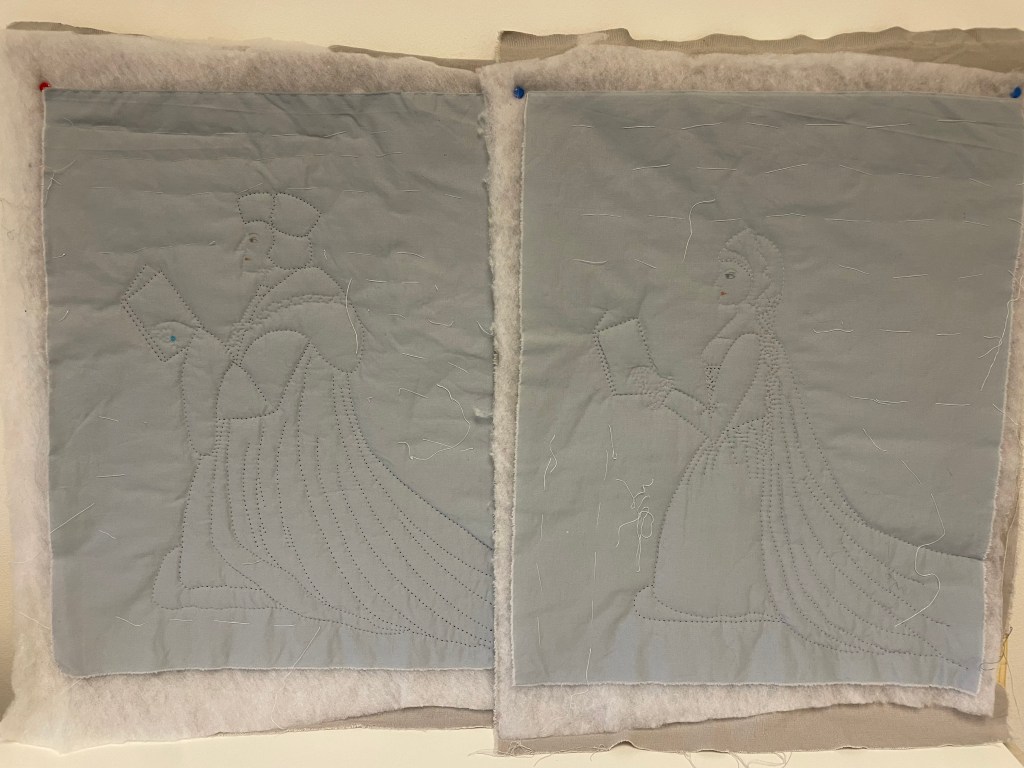
Two quilted figures on grey fabric: one a man wearing long robes and a hat; the woman wearing a long dress and cloak. Both are kneeling and holding books
Thomas and Elizabeth, hanging in my studio, awaiting further development

The Object and the Image

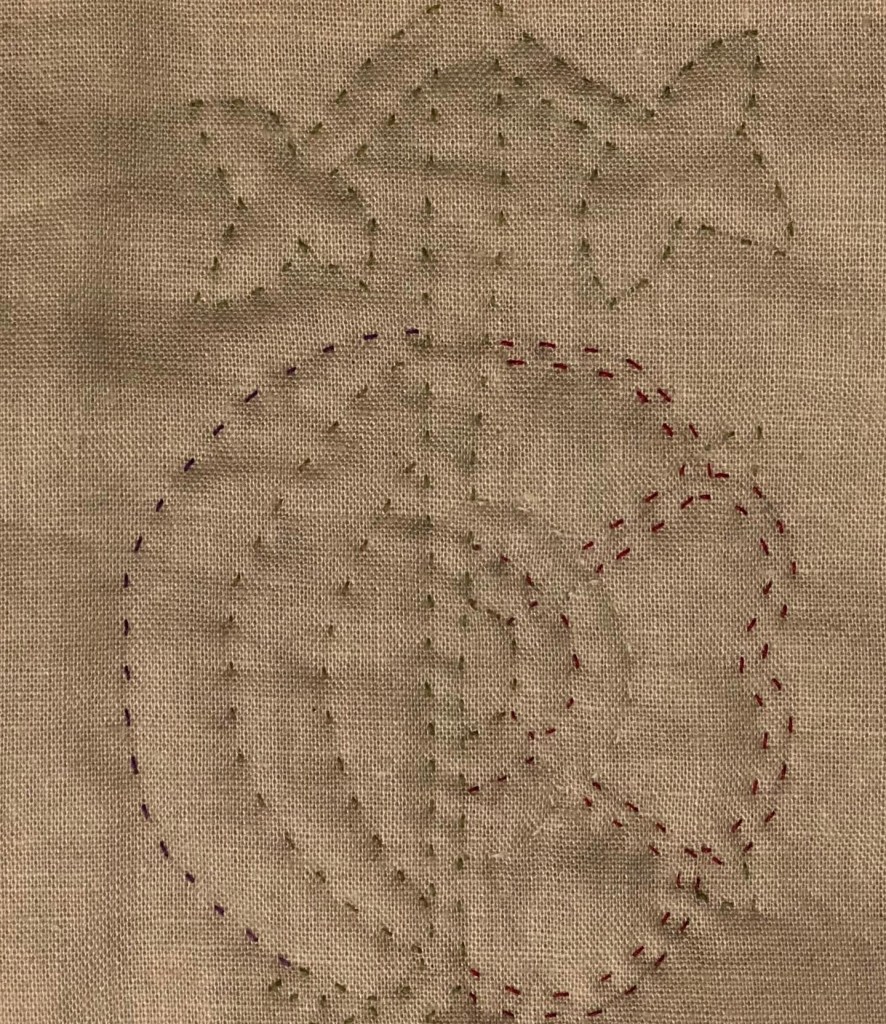
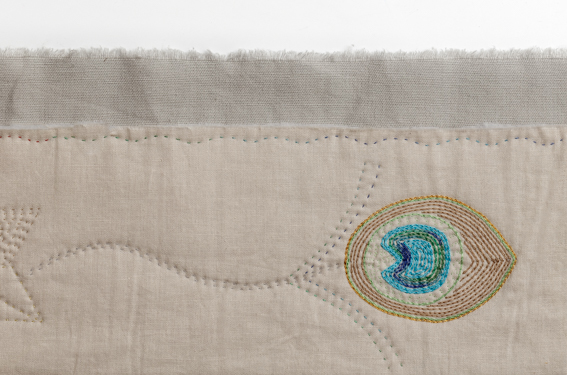
Cream fabric quilted with a motif of a Tudor rose combined with a pomegranate, leaves and a stem at the bottom. To the right of the motif is a quilted bird with large feet
The Pomegranate and the Tudor Rose combined
Photographer: © Michael Wicks

When I was working on the first Cromwell Trilogy Quilt back in 2020-2021, we were in lockdown in England, and all my research was home based. Museums were closed and I relied on online catalogues and images for both reference and inspiration.

One of the first motifs I stitched into the quilt – in the Paternity section – was a symbol representing Katherine of Aragon, based on a livery badge held in the collection of the Museum of London. The badge represents a pomegranate (Katherine’s emblem) combined with the Tudor Rose.

A hand stitched image of a rose and pomegranate combined, the leaves at the bottom of the stem. The image is displayed in a rounded format.
Katherine of Aragon’s Livery Badge, stitched

At this stage in the project, I was still working out my approach, and I used this badge to start thinking about the way in which the emblems of Henry VIII’s queens needed replacing, a theme that Hilary Mantel returned to throughout the Cromwell trilogy, and which I have returned to repeatedly in my stitching.

Yesterday I had the opportunity to go into the Museum of London for the first time since lockdown (and the last time I will do so until the Museum reopens in its exciting new home in due course). In the Medieval Gallery, I found that the actual livery badge was on display – so I saw the real, tiny thing for the first time. And in its display case, it is presented the other way up to my interpretation, and indeed in the catalogue photograph.

Part of a display case featuring a dark grey rose and pomegranate design with the leaves and stem at the top of the object. In the case there is also a gold and silver belt buckle on a clear Perspex block, and a round object is also just visible.
The livery badge in its display case

So is it the “wrong” way up in my quilt? As an image, the leaves appear more natural sitting at the bottom like a flower; but as an object, could there be the remains of a clip, a pin, a fastener to indicate it was worn with the leaves at the top? Would I have approached it differently had I seen the object first, or not even looked at the online catalogue at all?

It’s one of those unanswerable questions that result from the first Cromwell Trilogy Quilt being made in a situation of restriction, with no access to actual objects. And access is still restricted for me personally: I am currently living with the after effects of Covid-19 – fatigue meant that I spent most of my visit sitting down whenever and wherever I could and reserving my energy for looking at this one object.

Whether the livery badge should have been worn this way or that, Wolf Hall describes the way in which Katherine and her supporters found themselves the “wrong” way up once their stability was upended by the rise of Anne Boleyn. So there is an additional layer of meaning in its representation in my quilt – however unintended it might have been when I picked up my needle.

The stitched rose and pomegranate motif again, this time the “wrong” way up with the leaves and stem at the top of the motif.
Upended

The Weepers

In recent weeks, my thoughts have turned to the remembering of the dead, to commemorations, and the marking of lives.

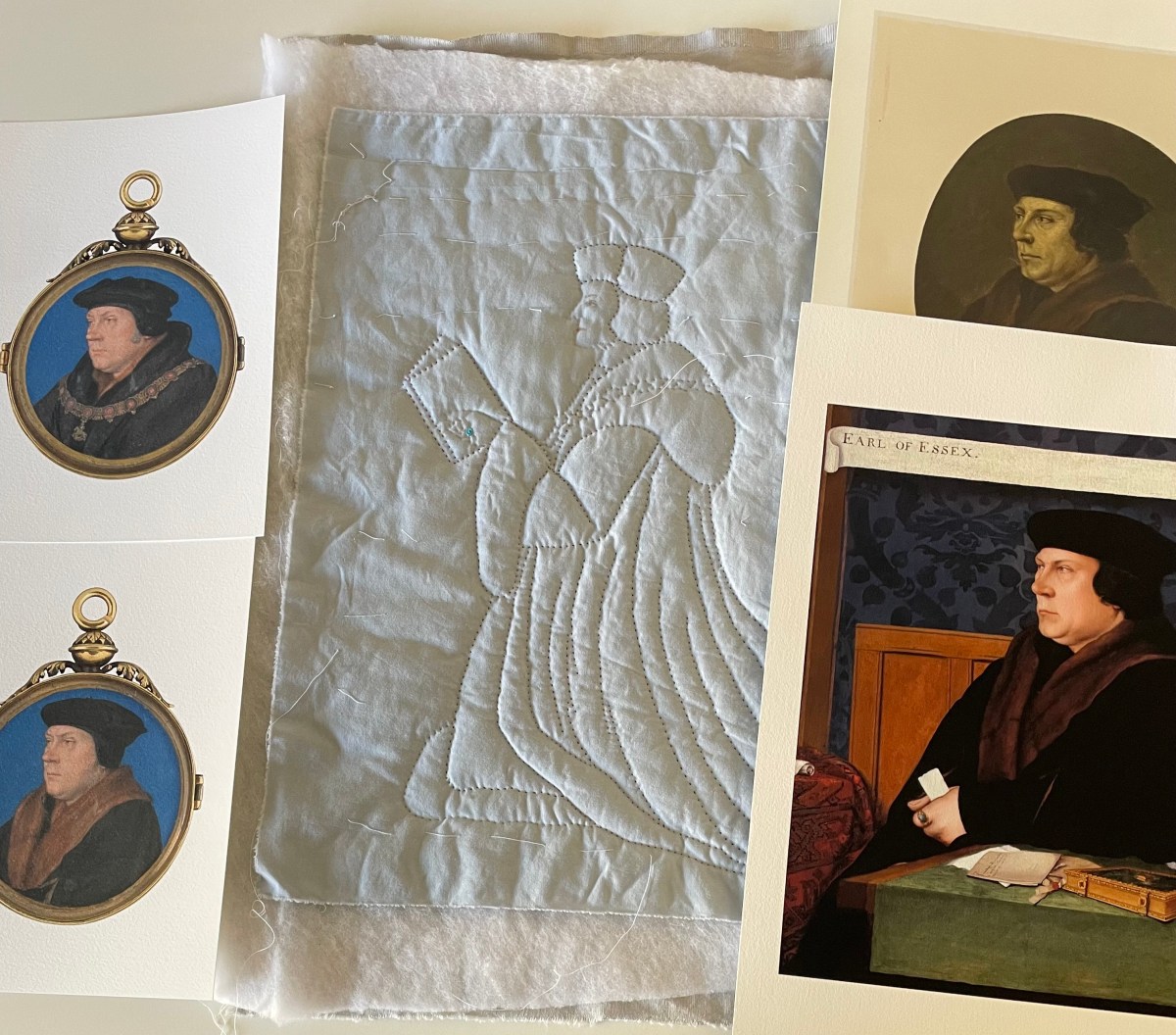
A quilted picture of a kneeling Thomas Cromwell, holding a book. He is surrounded by four painted portrait prints of differing sizes and styles.
Work in progress: Thomas Cromwell as weeper

In Hilary Mantel’s Bring Up the Bodies, Thomas Cromwell considers the tombs of the ancestors of the nobility:

men armoured cap à pie in plate and chain links, their gauntleted hands joined and perched stiffly on their surcoats, their mailed feet resting on stone lions, griffins, greyhounds … We think time cannot touch the dead, but it touches their monuments.

Hilary Mantel, Bring Up the Bodies: Falcons

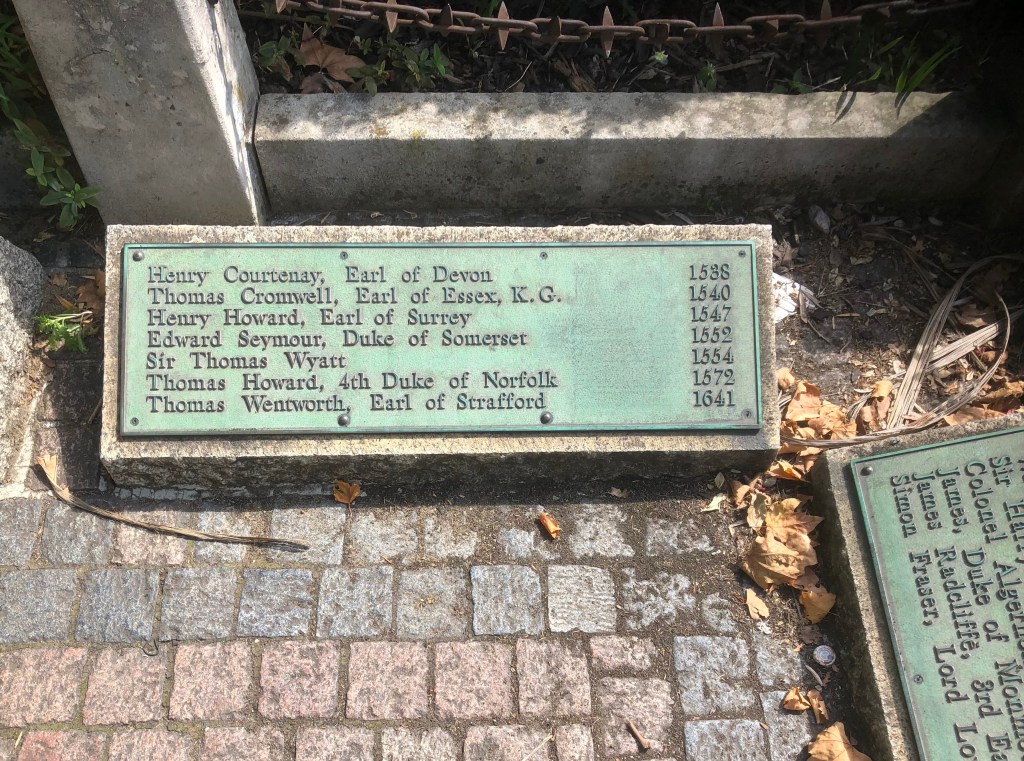
Coming from modest beginnings, Cromwell himself had no family tomb. And there was no elaborate tomb for him following his execution in 1540. His remains were buried in the Chapel Royal of St Peter ad Vincula, within the Tower of London, where there is a brass plaque that lists individuals “buried in this chapel”; and there is a plaque marking the site of his execution on Tower Hill.

A plaque containing a list of names of individuals executed on Tower Hill, including the name of Thomas Cromwell, Earl of Essex.

In the Cromwell trilogy, Mantel wrote of the tomb commissioned by Cardinal Wolsey – “the black marble, the bronze, the angels at his head and foot” (Wolf Hall, Entirely Beloved Cromwell). Wolsey was not buried in his tomb; in the trilogy, the King expresses a wish to be buried in the “sarcophagus of black touchstone, in which the cardinal never lay” (The Mirror and the Light, Wreckage II). But Henry was not buried in it either: the sarcophagus is now in St Paul’s Cathedral, and is part of the tomb of Admiral Lord Nelson. The Wolsey Angels, which never found their way to Wolsey’s tomb, are now in the collection of the Victoria and Albert Museum, after centuries of separation and misidentification.

Looking at the place of tombs in the three novels, I started to think about other memorials. My imagination was particularly captured by the idea of weeper tombs – those tombs that feature kneeling figures, praying for the soul of the departed.

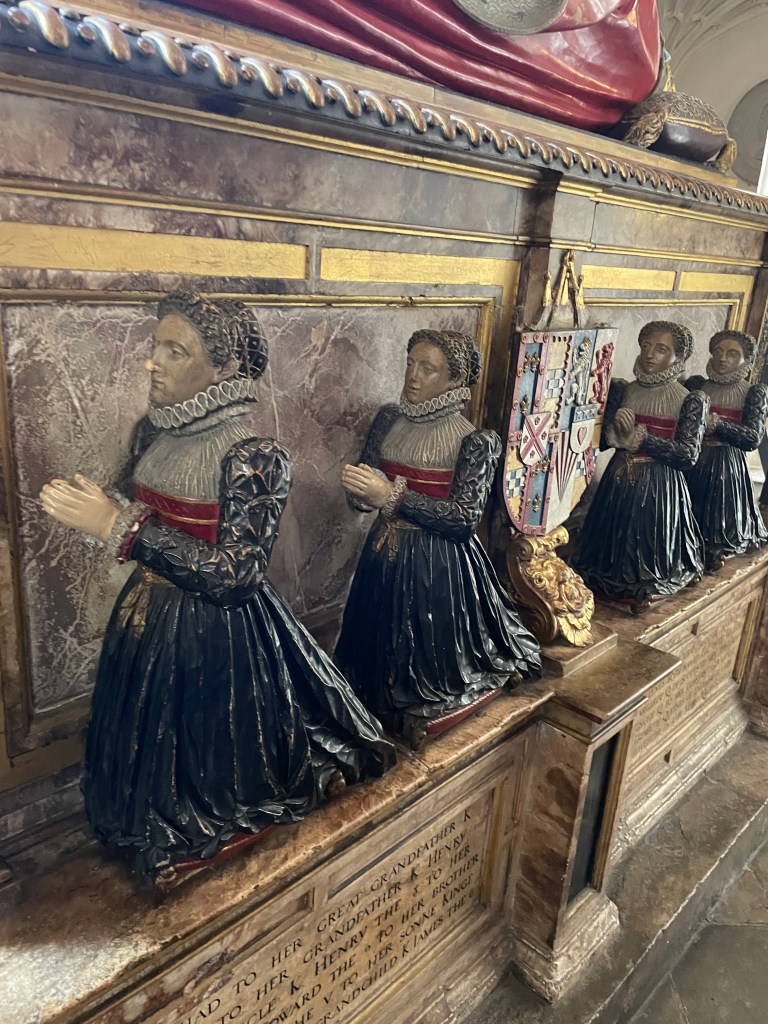
In Westminster Abbey, I visited the elaborate tomb of Margaret Douglas, Countess of Lennox (who plays a significant role in The Mirror and the Light), and looked at the weepers that represent her sons and daughters. And I started drafting out some weepers of my own.

An elaborate tomb, with the figure of a woman lying on the top, four kneeling figures decorate the sides: three male figures are fully visible in the picture, kneeling on red cushions and praying.
Four female figures dressed in black are shown on a tomb kneeling in prayer.
The tomb of Margaret Douglas in Westminster Abbey, London

Through a series of leaps and tangents, I started to muse on the identity of the characters in Mantel’s trilogy who might weep for Thomas Cromwell.

Nobody, he thinks, will ever cry for him.

Hilary Mantel, Wolf Hall, Across the Narrow Sea

I think Cromwell is wrong about this. What about Christophe? Rafe?

I have started to compile a list of weepers who are to be quilted, beginning with Cromwell himself. These weepers won’t be praying. They will be reading. And they will be reading Hilary Mantel’s Cromwell Trilogy.

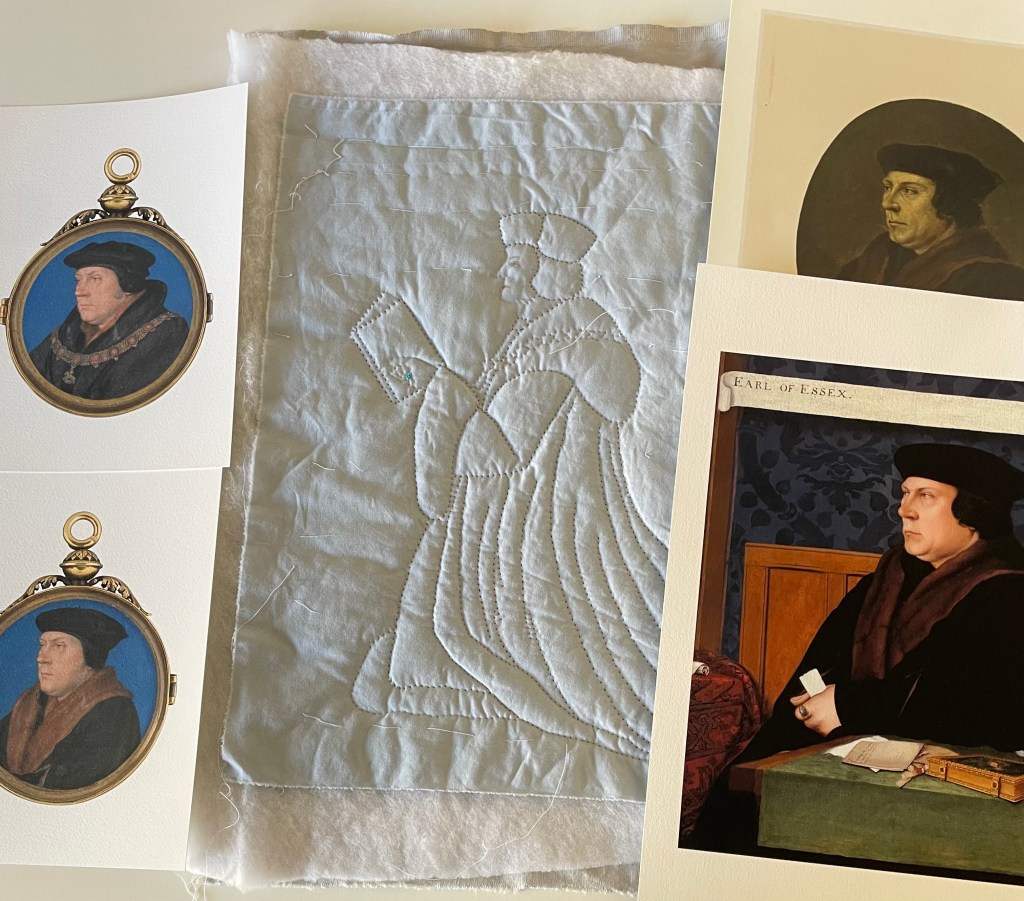
A quilted picture of a kneeling Thomas Cromwell, holding a book. He is surrounded by painted portrait prints of differing sizes and styles.

Follow the River

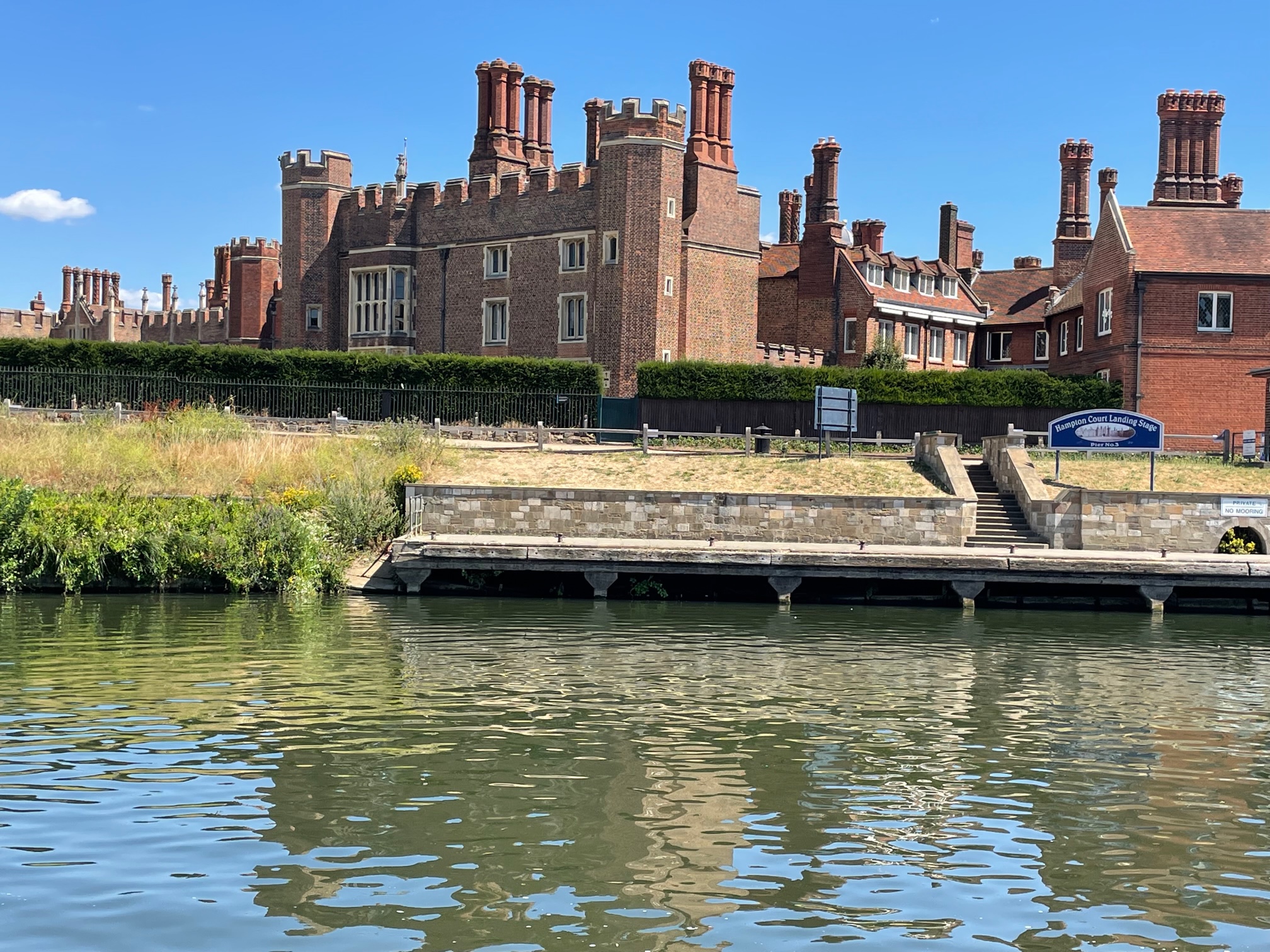
Hampton Court Palace - a brick building with numerous tall chimneys is shown on the opposite bank of the river on a sunny day. The Palace is reflected in the ripples of the water.
Three sets of rolled and embroidered fabric, on a wave designed background
Three Cromwell Thames Rolls

Since finishing the first Wolf Hall quilt, and reframing the shape of the Cromwell Trilogy Quilt project, I have been working thematically, rather than novel by novel. Closely following the structure of Wolf Hall worked well for the first piece, but the temporal shifts and reassessments of past events that run through Bring Up the Bodies and The Mirror and the Light mean that continuing this approach would not satisfy me and, more importantly, would not do justice to Hilary Mantel’s work.
For a while, I was stuck, but once I realised that a thematic approach would serve the project better, I knew I had unlocked something creatively. I have already noted how the role of the river influenced the shape of the Wolf Hall piece, and how it led me to make something long and flowing. This is because the River Thames plays such an important role in Hilary Mantel’s Cromwell trilogy. And now my stitching is seeking to answer young Thomas’ enquiry in the opening chapter of Wolf Hall:

If I follow the river, is that as good as anything?

Hilary Mantel, Wolf Hall (Across the Narrow Sea, Putney, 1500)

From sixteenth century Putney where he begins, to the Tower of London, where he ends, travelling by water is part of Thomas Cromwell’s routine. There is only one bridge over the Thames – London Bridge – so many of his journeys to and from Westminster, Whitehall, Richmond, Greenwich, the Tower, and Hampton Court are by boat. Travel unfolds at a slower pace than many of us are used to today, and it’s not always straightforward.

Hampton Court Palace - a brick building with numerous tall chimneys is shown on the opposite bank of the river on a sunny day. The Palace is reflected in the ripples of the water.
Hampton Court Palace from the river

Cromwell can’t go about his business without the services of the Thames boatmen. We first meet him as an adult, made late by the revelry of boatmen on the river who are celebrating the eve of one of their patron saints. His later elevation means his travel will be far easier:

It would be convenient, he thinks if I had Master Secretary’s barge, instead of making ad hoc arrangements when we have to cross the river.

Hilary Mantel, Wolf Hall (Devil’s Spit, Autumn and Winter, 1533)

But while he is still making ad hoc arrangements, Cromwell gets valuable information from the gossip of Boatmen, who are a reliable – and salaciously filthy – source. His conversation about Putney’s opinion of the Boleyn family with his old acquaintance Sion Madoc reminds him:

… how much you can learn from boatmen, their argot blasphemous and rapid. At twelve he spoke it fluently, his mother tongue, and now it flows back into his mouth, something natural, something dirty.

Hilary Mantel, Wolf Hall (Arrange your Face, 1531)

There is much inspiration in Mantel’s writing of Cromwell’s river, and I am currently enjoying making a series of Thames Rolls to explore the many references and images that run through the trilogy. It’s going to be a long job but it’s endlessly pleasurable – and I want to ground this part of the project with a sense of place.

The first Thames Roll, representing the river in Wolf Hall (Across the Narrow Sea)

I am not yet sure how this will materialise in the finished work, but I have been accompanying my stitching with visits to the Thames. Of course I can’t recreate the experience of Cromwell – either the real person or Mantel’s version – growing up alongside or travelling by the river but I can experience the Thames as it is now.

Cobbles and a brown stretch of water, shadowed on a sunny day.
Cobbles leading into the Thames, near Ship Lane, Mortlake

I can visit Ship Lane in Mortlake and see the perimeter wall of Mortlake Manor, once owned by Cromwell.*

A white woman with blonde hair and dark glasses, in a blue dress, holds a strip of fabric in an alleyway between two brick walls. The wall on the right of the picture dates from the Tudor period.
Unrolling a Cromwell Thames Roll (Across the Narrow Sea) by what remains of Mortlake Manor

I can take trips on the river between Greenwich and Hampton Court and get an inkling of the time it takes to travel by boat, albeit by motor rather than oarsmen. If I focus hard, I can tune out the running commentary by the boat crew, and imagine the tales of Sion Madoc. I can ignore buildings on the banks and wonder what Cromwell saw. I can look at the river and wonder at the stories it can tell and what it has seen.

The river with a bank of trees and parched grass on the opposite bank.
Thames bank from the river on the approach to Hampton Court, July 2022

* If you want to know more about Mortlake Manor, this post by the Tudor Travel Guide is very informative. It was invaluable when I took a trip to Ship Lane earlier this year.

Serpents

A stitched woman's head with snakes for hair.
Anne Boleyn as Medusa

The more I immerse myself in Hilary Mantel’s Cromwell Trilogy, the more strands I see running through the three books. One of my favourite strands is serpentine: snakes slither through the narrative. The snake Cromwell picks up in Italy for a bet is his companion in dreams and during fevers. It bit him, sank its fangs into his wrist, but he survives. The nature of the snake lives on in him, but he also lives on in the snake, after he ‘let it slip away to its future’.

The bite leaves Cromwell with a snake-like duality which enhances his usefulness to the King, but is also a potential threat: Henry tells Cromwell he is ‘as cunning as a bag of serpents’, but warns him against being ‘a viper in my bosom’. Cromwell himself resists his serpentine nature: when Margaret Pole calls him a snake he corrects her: he advises her that he is a dog, not a snake. Later, tiring of the need for endless reinvention, and the constant assessing and reassessing of political and religious factions, enemies and allies, Cromwell notes that ‘he is not a snake who can slip his skin’.

In Cromwell’s world, women who don’t comply with male wishes are likened to snakes. ‘God punish these women, they are serpents!’ rages the King. The mythical queens of England have serpents’ tails; the snake in the Garden of Eden was a woman.

The most destabilising woman is, of course, Anne Boleyn. Cromwell likens her to a snake waiting to strike, and dangerous because you do not know when that strike will come. She is Cardinal Wolsey’s ‘serpentine enemy’. All three novels – Wolf Hall, Bring Up the Bodies, and The Mirror and the Light – contain references to her as Medusa, the mythical gorgon with hair of writhing snakes. If you look Medusa in the eye, you will turn to stone.

When the painter Hans (Holbein) tells Cromwell he wants to paint Anne, Cromwell points out that Anne may not want to be studied. Hans considers painting her as Medusa: a risky proposition. At this stage in the trilogy (Wolf Hall, ‘Alas, What Shall I Do For Love?’) Anne has power: like Medusa, she has the power of life or death. Even when Anne’s day is done, Cromwell knows he should not look her in the face. After her death, he cannot sleep. The image of her head, her Medusa head, stays in his mind. He wants to keep her head hidden wrapped in cloth, trapped in the steel of the sword with which she was executed.

You know what Medusa does. You cannot look her in the face. You must trap her image in polished steel. Gaze into the mirror of the future: the unspotted glass, specula sine macula.

Hilary Mantel, The Mirror and the Light (Salvage), 2020.

My series of Faces of Anne includes an image of Anne as Medusa. It’s probably the one I like best. As I continue to work on this project, I expect I will sew more serpents. The snake that bit Cromwell in Italy is still waiting to be committed to stitch.

Master of the Rolls

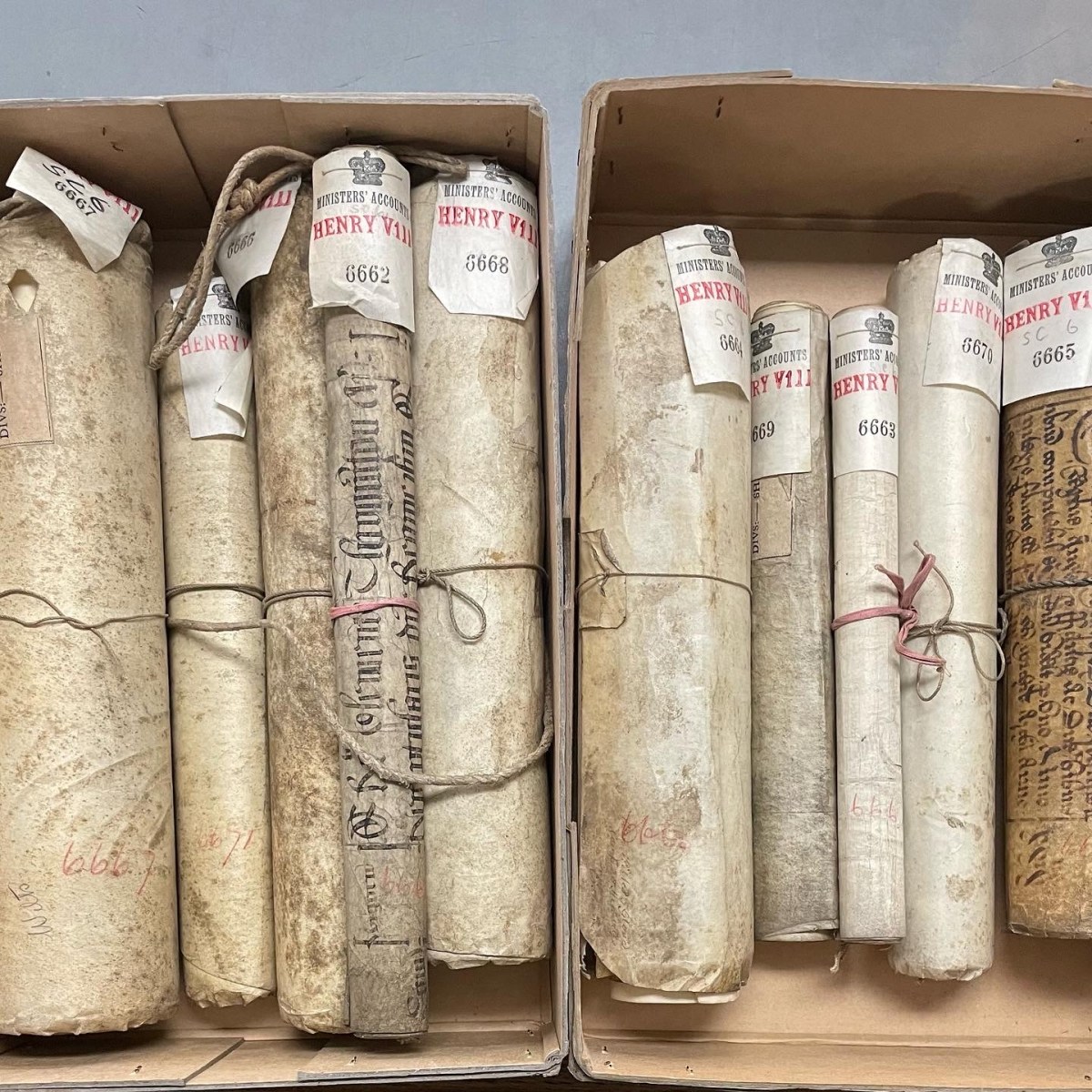
Two cardboard boxes containing rolls of parchment labelled Henry VIII
Three sets of rolled and embroidered fabric, on a wave designed background
Three Cromwell Thames Rolls

My Cromwell trilogy stitching project seems to have found a recurring shape: I keep rolling my stitchery.

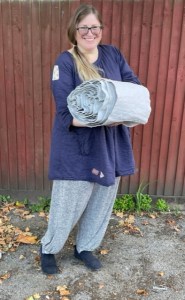
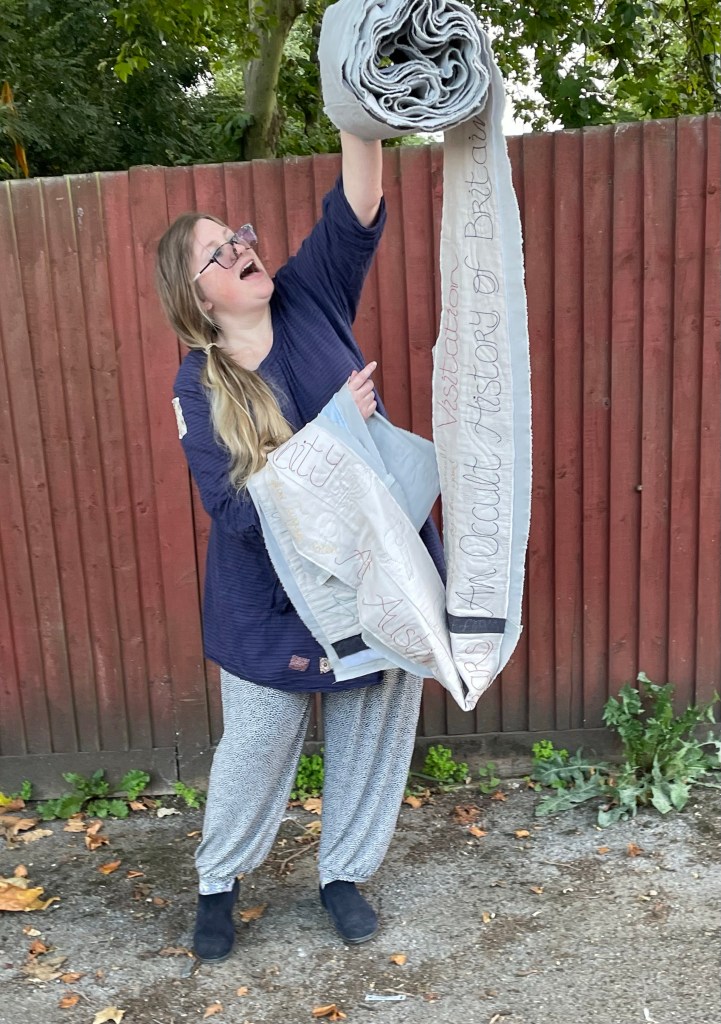
Rolling started as a practical solution to making the first Wolf Hall quilt: a very long (forty six feet) quilted piece. I had to store it somehow and the best solution was to roll it. Then when I had finished it, and was wondering what have I made? I came to the conclusion that rolling felt entirely natural because I felt strongly that the whole piece should not be visible at once.

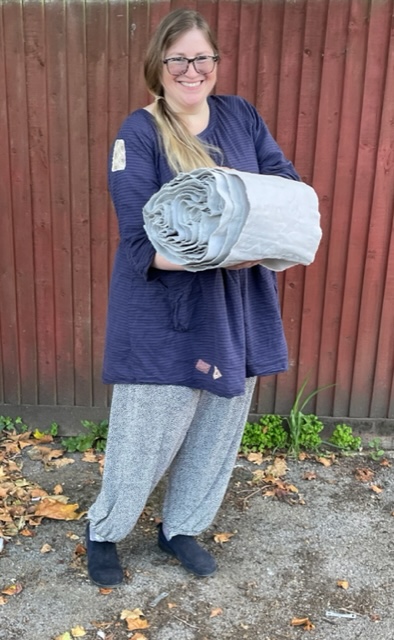
A white woman stands in front of a fence, holding a rolled piece of quilting which is predominantly pale grey.
The Rolled Wolf Hall Quilt, August 2021

This is also a play on words. Thomas Cromwell became Master of the Rolls on 8 October 1534, a post he held until 10 July 1536. Hilary Mantel describes it as ‘an ancient judicial office, it commands one of the kingdom’s great secretariats’. (Wolf Hall, ‘The Map of Christendom’); and in this lucrative role Cromwell had access to official records; inked on rolls of parchment.

A black and white illustration of Sir Thomas Cromwell, Knight. Cromwell is seated behind a table, holding a roll of parchment in his hand.
Thomas Cromwell Earl of Essex by Unknown artist, by Wenceslaus Hollar etching,
mid 17th century NPG D9736 © National Portrait Gallery, London.
This work is licenced under https://creativecommons.org/licenses/by-nc-nd/3.0/ *

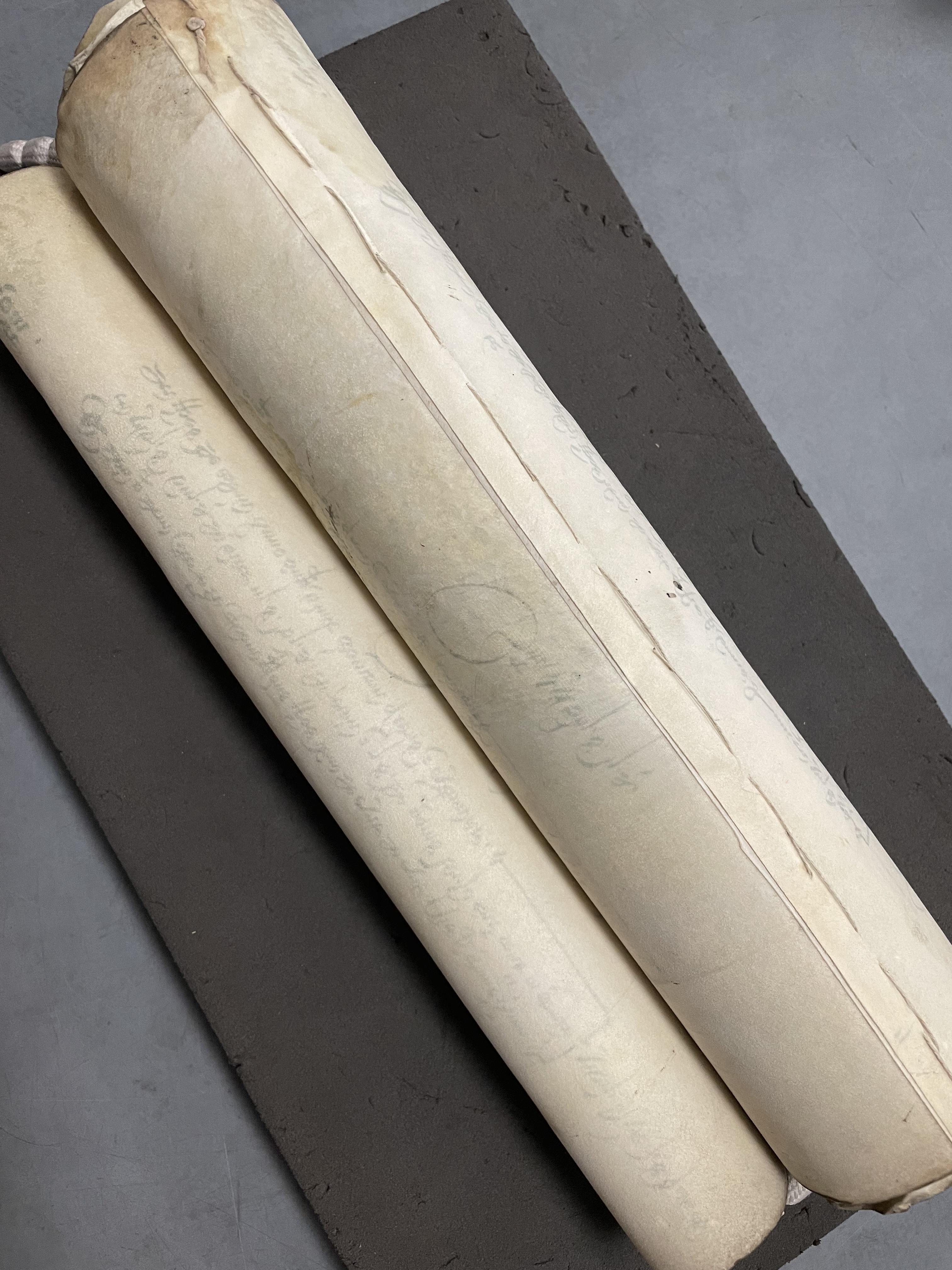
A couple of weeks ago I went to the National Archives at Kew in order to look at some sixteenth century documents. I ordered up various papers including Cromwell’s ‘remembrances’ or to do lists, some dating from his years with Cardinal Wolsey and some dating from the 1530s when he was high in the King’s favour. These documents were all flat and had been pasted into a book by some 19th century organising hand; but I then had the thrill of opening boxes of rolls.

Two cardboard boxes containing rolls of parchment labelled Henry VIII
Boxes of Henry VIII’s rolls

I was looking for a specific item that I hoped was listed in an inventory roll; I didn’t find it.

I had – optimistically – neglected to take into account two basic facts: firstly, I don’t read Latin, and secondly, Secretary Hand is a challenge to my 21st Century eye. I also hadn’t appreciated how difficult rolls can be to handle. Some are single sheets and can be unrolled very easily, but others are made up of multiple sheets stitched together.

The inventory to which I was particularly drawn defeated me: not only were single sheets stitched together to create one long piece, but in places multiple sheets had been stitched on top of each other. I simply could not work out where the different elements ended or find a way to unroll it without fear of damaging it. So I didn’t gain a full impression of the content – but I did find treasure nonetheless.

An old roll of parchment
I couldn’t find the end of this roll…

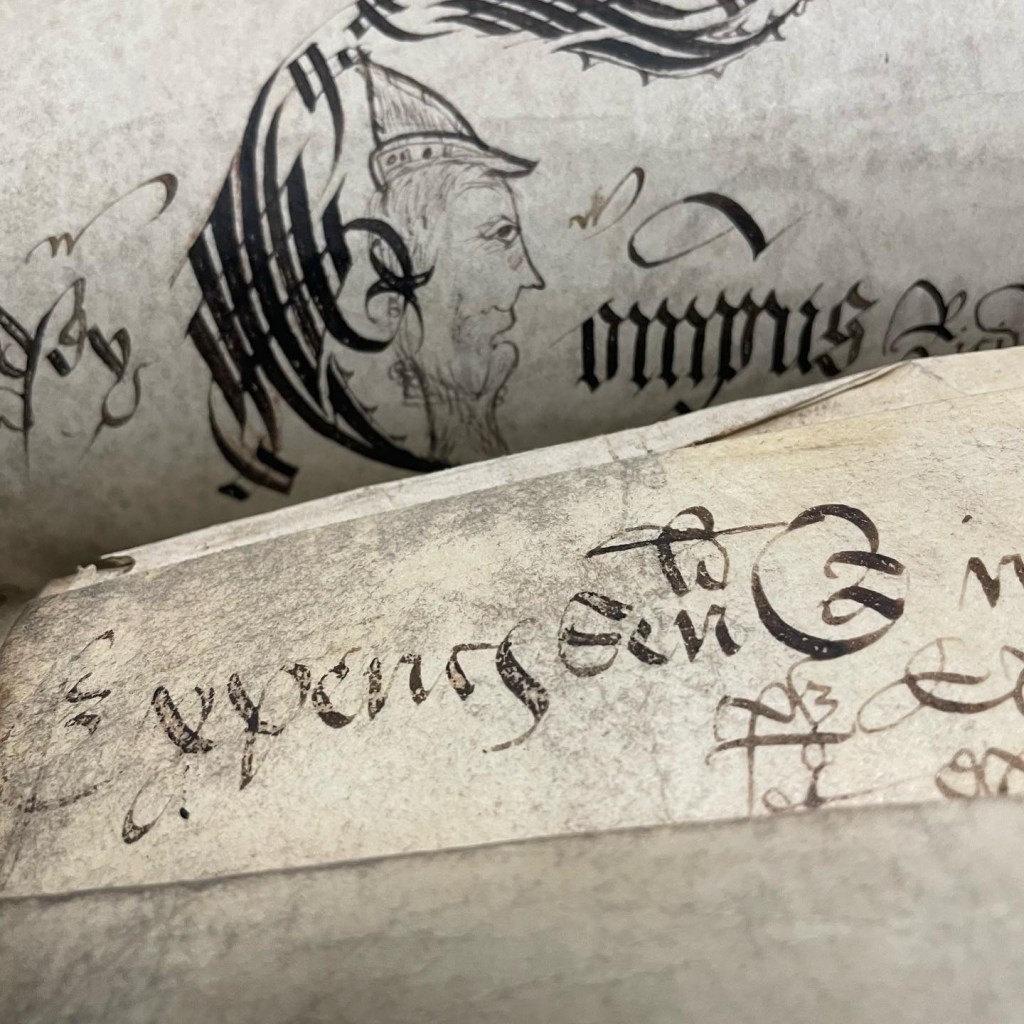
I spotted a magnificent “S” – and then another in a different style. Then another… and I started to suspect that the clerk who had the task of writing this document – a very long inventory of property and land – had been bored, and to alleviate that boredom, had started to play a game with his lettering.

Four elaborate S shapes written in ink on parchment
S is for…..

And as I looked for more of these elaborate “S” shapes I had a splendid surprise! A 500-year old face popped out to say hello. The bored clerk had left a gift – but I suspect they did not know that they would make someone laugh centuries later. I salute you, unknown clerk. I hope you and your sense of mischief did well in the 1540s.
A bearded face doodled on a roll of parchment
Boo!

* Portrait of Thomas Cromwell provided under Creative Commons license as at https://creativecommons.org/licenses/by-nc-nd/3.0/legalcode

The Queen’s Head

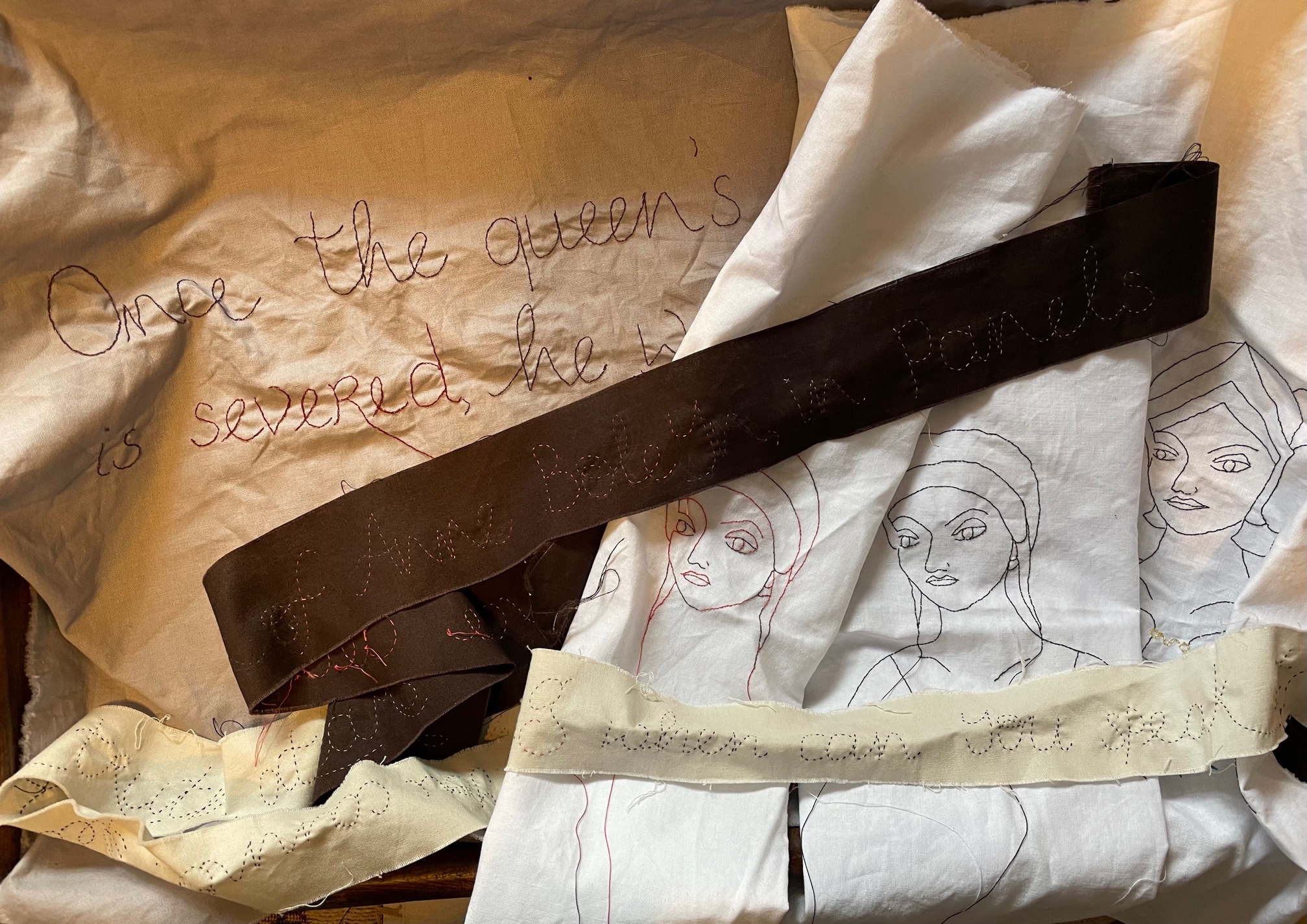
A selection of embroidered pieces, wording and three heads of a woman. The words 'Anne Boleyn in panels', 'when can you speak', and 'Once the queen's' and 'is severed' are visible.

Content warning: the final image on this page may be unsettling; and this post refers to executions.

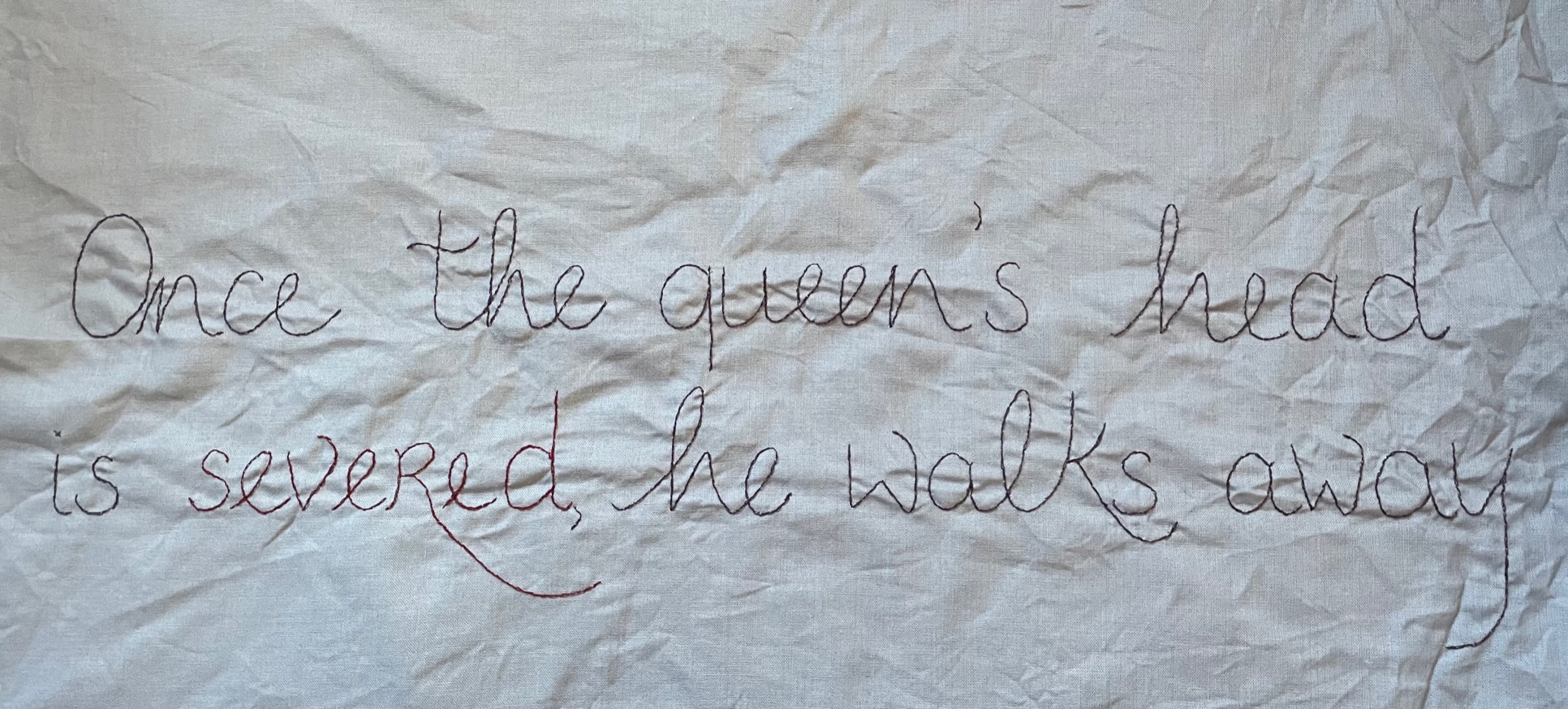
Once the queen’s head is severed, he walks away.

Hilary Mantel, The Mirror and the Light (London: Fourth Estate, 2020), p.3.

The opening line of Hilary Mantel’s third book in the Cromwell Trilogy, The Mirror and the Light, is violent and shocking, mirroring the violence and shock of the event it describes.

White fabric embroidered with the words 'Once the queen's head is severed, he walks away'
I left this lettering creased and taut – the discomfort of reading the scene translated into stitch

The queen in question is Anne Boleyn. In The Mirror and the Light no-one will emerge unscathed from the violence of her execution.

The historical record tells us that Anne Boleyn was executed on Tower Green on 19 May 1536, after a very swift downfall, arrest, and trial. Advocates for Anne believe she was condemned on false charges of adultery and treason; that her reputation has been unfairly traduced over the centuries; and that her accusers were motivated by political and personal expediency. As Mantel writes in her Author’s note to Bring up the Bodies:

The circumstances surrounding the fall of Anne Boleyn have been controversial for centuries. The evidence is complex and sometimes contradictory; the sources are often dubious, tainted and after the fact.

Hilary Mantel, Bring Up the Bodies (London: Fourth Estate, 2012), p.407.
A selection of embroidered pieces, wording and three heads of a woman. The words 'Anne Boleyn in panels', 'when can you speak', and 'Once the queen's' and 'is severed' are visible.
Stitching the opening of The Mirror and the Light

My sewing project is firmly focused on Hilary Mantel’s Cromwell who is no friend of Anne’s: he sees her as someone who is motivated by self interest and assumes everyone else is the same. ‘Good morning, Master Cromwell, what can we sell each other today?’ he imagines her saying. (Wolf Hall, p.430). He believes ‘Anne is not a carnal being, she is a calculating being, with a cold, slick brain at work behind her hungry black eyes’. (Wolf Hall, p.350).

But even though he has disliked her, and been indifferent to her attractions in life, Cromwell is unable to simply walk away from Anne and her fate after her death: the fate that he has helped bring about. Instead he is haunted by her. He dreams of her, he sees her, he feels her presence throughout the final book in the trilogy. The night after her execution:

he dreams the death of Anne Boleyn, in panels. In the first he stands watching as she walks to the scaffold, wearing her clumsy gable hooded. In the second she kneels in a white cap while the Frenchman raises his sword. In the last, her severed head, smothered in linen, bleeds its image into the weave.

The Mirror and the Light, pp.24-25
Three heads of a woman, wearing firstly a gable hood, secondly a cap, thirdly a head alone wearing a cap.
That night he dreams the death of Anne Boleyn, in panels

King Henry also dreams of “Ana Bolena with her collar of blood”. The men who brought about her death are haunted by her.

A woman's head stitched in red thread. Strands of red thread hang down from her jawline. The words 'Ana Bolena with her collar of blood' are embroidered underneath
Ana Bolena with her collar of blood

I thought a lot about how to represent this key chapter in my stitching. A few years ago, when visiting the Tower of London, I found that I could only access the chapel of St Peter ad Vincula – where Anne is buried – as part of an official tour. So I waited near the chapel, attached myself to a tour party already in progress, and entered. Once inside, there was no opportunity to look around; instead, the tour party sat in the pews and listened to the male tour leader talking about the executions of both Anne and Katherine Howard as though they were a subject for humour. I was revolted at his flippancy. Remembering this incident informed my desire to work on representing these moments in a respectful way. I hope I have done so.

The third book of Mantel’s trilogy begins with Anne’s death, but she remains present until the very end. And it is right that she disturbs the consciences of the men who brought about her execution.

The First Wolf Hall Quilt: What have I made?

I have a very complex relationship with the first Wolf Hall quilt. Ten months after putting the last stitch in place, I am still not sure what I think of it. I think I am reaching the conclusion that it isn’t a discrete piece of work in its own right but it is a jumping off point for other work – and I am happy with that conclusion.

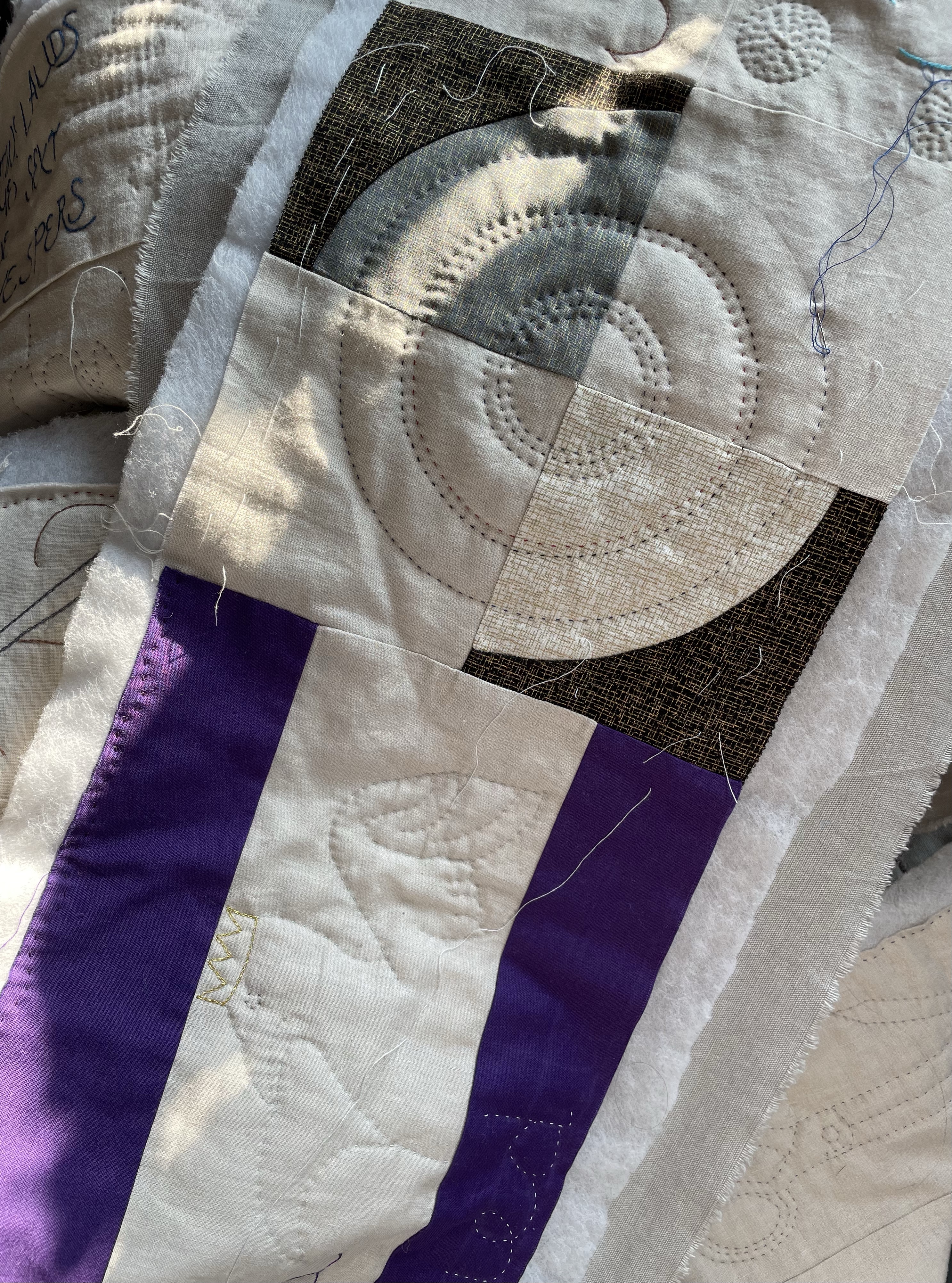
Quilted fabric strips, in cream, purple, black, and grey. A quilted falcon is visible, and a curved quilt block is being quilted with circles, a needle and thread are waiting to be stitched in.
The first Wolf Hall Quilt: at this point I didn’t know how it would turn out.

Because of lockdown restrictions in 2020 and 2021, no-one apart from me was in the same space as this piece until it was almost complete. I didn’t show the work in progress to anyone face to face; and I didn’t have the space to see the whole thing. In fact I didn’t actually see the piece as a whole myself until May 2022 when I was finally in a space that could accommodate the whole unrolled length of 46 feet.

Before that, the only way I could see the quilt in its entirety was to have it photographed.

Michael Wicks, the marvellous photographer who produced a great set of pictures of the work, did a great job in taking detail shots. Before we met, we talked about the shape of the project and its length; I drew him out a map of each section on index cards so he could match them up with the photographs I had commissioned. At his studio we tried to lay the piece out flat but it was actually too long, being longer than the width of the building, and so it ended up being folded back on itself. But within 24 hours of dropping it off, I had an image of how the first Wolf Hall quilt looked thanks to Michael’s photographic magic.

The piece didn’t look as I had expected, and I had some difficulty working out what I had made until a friend said it reminded her of a piece of code. The significance was in the detail.

And after a couple of weeks, when I looked at the full image again, I realised she was right. I started to view the quilt in that light – as a piece of code that represented my personal response to Wolf Hall; I have detailed notes, sketchbook diagrams, a colour coding system, and a key that unlocks each reference on the quilt, but without these, can the whole code be read? As Cromwell himself wonders, when reading some of Cardinal Wolsey’s letters to the rulers of Europe, could the encryption be more tricky?

In the same way that one can’t see the contents of a book all at once, I realised that one shouldn’t be able to see the whole quilt all at once. It’s meant to be rolled – in a nod to Cromwell being Master of the Rolls – only revealing part of its code at any one time. The encryption should indeed be tricky.

The first Wolf Hall Quilt – completed and rolled,
19 August 2021

When I finally unrolled the Wolf Hall quilt a couple of weeks ago, as the guest of a very welcoming quilting group, I was in a space large enough to accommodate it, and eight quilters held it up along its length. It was a very intense experience: even though I made it, I hadn’t appreciated the scale of it before that. I am still not sure what I think of it, but I have now been able to see what the entire piece looks like all at once.

And now, once again, it is rolled up, hiding its codes and its tricky encryption.

Forty Six Feet of Wolf Hall

Quilted strips, showing words and images, including circles, a falcon, a needle and thread. Fabric in cream, grey, black and cream is visible.
Wrestling the Wolf Hall Quilt together

When I started working on the Cromwell Trilogy Quilt project, I had the intention of making one single piece to convey my interpretation of the whole of Hilary Mantel’s trilogy. But – best laid plans and all that – I didn’t realise how long the Wolf Hall section alone would turn out. Forty six feet of quilting later, and having faced the difficulties inherent in managing such a long textile piece, I have revised my plans.

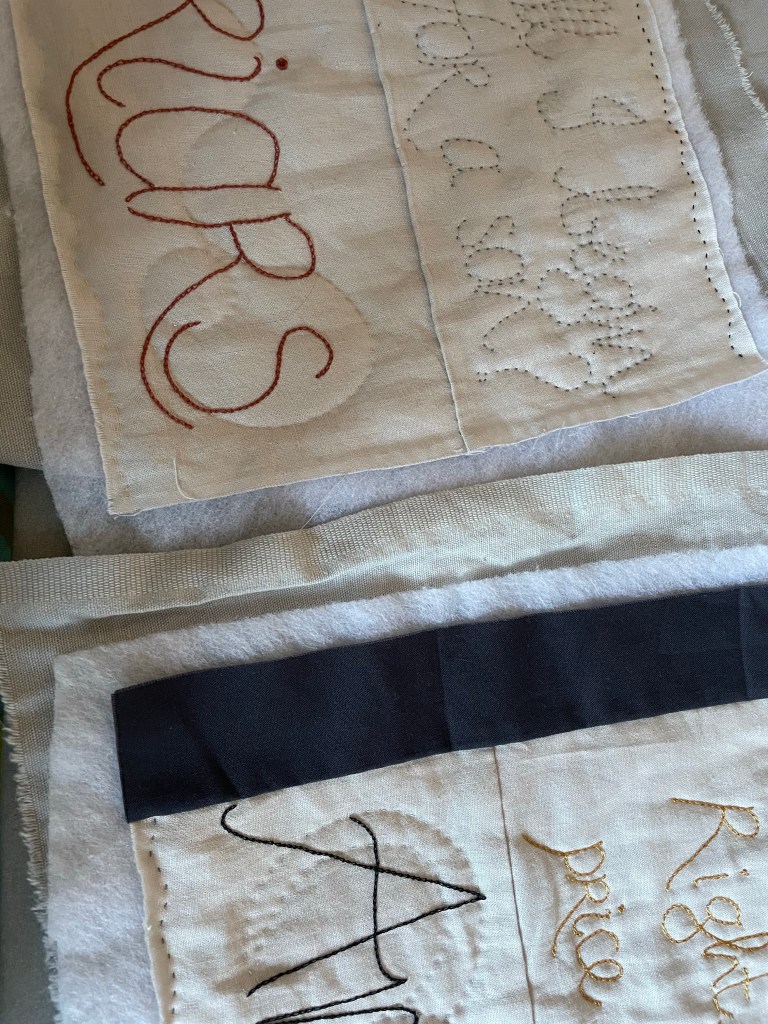
Pieces of quilted and decorated textile in pieces, with a join ready to be made with some grey fabric.
Parts One and Two, still in separate sections, 14 August 2021

I stitched the Wolf Hall quilt in sections – one section for each of the six parts of the book. As each section was stitched, I drew myself a key to show the elements I had included. Once that was ready – at the very end of the making – I had the slightly nightmarish job of joining the sections together to make a single piece.
An open notebook containing a diagram showing chapter titles from Hilary Mantel’s Wolf Hall, and notes written in orange text, with scribbled sketches and words.
The Wolf Hall Quilt key – parts Five and Six

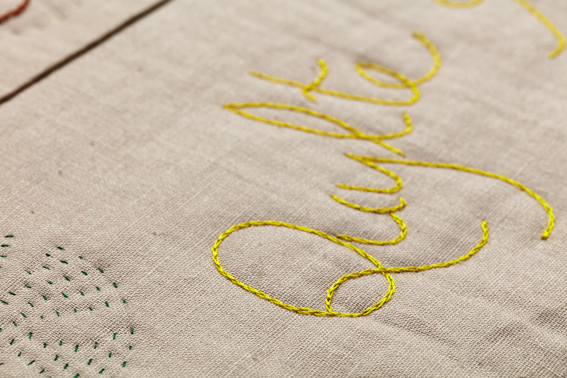
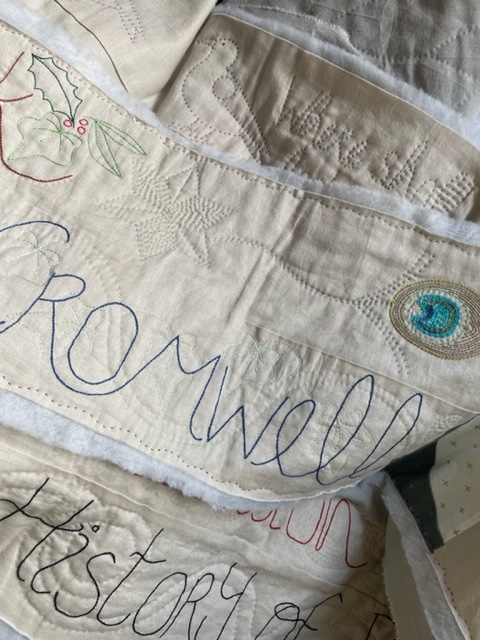
I joined each section with a placefinder bar, quilting the book title and part number at each join. As the piece got longer and longer and heavier and heavier, I found I was grappling with something that twisted and writhed like the snake that bit Cromwell in Italy. And as it grew, I became increasingly afraid to move in case I twisted it further.

The day that I finished the Wolf Hall quilt was odd. I was very tired, and my hands and wrists hurt from manipulating 46 feet of quilt. It had taken five days to join the sections together, and hours were spent just trimming off excess wadding. On the last day, I sat for hours ploughing on, which was very bad for the hands and the back. But finally, it was done.

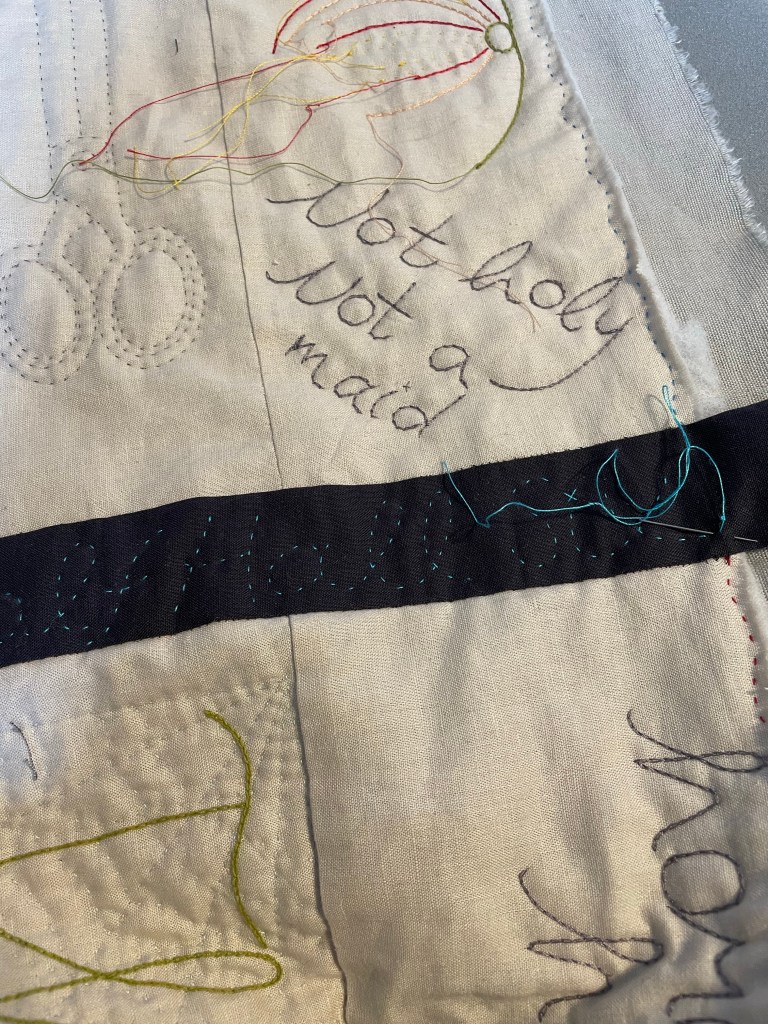
Pieces of quilted fabric in cream with decoration; a dark grey strip joining two pieces with blue text stitching and a needle and thread ready to set a stitch.
The very last stitch going in, 19 August 2021

I finished all the joins at 3 minutes past 1 on 19 August 2021. I was exhausted but also exhilarated as I rolled it up as one piece. This all-consuming project had reached a significant milestone – the first large piece was complete.

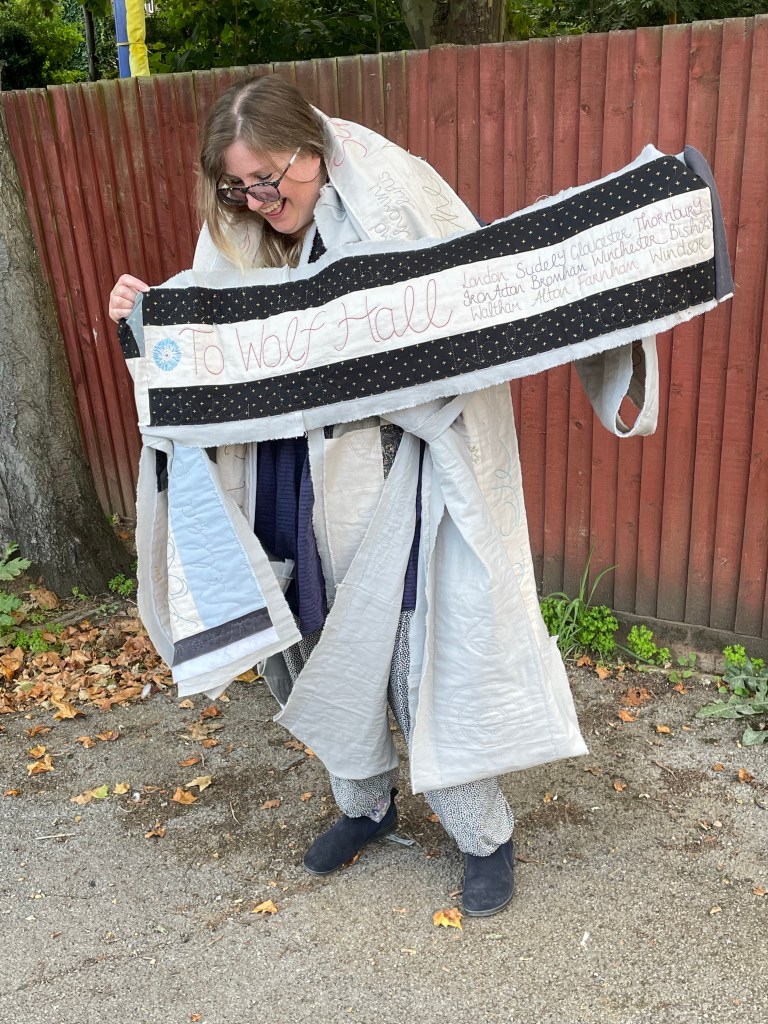
A woman in a blue dress and grey trousers holds up a long pieces of quilted work against a backdrop of a brown fence.
A woman in a blue dress and grey trousers holds up a long pieces of quilted work against a backdrop of a brown fence. The quilted lettering reads “To Wolf Hall”

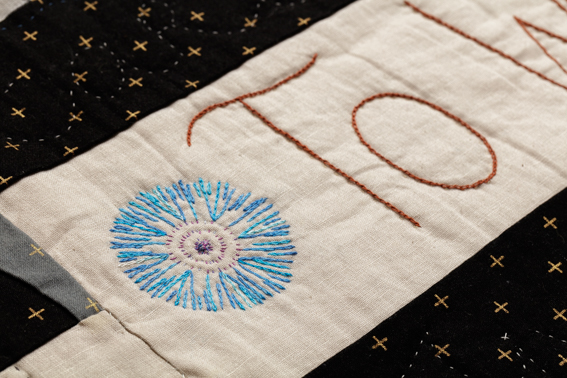
Last week, for the first time in months, I unrolled all 46 feet of the Wolf Hall quilt. I was giving a talk about the project, and the audience of quilters was keen to see the stitching close up – and to experience the scale of this unwieldy textile piece. Given that I rarely get a chance to see the quilt in one go – its length makes it difficult to view – it was very exciting.

I had completely forgotten that I’d left an unfinished grey placefinder bar at the end – after “To Wolf Hall” – thus leaving my options open. In August 2021, I clearly intended to join similar quilted pieces interpreting Bring Up the Bodies and The Mirror and the Light to the Wolf Hall piece. But the challenges of 46 feet of quilting made me rethink this idea. Now I am pleased that the ending of the first Wolf Hall quilt is still open to further possibilities. As Hilary Mantel writes at the very end of Bring Up the Bodies:

There are no endings. If you think so you are deceived as to their nature. They are all beginnings. Here is one.