It is now a year since the sudden passing of Hilary Mantel on 22 September 2022. I still cannot believe that this is true.
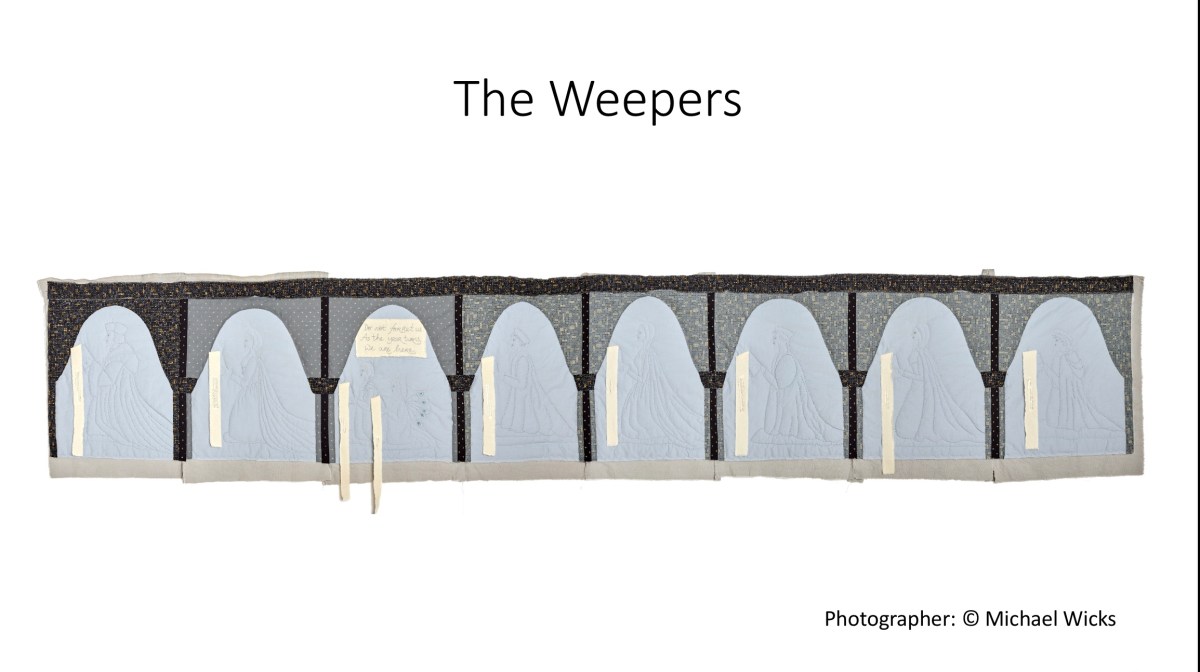
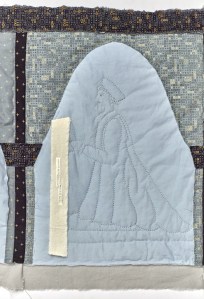
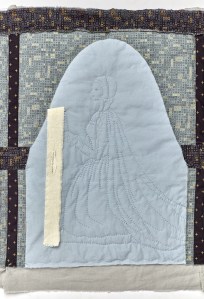
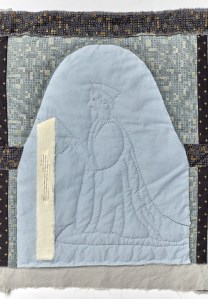
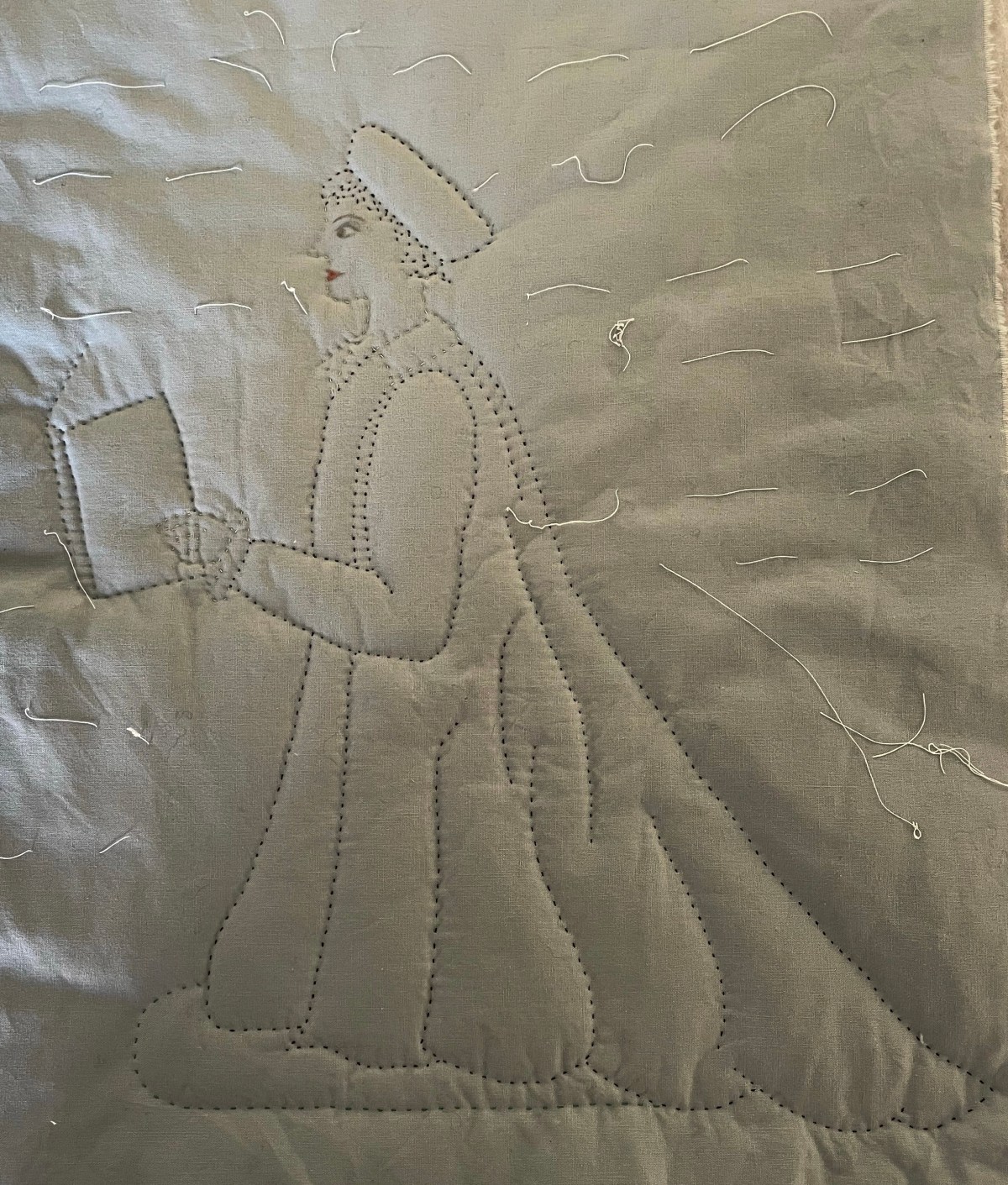
In the days following her death, I thought of memorials, mourning, and grief; I wondered how her characters – so alive on the page – might pay tribute. I thought of weeper tombs – those elaborate memorials that include kneeling mourners paying silent tribute to the departed. And I stitched a series of weepers, who do not pray, but who each hold a copy of a book from Hilary Mantel’s Cromwell trilogy; with precisely written and now carefully chosen words about each of them unrolling from the pages.
The Weepers: A tribute to Dame Hilary Mantel, 6 July 1952-22 September 2022.
Twenty five months ago today – on 19 August 2021 – I put the last stitch into the First Wolf Hall Quilt. I’d spent a very uncomfortable few hours joining all the sections together to make forty six feet of quilting, and had struggled while wrestling the writing and coiling length into one long roll.
More recently, I have been regularly visiting the National Archives at Kew, just outside London, looking at Sixteenth Century documents relating to Thomas Cromwell. Such documents – especially those that take the form of rolls – are often stitched together. This gives me a feeling of continuity – these old parchments and my quilting are hand-sewn together with needle and thread, joining narratives and the historical record.
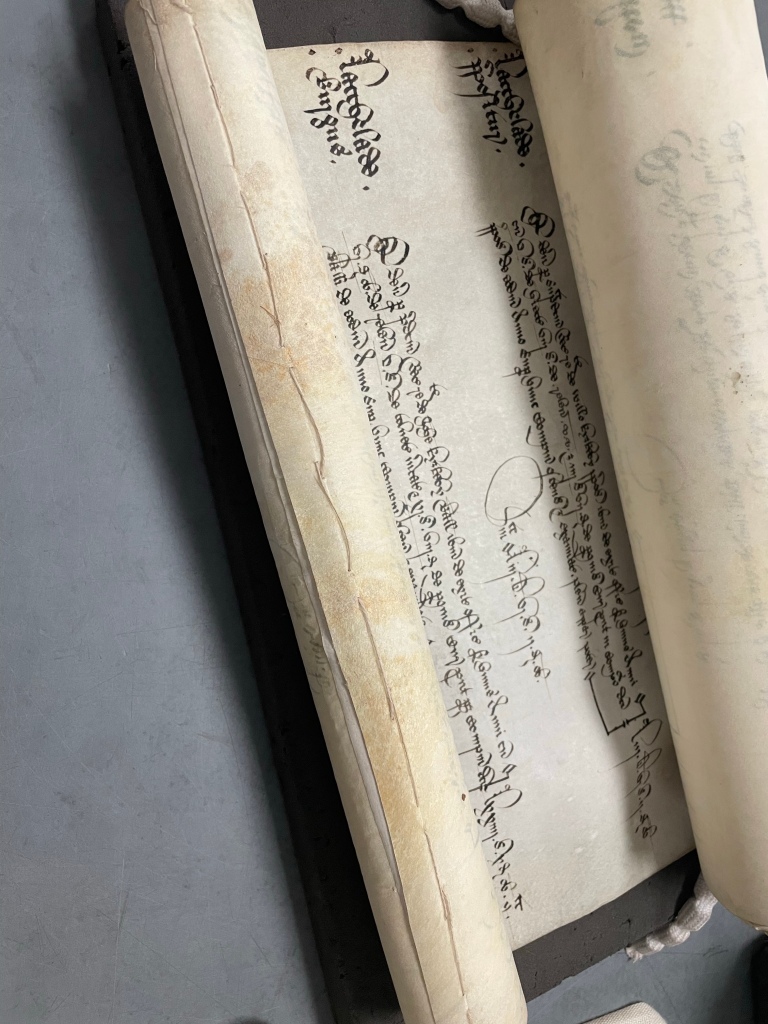
Many documents are stitched together at the top – or the end that eventually forms the core of the roll. And, having been rolled up for centuries, contents can be challenging to untangle. On numerous occasions, I haven’t dared unroll very far for fear of damage. Sometimes, I can’t find the end and struggle to unroll in such a way to avoid different membranes springing back.
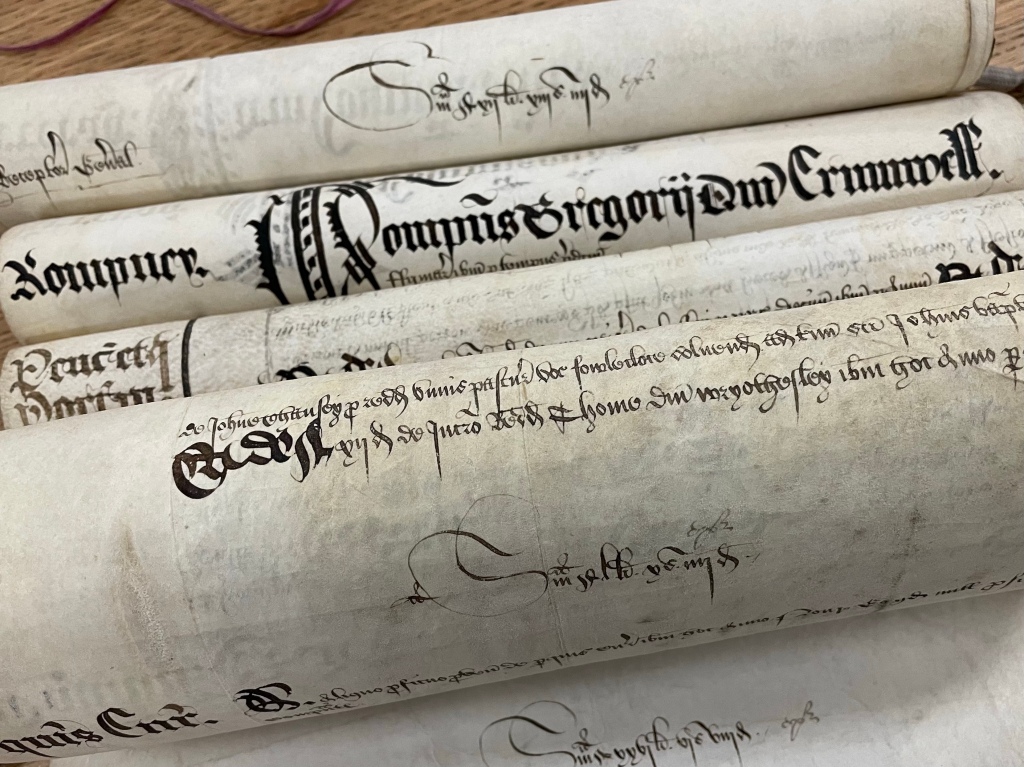
Where is the end of this document that refers to Gregory Cromwell?
Despite the frustrations of working with these rolls, I love them. I love seeing the stitches, and I love the act of unrolling bit by bit, an inch at a time, and not being able to see the whole document at once. It reminds me of my rolled quilted interpretation of Wolf Hall, which cannot and should not be seen all at once.
Some invaluable surviving documents are not rolled, but preserved flat, boxed carefully under lock and key. These are King’s Bench documents from 1536 – and they are from the trial of Queen Anne Boleyn and the men accused of treason alongside her.
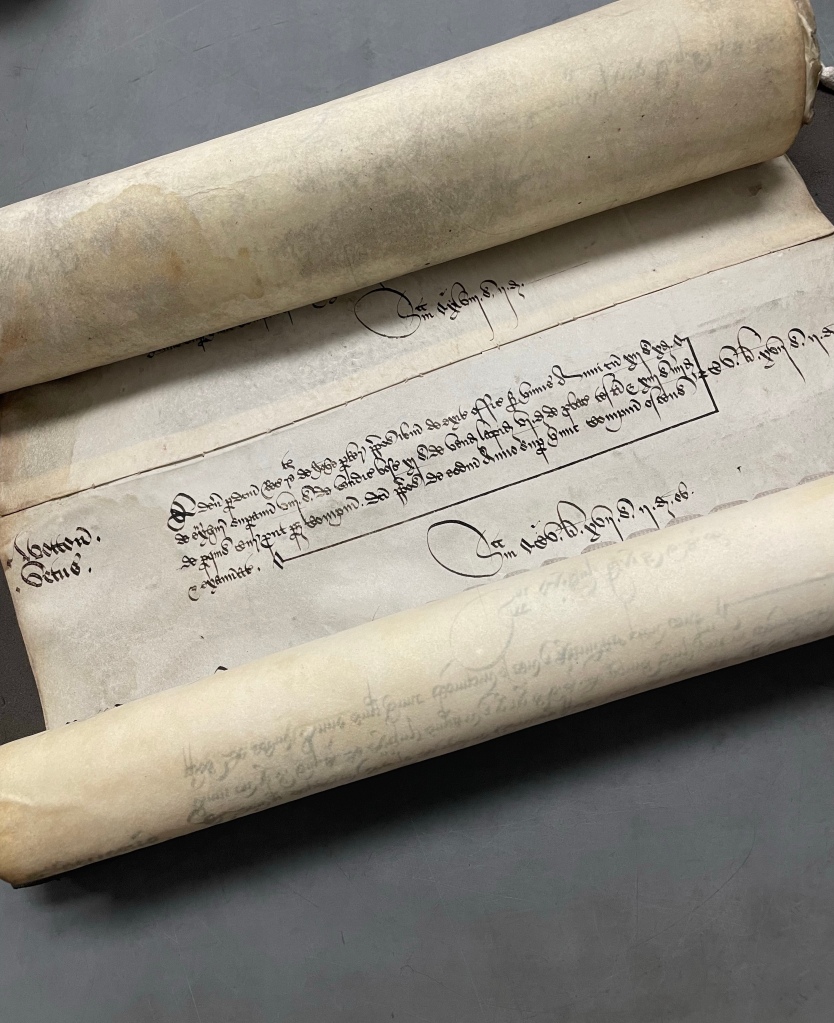
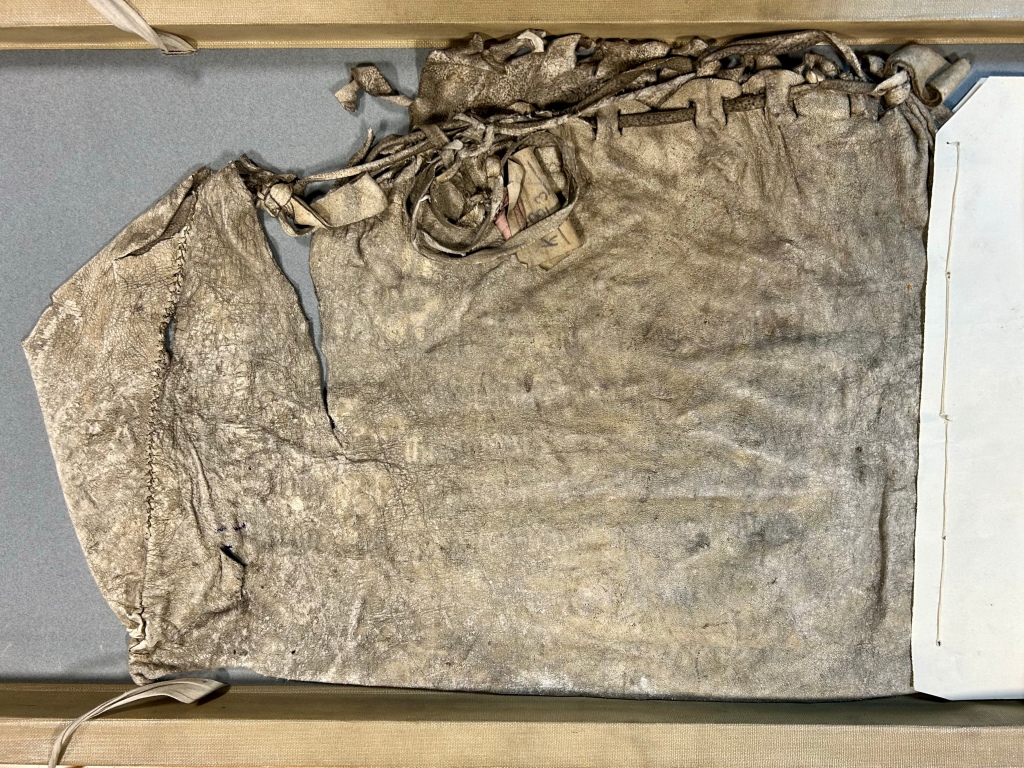
Today, I saw documents listing the names of George Boleyn, William Brereton, Francis Weston, Henry Norris, and Mark Smeaton – the men accused with the queen. Their names are clearly readable in beautiful script – but there’s something very unsettling about carefully controlled handwriting when it documents death sentences. I have never had such a strong visceral reaction when looking at documents before. These papers carry a weight of pain, grief, fear, death, and betrayal. I felt shaken just brushing my hand against them, and against the remains of the leather bags in which the documents were once carried.
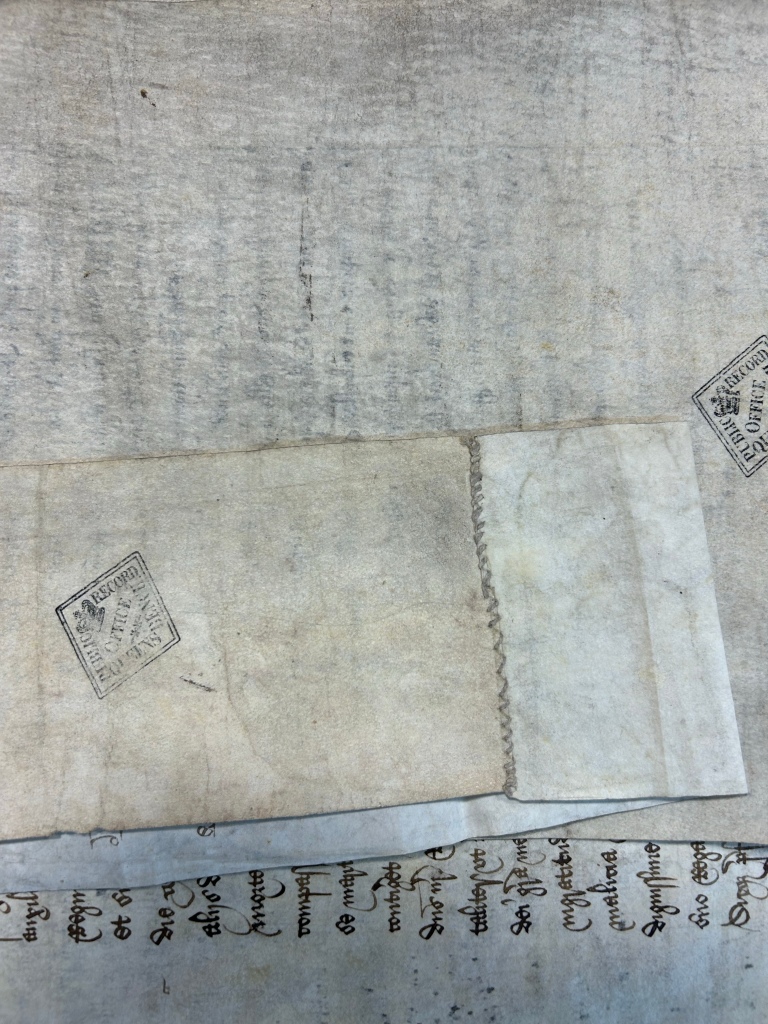
What remains of the leather bag that held the trial documents that condemned Anne Boleyn
These papers remind me of the stage play of Bring up the Bodies. Gregory asks his father whether the executed men are guilty. And he clarifies, “I didn’t mean, ‘Did the court find them guilty?’ Father. I meant, ‘Did they do it?’” Thomas replies: “Who knows?”
The trial papers include documents that were extended by the careful use of herringbone stitch. As Hilary Mantel wrote in The Mirror and the Light, “it’s useful to have the evidence stitched together”. But even today, this stitched together evidence is controversial, contested, unreliable, shifting. The stitches don’t strengthen the evidence, but they strengthen its documentation.
Herringbone stitch, stitching the evidence together
I have been searching for Thomas Cromwell’s quylte of yelow Turquye Saten for some years now. What I mean is, of course, that I’ve been looking for any traces of it in anything other than Cromwell’s will (and of course in Hilary Mantel’s Cromwell Trilogy). I don’t expect to find the actual object – it is highly likely to be long gone, such is the nature of old textiles.
But I have become a bit obsessed by knowing what happened to this high value item. In his 1529 will, Cromwell left his yellow quilt to his son Gregory. However, many of Cromwell’s possessions were seized after his arrest and execution in 1540: so whether Gregory ended up with the quilt is questionable. I’ve started to look into documents relating to the King’s Wardrobe, and note that some of Cromwell’s textiles were listed there – does this include the yellow quilt? I will be taking a closer look in the coming weeks.
A few days ago, I was reading a 1527 inventory of Cromwell’s possessions, and noted a reference to a second quilt- a “yerdure coverlid” or “detailed green quilt” (as listed in Caroline Angus: My Hearty Commendations: The Transcribed Letters and Remembrances of Thomas Cromwell). And a closer look at Cromwell’s 1529 will indicates a bequest of another coverlet or quilt to be left to “Elizabeth Gregory, sometime my servant”.
My quilt search has given me the perfect excuse to spend some very pleasurable days at the National Archives looking at Sixteenth Century documents. I have seen beautiful things, been frustrated by tightly rolled layers, learned to read a little bit of Secretary Hand – and cursed my lack of Latin. So far I haven’t come across any references to Cromwell’s quilts but I am loving the process of looking.
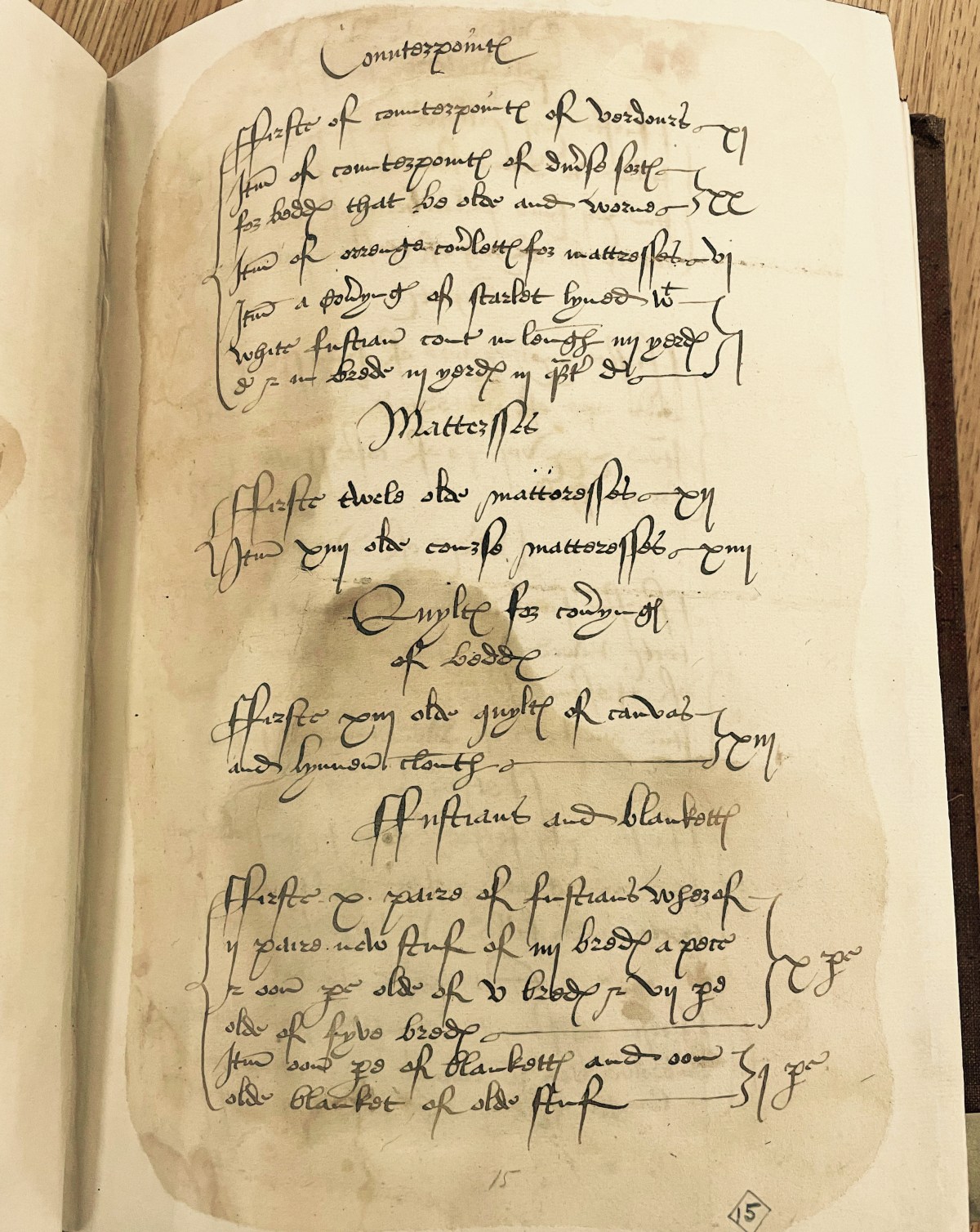
And I was delighted to recognise the word Quylte when I finally saw it – even thought it was a quilt belonging to someone else. In an inventory of Cardinal Wolsey’s goods taken at Cawood in about 1530, there is a “Quylte for covyring of bedde” and “another very old Quylte”.
Of course that inventory sent me straight back to the Cromwell Trilogy. In Wolf Hall, Hilary Mantel imagined George Cavendish, Wolsey’s Gentleman Usher, telling Cromwell about Wolsey’s arrest at Cawood in November 1530 – the context in which this real inventory, including its quilts, would have been taken.
In Mantel’s version, at Austin Friars, Cromwell’s city house, Cavendish has to recount the event in detail, he has to tell someone, he has to tell Cromwell everything:
‘George, make this story short, I cannot bear it.’ But George must have his say…
Hilary Mantel, Wolf Hall, Entirely Beloved Cromwell
Cromwell cannot bear it. He turns away, so he does not have to witness Cavendish’s grief – and to hide his own: “He looks at the wall, at the panelling, at his new linen fold panelling, and runs its fingers across its grooves.” This is the moment when he knows he will take revenge on all those who brought down his master.
And right now in 2023, I’m energised by the shock of seeing Wolsey’s quilts inventoried nearly 500 years ago. I shall carry on looking.
Thomas Cromwell’s son Gregory is a delightful character in Hilary Mantel’s Cromwell Trilogy. He is one of my favourite people in the books: I am like the servants at Austin Friars, who ‘cluster round Gregory, admiring him from hat to boots; all servants love him for his pleasant ways.’ (Bring Up the Bodies, Crows).
His pleasure in reading tales of King Arthur; in believing tall stories to give pleasure to the tellers; his uninformative letters (‘And now no more for lack of time’); his kindness to and concern for poor Anna of Cleves – Gregory’s innocent good nature runs through the Trilogy. I see him as a delicate youth, finely dressed in black velvet.
Accordingly to Professor Diarmaid MacCulloch’s excellent biography of Thomas Cromwell, the real Gregory was younger than has long been assumed thanks to the long-ago misdating of some of his and Cromwell’s letters. MacCulloch argues that Gregory was born in either 1519 or 1520, ‘not 1516 as many commentators have asserted since the early nineteenth century. Much patronising nonsense has been written about Gregory based on that persistent miscalculation of his age. He has frequently been denigrated for not having the educational attainments of a teenager at a time when he was in fact ten years old or less.’ (Diarmaid MacCulloch, Thomas Cromwell: A Life, 2018)
When writing her Cromwell trilogy, Hilary Mantel had a suspicion that this might be the case, but didn’t have the archival evidence to challenge these long-held views. During a discussion between Mantel and MacCulloch in the summer of 2019, held at Launde Abbey where Gregory Cromwell lived in the 1540s, Mantel remembered:
So what I did was I very surreptitiously started reducing his age. But I didn’t quite have the courage of my convictions – I didn’t reduce it enough. If I had had the good fortune that Diarmaid had written before my novels, that would have been a big change, because I would then have had chapter and verse for my strong feeling that we were getting Gregory all wrong.
Church Times, ‘Make something of me’: creating Thomas Cromwell, 2 August 2019. This discussion can also be heard on the Church Times podcast.
In the trilogy, one of Cromwell’s major preoccupations is to protect Gregory from the realpolitik of the Court of Henry VIII. Prior to the fall of Anne Boleyn, he sends Gregory to stay with a friend out of London, because ‘if he is to place all in hazard, and he thinks he is, then Gregory should not have to go through the pain and doubt, hour by hour. Let him hear the conclusion of events; he does not need to live through them.’ (Bring up the Bodies, The Black Book). Gregory’s tougher cousin Richard, or Cromwell’s chief clerk Rafe Sadler are always with his father, always taking action and supporting Cromwell’s actions and negotiations – while Gregory is shielded from the harsher aspects of life.
But in seeking to protect Gregory, Cromwell also fails to understand him. In Wolf Hall we learn that ‘little about Gregory is clear to him. “What is it,” he asks him, “what’s wrong?” The boy won’t say. With other people,he is sunny and lively, but with his father guarded and polite, as if to keep a formal distance between them.’ (Wolf Hall, An Occult History of Britain). Gregory wants to be recognised as Cromwell’s son, he wants to be useful to him like Richard or Rafe. And eventually, Cromwell’s underestimation is a source of tension and bitterness. As Gregory tells his father, ‘You do everything. You have everything. You are everything. So I beg you, grant me an inch of your broad earth, Father.’ (The Mirror and the Light, The Image of the King)
When I started working on my Weepers, I asked myself who would weep for Cromwell. Would Gregory? At his arrest, Cromwell imagines Gregory ‘inconsolable, crying like a child’, but is told that Gregory is simply ‘pensive’ (The Mirror and the Light, Mirror).
Protective of him to the end, Cromwell decides ‘it is time for Gregory to write a letter repudiating me. He should speak ill of me. Say he does not know how he comes to be related to such a traitor.’ (The Mirror and the Light, Mirror). Gregory’s wife writes the letter for him. Poor Gregory. His whole world has been rocked, the protection he has always known, the stability of Austin Friars, has gone. And so, at the age of just 20, he is one of my weepers.


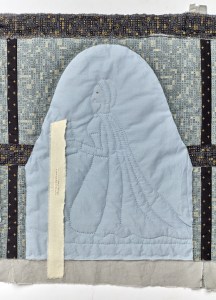
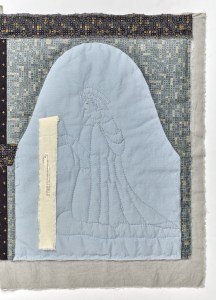
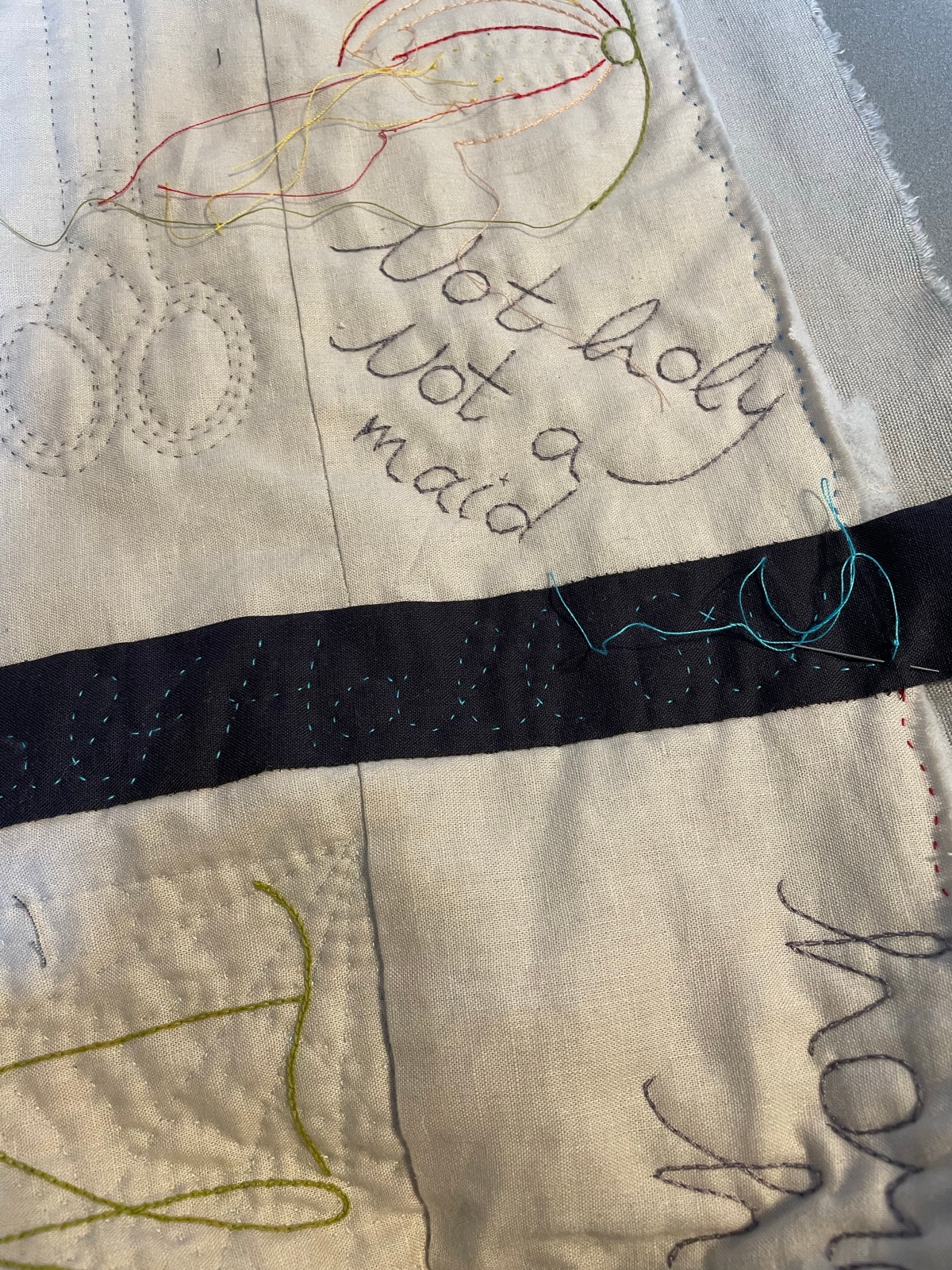
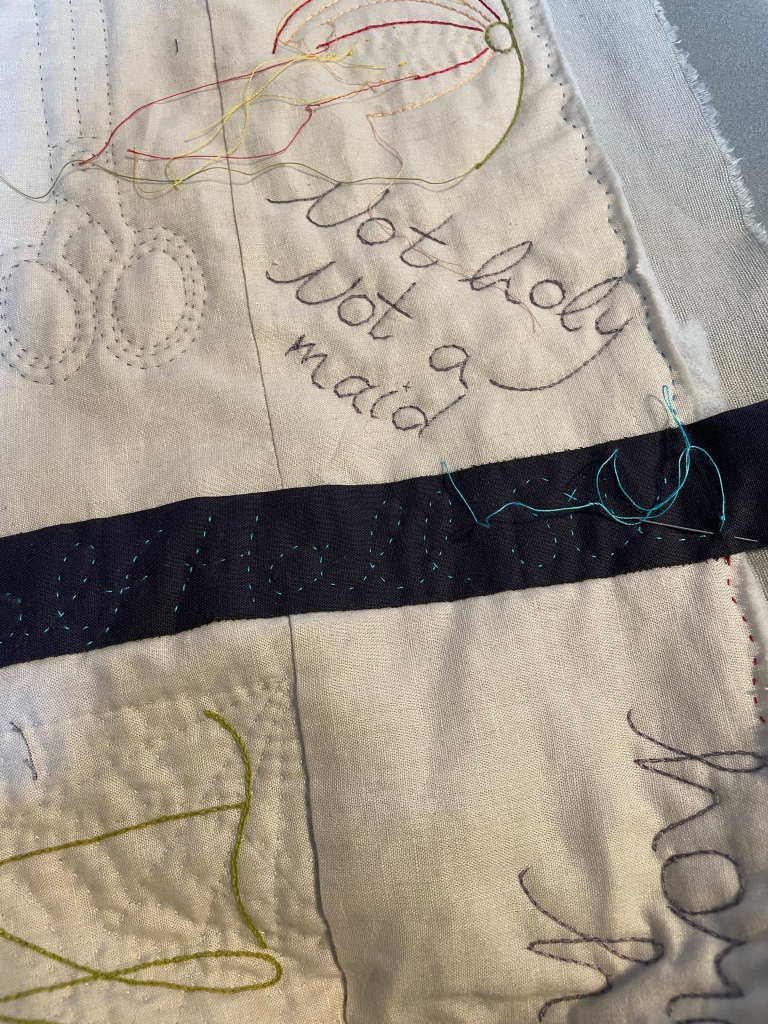


 Stitching Thomas Cromwell