Helen Barre’s Needle: The act of stitching in Hilary Mantel’s Cromwell Trilogy

This is an extract from my paper written for and delivered at An Overflow of Meaning, the first international conference dedicated to the work of Hilary Mantel, held at the Huntington Library, California, in October 2021.

As a stitcher, specifically a quilter, I am particularly interested in the way in which Hilary Mantel described needlework in her Thomas Cromwell Trilogy. She differentiated between different types of stitchery, the people who stitched, and what they made, in a way that paid tribute to the hands that plied – and continue to ply – needles. After reading my analysis of her literary stitchery, Hilary wrote to me that “I cannot really sew”. I find that almost impossible to believe, given her respect for the act of stitching, but it is evidence of her astonishing talent as a writer.
They have brought out bolts of fine holland, velvets and grosgrain, sarcenet and taffeta, scarlet by the yard [1]

Anyone who reads the Cromwell Trilogy cannot fail to notice the centrality of fabric to the lives of those within it. There are incredibly descriptions of textiles of varying weights, weaves, fibres, and designs, as they are deployed to make up clothes, bedhangings, carpets, and napery. As Lucy Arnold has pointed out:

The language of the textile industry, the processes of weaving, dying, tailoring and adapting fabrics, saturates the novels as a well of talking about textuality, intertextuality and the signifying power of words. Cromwell returns repeatedly to tapestries which depict Biblical and mythological texts, and identifies flaws in the weave of fabrics which interrupt their ability to signify or signal authenticity […] Even written dispatches are sewn into their envelopes.[2]

It helps having a protagonist who knows about textiles. Thomas Cromwell appreciates fabric and the processes that lie behind it: having a background in the cloth trade, how could he fail to do so? Cromwell’s appreciation allows the reader to enjoy many stitched items: the silk flowers given to Katherine by Henry; Jane Seymour’s Kingfisher sleeves; Anselma in the tapestry; Cromwell’s orange coat; Margaret Pole’s treasonous embroidery. My favourite is Cromwell’s own Quylte of Yelow Turquye Saten – a piece of bedding that once existed, according to his will. I have an expensive piece of Yelow Saten ready and waiting to be quilted.

The first time I read Wolf Hall back in 2009, I was struck by the amount of textile imagery. I remember noticing the recycling of Wolsey’s clothes on that reading, and drawing parallels with spotting an old and much-loved piece of fabric in a patchwork quilt:

The cardinal’s scarlet clothes now lie folded and empty. They cannot be wasted. They will be cut up and become other garments. Who knows where they will get to over the years? Your eye will be taken by a crimson cushion or a patch of red on a banner or ensign. You will see a glimpse of them in a man’s inner sleeve or in the flash of a whore’s petticoat.[3]

Two other phrases stuck with my stitching self, as they related to difficulties with a needle. One was the child Jo’s ‘awkward little backstitch which you would be hard-pushed to imitate’.[4] Her technique might not be all her mother Johane would desire, but its value is quickly recognised by Cromwell, who knows that even an unconventional stitch can come in useful, provided it can hold together, and promises her ‘I shall give you a present for sewing the cardinal’s letters’.[5] The other related to knitting:

He has never witnessed, or quite believed in, Lady Anne’s uncontrolled outbursts of temper. When he is admitted she is pacing, her hands clasped, and she looks small and tense, as if someone has knitted her and drawn the stitches too tight.[6]

I’m not a knitter, but I understand the difficulties of pulling a thread too tight when quilting and watching the fabric pull and pucker, knowing that at some date in the future, the thread will pull itself out, its starting knot emerging to the front of the quilt, insecure and hanging loose.

Neat Stitching … Who did this? [7]
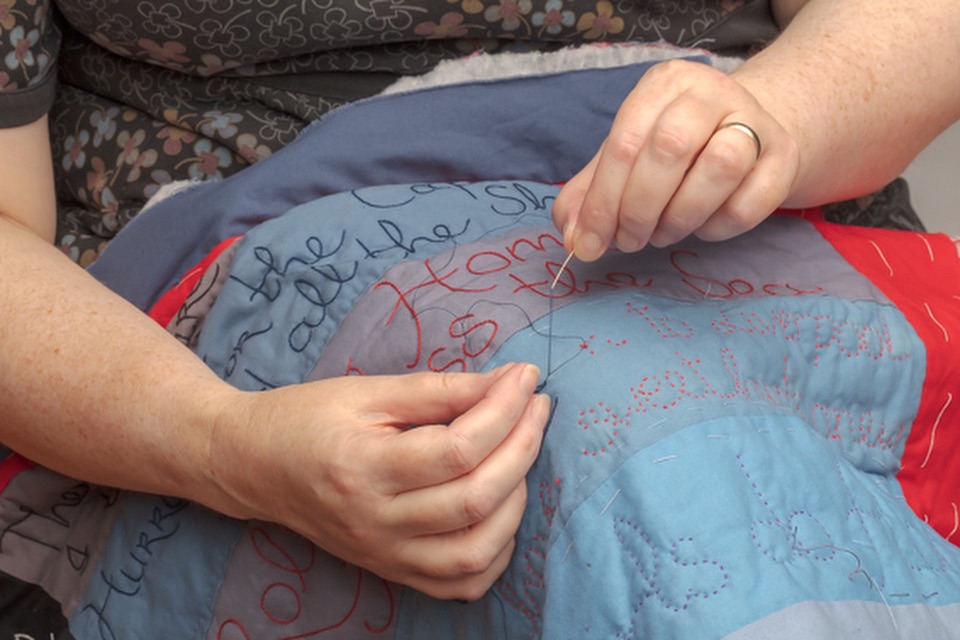
My stitching hands: photography © Michael Wicks

 It is the descriptions of the actual practice of stitchery that thread their way throughout the trilogy that fascinate me most. There is a clear understanding that needlework is labour, that it takes time, effort, and skill, that it is a deliberate act. George Cavendish knows this. As the Cardinal’s vestments and copes, ‘stiff with embroidery’, are confiscated he asks that the chests are lined:

with a double thickness of cambric. Would you shred the fine work that has taken nuns a lifetime?’ [8]

Mary Boleyn knows this. When she leaves Anne’s chamber to talk to Cromwell:

she’s brought her sewing with her, which he thinks is strange; but perhaps, if she leaves it behind, Anne pulls the stitches out.[9]

Bess Seymour, now Bess Cromwell, knows this. She brings Cromwell ‘news of needlework’, in which there is emotional as well as physical labour:

I was bidden to do a piece of work. One of the maids could have done it, but it was handed to me out of malice. It was something of Jane’s. Jane the queen, my sister, it was her girdle book, her little prayers. I was told, take this and pick the initials out. I said, I will not do it. I am Mistress Cromwell, not some servant.’ […] ‘The next thing I see, Katherine Howard is wearing it at her waist.’ [10]

Unpicking is never a pleasant task, it represents wasted effort and wasted time. There is an additional viciousness here: in an act of deliberate cruelty, Bess is expected to remove embroidery stitched for her dead sister, so that it can be given to another of the King’s loves. And for some people, sewing will never be pleasant whether the thread is going in or coming out. Cromwell’s young daughter Anne knows this. She does not enjoy learning needlework from her mother:

When Anne applies to her needle, beads of blood decorate her work. Liz says, she’d be better with a cobbler’s awl, except a cobbler wouldn’t be so chatty. He will not let his wife strike her; Anne cannot be faulted for diligence, and for the rest he feels she should not be faulted. ‘I suppose she will outgrow it,’ Liz says.[11]

Cromwell’s unknown daughter Jenneke, on the other hand, having learned perhaps from Anselma, is a proficient stitcher. Before we meet her in person, before Cromwell knows who she is, he is commenting on her ‘neat stitching’:

As they speak he is unrolling the jerkin. With a shake, he turns it inside out, and with a small pair of scissors begins to split open a seam. ‘Neat stitching… who did this?’ The boy hesitates; he colours. ‘Jenneke.’ He draws out from the lining the thin, folded paper.[12]

Thomas Cromwell knows that stitching isn’t just something that happens, there is a person (in his world, usually a woman) behind it, and that it is a conscious act on the part of the person who plies the needle. He knows this because he recognises the vital importance of the cloth trade to England’s economy and to the people who work within it.

She has been sewing – or rather unsewing [13]

 In Cromwell’s world, sewing is never neutral. What is sewn, how it is stitched, and who threads the needle all have an impact on the cut of the cloth. Emblems and badges are embroidered so, as queens change, their supporters are kept busy unpicking and stitching new emblems to reflect the current state of the king’s matrimonial affairs. The blackwork embroidered by Henry’s first queen is long gone by the time of his third; now his shirts ‘are stitched by paid and proficient hands, with lions and laurel crowns’.[14] The politics of pregnancy are played out by the letting out and taking in of bodices.

Cromwell, who ‘of your gentleness… interest[s] yourself in the work we women do’,[15] hopes that Honor Lisle will incriminate herself with a letter to or from Reginald Pole hidden in her sewing box.[16] She is not caught out, but Pole’s mother is caught stitching treasonous embroidery. Margaret Pole’s hands might look innocent enough as she ‘takes a neat loop of her thread and slips her needle into the cloth’,[17] but her stitching demeanour is far from placid as ‘her hawk’s profile is lowered over her work, as if she is pecking it’.[18] Her stitched garden contains hopes of an alliance between the Princess Mary and the Pole family.

Cromwell, of course, is wise to what she is stitching and considers it ‘useful to have the evidence stitched together. “I hope that when that cloth is finished,” he says, “the family will protect it from the light.”’ [19] It is, ultimately, stitched evidence that Cromwell is able to present – wordlessly [20] –  to Parliament: ‘a figured vestment found in the possession of Margaret, Countess of Salisbury. It quarters the arms of England with a pansy for Pole and a marigold for the Lady Mary, signifying their union; between them grows a Tree of Life […] He says, I always maintained that embroidery would get her into trouble.’ [21]

Every hand that could hold a needle would go to work [22]

A close reading of the three novels shows that the stitching activities are as various as the (mostly) women who undertake them and the textiles to which they contribute:

Sail-making: Helen Barre

Utility stitching: Jenneke; Hans Holbein (metaphorical)

Backstitch (awkward): The child Jo

Shroud-making: Mercy (assumed); Cromwell, Jane Rochford, Thomas Wyatt (metaphorical)

Clothes-making: Queen Katherine; Anne Boleyn; Mary Boleyn; Jane Seymour; Liz (not explicit); Cromwell (implied)

Clothes recycling: Mercy; Johane; Bet; Kat; Princess/Lady Mary

Clothes repair: Lady Bryan; Katherine Howard (hemming); Margaret Douglas (hemming)

Patchwork: Liz

Quilting: Liz

Embroidery: Queen Katherine; Jane Seymour; Anna of Cleves; Mary Boleyn; Liz; Helen Barre; Margaret Pole; Bess Darrell; Honor Lisle; unnamed nuns; Mercy, Anne/Grace Cromwell (possible)

Blackwork embroidery: Queen Katherine; Liz

Silk work: Liz

Braiding: Liz

Unpicking: Jo; Anne Boleyn; Mary Boleyn; Bess Seymour; Jane Seymour’s ladies

Unspecified sewing: Johane; Kat; Anne Cromwell; Queen Katherine; Anne Boleyn; Jane Seymour; Anna of Cleves; Thomas Seymour’s wife; Anne Boleyn’s ladies; Jane Seymour’s ladies; Lady Shelton

Untangling of thread: Cromwell

Eye surgery using needle (dog): Cromwell

Both in the novels and in life, it should not be assumed that because someone can work in one type of sewing, they will be proficient at all. If, for example, you quilt, you are likely to be asked to repair a dropped hem on somebody’s skirt. If you embroider, you might be asked to take in a dress. If you are a dressmaker, you might be asked to finish off someone’s abandoned cross stitch. But this results from a misunderstanding of the difference in technique, skill, and specialism. Patchworkers are not necessarily quilters, who are not necessarily embroiderers, who are not necessarily tapestry weavers; who are not necessarily dressmakers, and so on. One of the many pleasures of the Cromwell Trilogy is Mantel’s differentiation of stitchery. From sail-making to silk embroidery, the needlework is various, and highly specialist. It is not a neutral activity, but is weighted with class, expectation, and intent.

The most able stitcher, in terms of the number of techniques in which she is proficient, is Elizabeth Cromwell. Liz uses patchwork and quilting techniques in the making of Twelfth Night costumes; she embroiders cushions for her home and narrows that embroidery down to blackwork when making shirts for Gregory (and, while the text is silent about this, perhaps we can assume she has stitched said shirts); she does silk work, including braiding, and, like many experienced stitchers, she has the muscle memory to work without thinking:

Once he had watched Liz making a silk braid. One end was pinned to the wall and on each finger of her raised hand she was spinning loops of thread, her fingers flying so fast he couldn’t see how it worked. ‘Slow down,’ he said, ‘so I can see how you do it,’ but she’d laughed and said, ‘I can’t slow down, if I stopped to think how I was doing it I couldn’t do it at all.’ [23]

And in an echo of Cromwell saying he would – deliberately – leave his needle in if he were stitching the king’s shirts,[24] Liz – unconsciously – stores her needle in a piece of embroidery, a bad habit shared by so many stitchers, and leaves behind a ghost in her stitching:

There is a cushion over on which she was working a design, a deer running through foliage. Whether death interrupted her or just dislike of the work, she had left her needle in the cloth. Later, some other hand – her mother’s, or one of her daughters’ – drew out the needle; but around the twin hole it left, the cloth had stiffened into brittle peaks, so if you pass your finger over the path of her stitches – the path they would have taken – you can feel the bumps, like snags in the weave.[25]

Liz’s skill with needle and thread is such that her hands can move while she talks or thinks of other things; her craft has become part of her. That is not to say that her work is without intent or that it is easy. Her confidence in the tiny movements of textile work is brought about from long experience and repeated practice.

Helen Barre unwinds the thread of her tale [26]
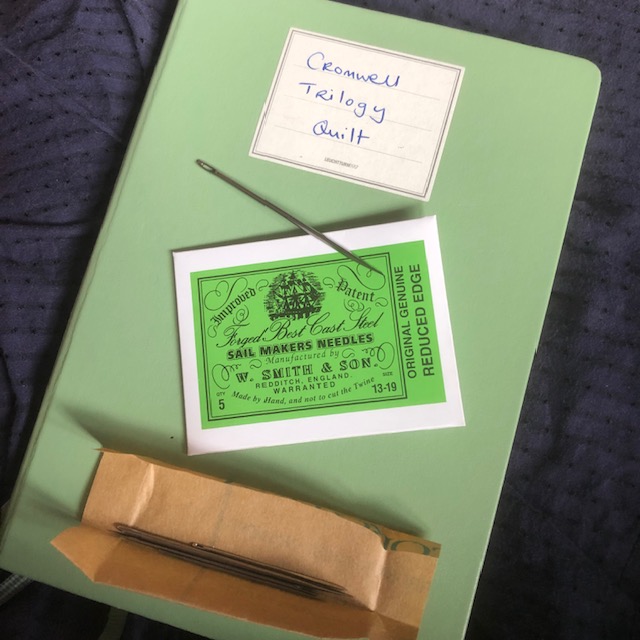
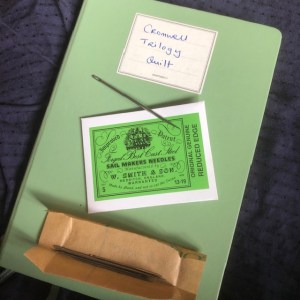
A green notebook with a packet of sail makers' needles resting on it, one of the needles is out of the packet and is large.
Sail Makers’ Needles

The different types of stitchery are exemplified in Helen Barre, and that is why this paper is named after her. When we first meet Helen, she explains that, in about 1530, she was ‘stitching for a sailmaker’ somewhere in Essex, maybe around Tilbury (where her first husband disappeared).[27] Cromwell notices that Helen’s hands are ‘skinned and swollen from rough work’.[28] This is unsurprising: while I am not an expert in antique sailmaking tools, I can confirm that from a 21st century stitcher’s perspective, sailmaking continues to be rough work. Sailmakers’ needles are terrifying things: long, thick, and lethal. You would not want to get on the wrong side of one. To get your needle through heavy canvas or to attach rope securely, a finger thimble would be useless; you need a Sailmaker’s Palm: a leather strap that goes around your hand with a metal pad that fits in your palm. Then you can employ all your strength to push your needle through. I have a Sailmaker’s Palm in my sewing basket, but it is far too big for my hand. I suspect these tools are designed for larger and stronger hands than mine, and indeed Helen’s.[29]
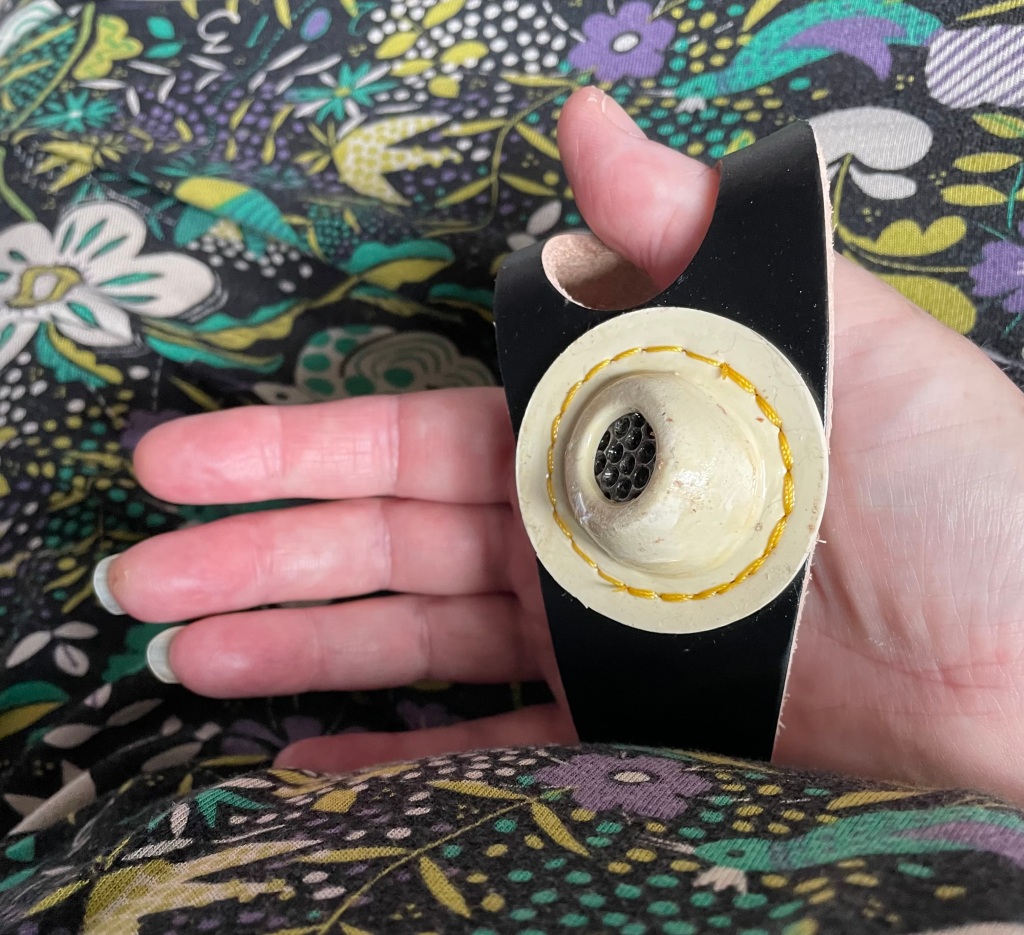
Sailmeaker’s Palm – too big for my hand

Helen is destined for finer fabrics. As with his habit of dressing and re-dressing queens, when she first arrives at Austin Friars, Cromwell ‘mentally… takes her out of cheap shrunken wool and re-dresses her in some figured velvet he saw yesterday, six shillings the yard.’ [30] Later, when Helen prepares a room for the visit of the Princess Mary, he watches her pleasure at the opportunity ‘to handle the fine stuff and have a brigade of cushions at her command.’ [31] And as Helen learns to ‘handle the fine stuff’, the nature of her stitching changes. As the wife of Rafe Sadler, a sailmaker’s needle is no tool for her gentlewoman’s hand. By 1536, she is working on fine embroidery; her thread is now fine silk rather than coarse twine or rope, her needle is thinner, shorter, and sharper. She sews for Dorothea Wolsey ‘a kerchief of fine linen […] worked with the three apples of St Dorothea, and with wreaths, sprigs and blossoms, the lily and the rose’,[32] in ‘loving stitches… to give pleasure to a stranger’.[33] The stranger – Dorothea – rejects both the loving stitches and Cromwell himself. When Cromwell returns to London, with the embroidered kerchief, he passes it to Rafe to give back to Helen.[34]

Dorothea’s rejection of Cromwell is shocking enough on its own, but for a stitcher, with a keen awareness of the time and effort that went into those loving stitches, the rejection of Helen’s work is an additional blow. Perhaps it would have been kinder for Cromwell – or perhaps Rafe – to keep the kerchief for himself, rather than let Helen know it was not wanted. I noted, with relief, when watching the stage version of The Mirror and the Light that Helen’s embroidery was absent when Cromwell went to see Dorothea. But the casting of Umi Myers in the dual role of both Helen and Dorothea is a subtle reminder that these two women are linked by stitch.[35]

My fingers are kept supple by plying my needle [36]

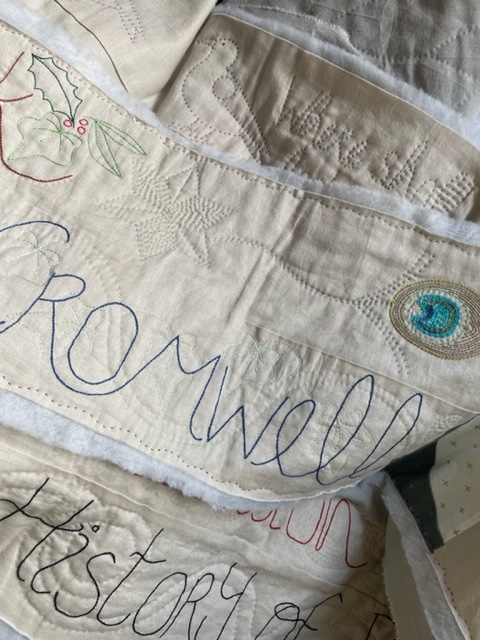
 It is unsurprising that a trilogy of novels that pay so much respect and attention to the act of stitching should have a particular resonance for anyone who works in textiles, and, in my case, form the inspiration for a large ongoing sewing project (or should that be projects?). My first Cromwell-related quilt was made in 2014; since then there have been numerous projects. As I write, I am looking at the first 30 feet of my current Cromwell Narrative Cloth – a piece that tells the story of the Trilogy in chronological order. Hilary Mantel’s Cromwell Trilogy is a constant source of inspiration, and now I cannot think that I will ever stop stitching it.
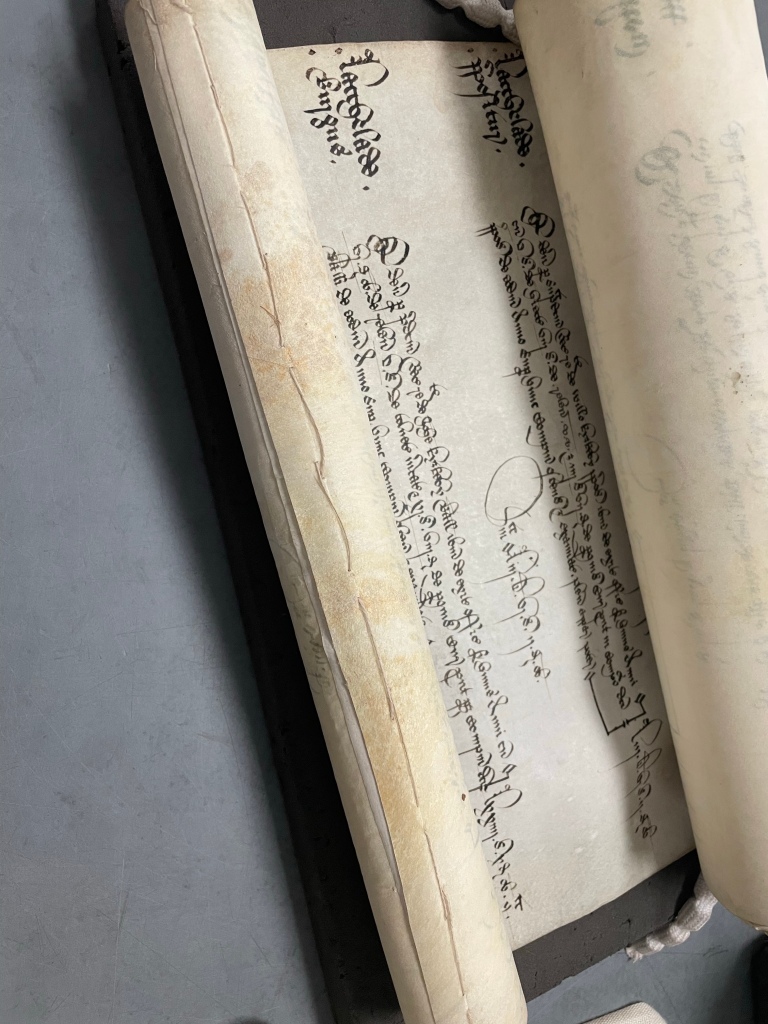
Sixteenth Century Stitchery – still holding documents together

[1] Hilary Mantel, Wolf Hall: Visitation (London: Fourth Estate, paperback edition, 2019) , p.50.

[2] Lucy Arnold, Reading Hilary Mantel: Haunted Decades (London: Bloomsbury, 2020), pp.166-167.

[3] Wolf Hall: Entirely Beloved Cromwell, pp.265-266.

[4] Wolf Hall: Entirely Beloved Cromwell, p.239.

[5] Wolf Hall: Entirely Beloved Cromwell, p.259.

[6] Wolf Hall: ‘Alas, What Shall I Do For Love?’, p.373.

[7] Wolf Hall: Arrange Your Face, p.304.

[8] Wolf Hall: Visitation, p.50.

[9] Wolf Hall: Entirely Beloved Cromwell, p.203.

[10] The Mirror and the Light: Magnificence (London: Fourth Estate 2019), p.788.

[11] The Mirror and the Light: The Bleach Fields, p.420.

[12] Wolf Hall: Arrange Your Face, p.304.

[13] Wolf Hall: Devil’s Spit, p.501.

[14] The Mirror and the Light: Vile Blood, p.334

[15] The Mirror and the Light: Salvage, p.193.

[16] The Mirror and the Light, Magnificence, p.766.

[17] The Mirror and the Light: Salvage, p.194.

[18] The Mirror and the Light: Salvage, p.106.

[19] The Mirror and the Light: Wreckage II, p.198.

[20] See Susan Higginbotham, Margaret Pole: The Countess in the Tower (Stroud: Amberley Publishing, 2017), p.129.

[21] The Mirror and the Light: Ascension Day, p.665.

[22] The Mirror and the Light: Magnificence, p.720.

[23] Hilary Mantel, Bring Up the Bodies: The Black Book (London: Fourth Estate, paperback edition 2019), pp.286-287.

[24] Wolf Hall: An Occult History of Britain p.92.

[25] The Mirror and the Light: Salvage, p.65.

[26] Wolf Hall: Anna Regina, p.419.

[27] Wolf Hall: Anna Regina, p.420.

[28] Wolf Hall: Anna Regina, p.419.

[29] Traditional Sailmaking is now officially considered an Endangered Craft with between just 21 and 50 professional makers left in the UK. As the Heritage Crafts Association note, ‘Many people would like to have sails made traditionally, but very few are willing to pay the price of someone working eight hours a day hand-sewing’. Red List of Endangered Crafts: Sailmaking, Heritage Crafts Association website, https://heritagecrafts.org.uk/sail-making/ [accessed 1 October 2021].

[30] Wolf Hall: Anna Regina, p.419.

[31] The Mirror and the Light: Salvage, p.149.

[32] The Mirror and the Light: The Five Wounds, p.282.

[33] The Mirror and the Light: The Five Wounds, p.289.

[34] The Mirror and the Light: The Five Wounds, p.290.

[35] The Mirror and the Light, Royal Shakespeare Company and Playful Productions, first performed at the Gielgud Theatre London on 23 September 2021.

[36] The Mirror and the Light: Magnificence, p.726.
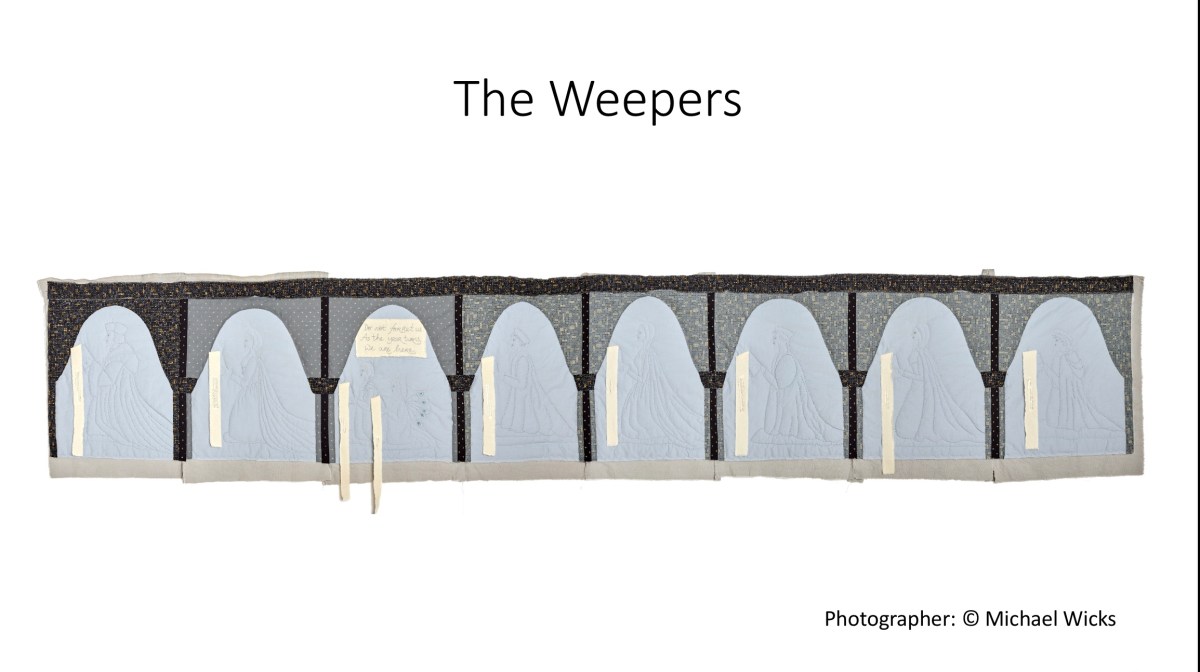
A Year of Weeping

The Weepers, 2022-2023

It is now a year since the sudden passing of Hilary Mantel on 22 September 2022. I still cannot believe that this is true.

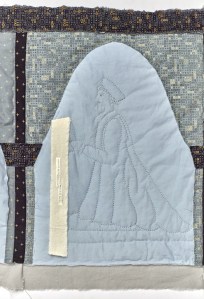
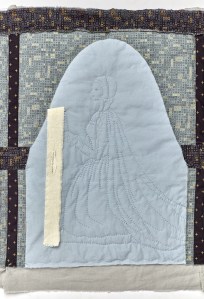
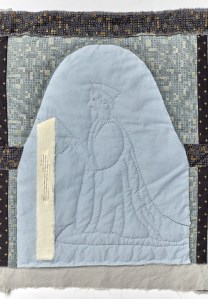
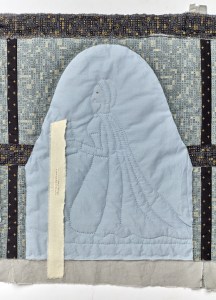
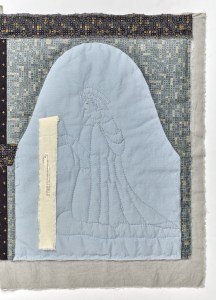
In the days following her death, I thought of memorials, mourning, and grief; I wondered how her characters – so alive on the page – might pay tribute. I thought of weeper tombs – those elaborate memorials that include kneeling mourners paying silent tribute to the departed. And I stitched a series of weepers, who do not pray, but who each hold a copy of a book from Hilary Mantel’s Cromwell trilogy; with precisely written and now carefully chosen words about each of them unrolling from the pages.

The Weepers: A tribute to Dame Hilary Mantel, 6 July 1952-22 September 2022.

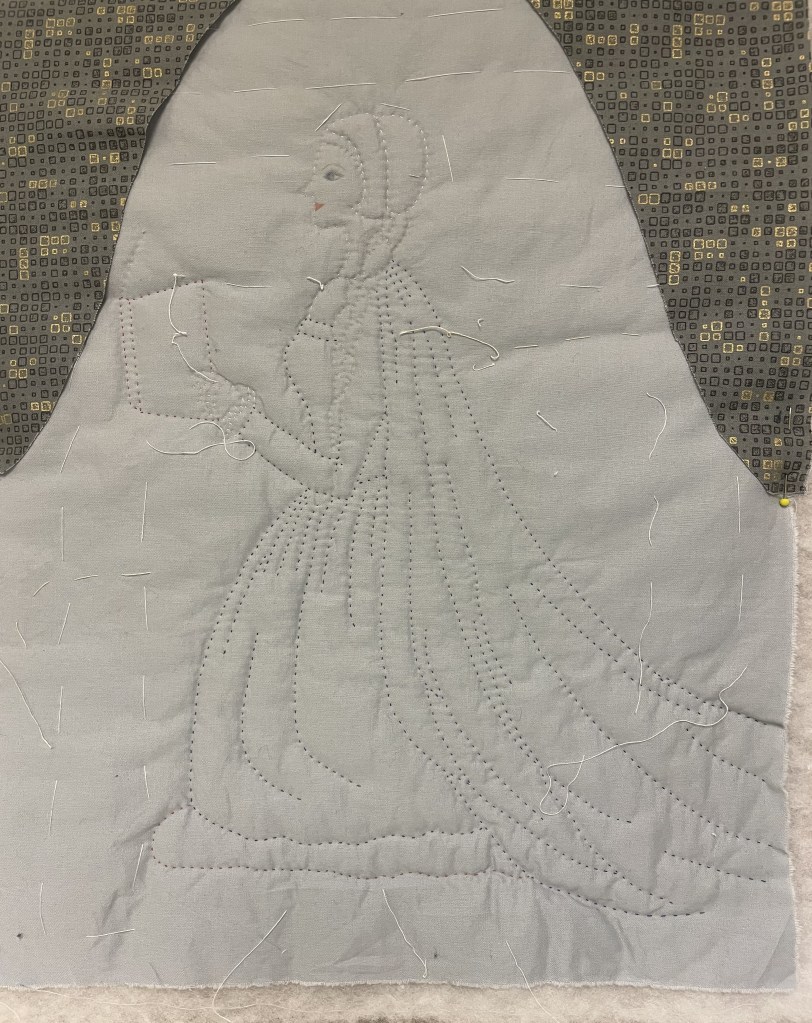
A quilted picture of Thomas Cromwell, kneeling under an arch and holding a book. A strip of fabric with text attached falls from the book.
The Weepers: Thomas
A quilted picture of Elizabeth Wykyes, kneeling under an arch and holding a book. A strip of fabric with text attached falls from the book.
The Weepers: Lizzie
A quilted picture of Anne and Grace Cromwell, kneeling under an arch and holding a book each. Strips of fabric with text attached fall from their books. Above them, stitched text reads “Do not forget us. As the year turns, we are here”.
The Weepers: Anne and Grace
A quilted picture of Gregory Cromwell, kneeling under an arch and holding a book. A strip of fabric with text attached falls from the book.
The Weepers: Gregory
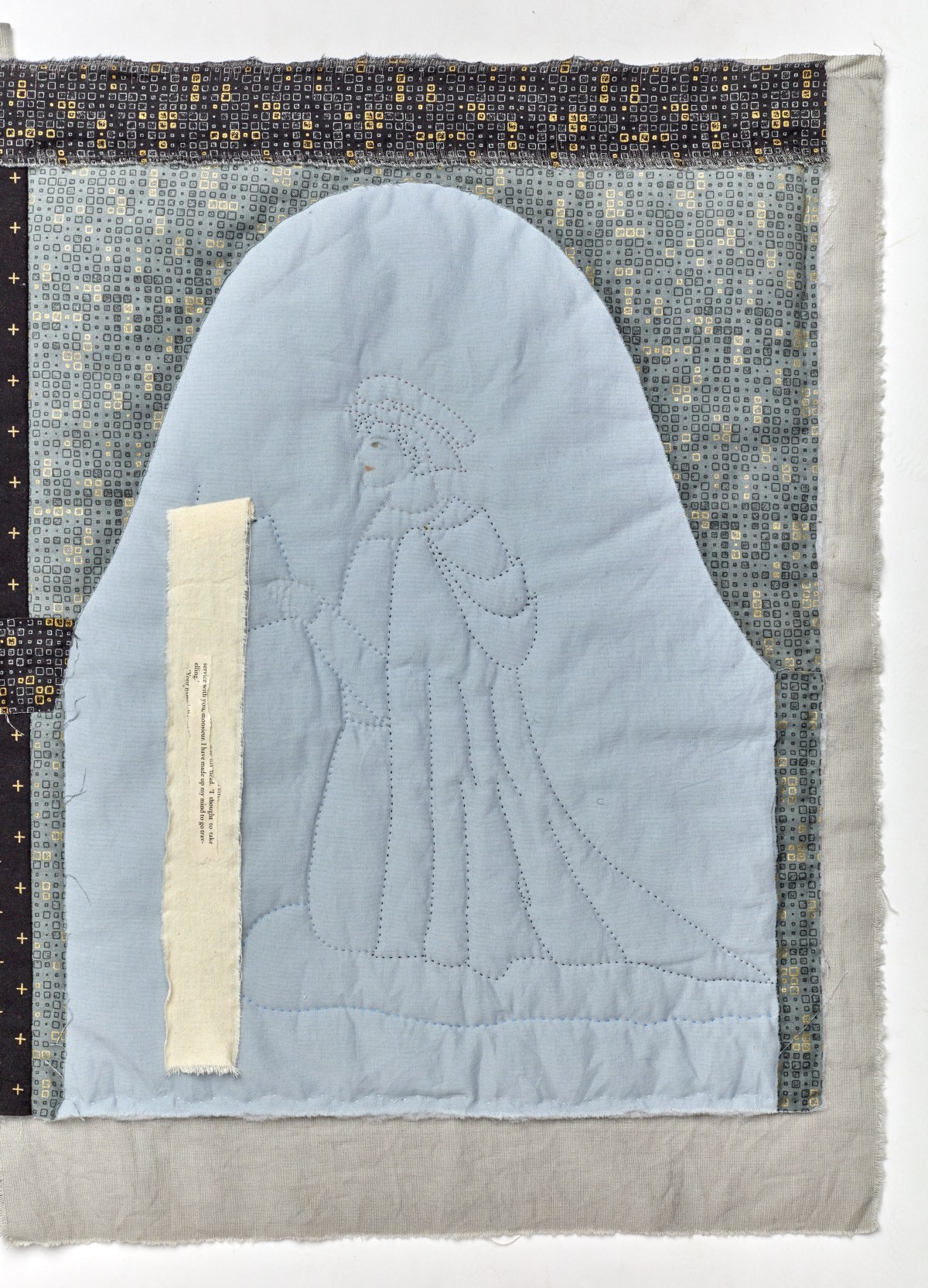
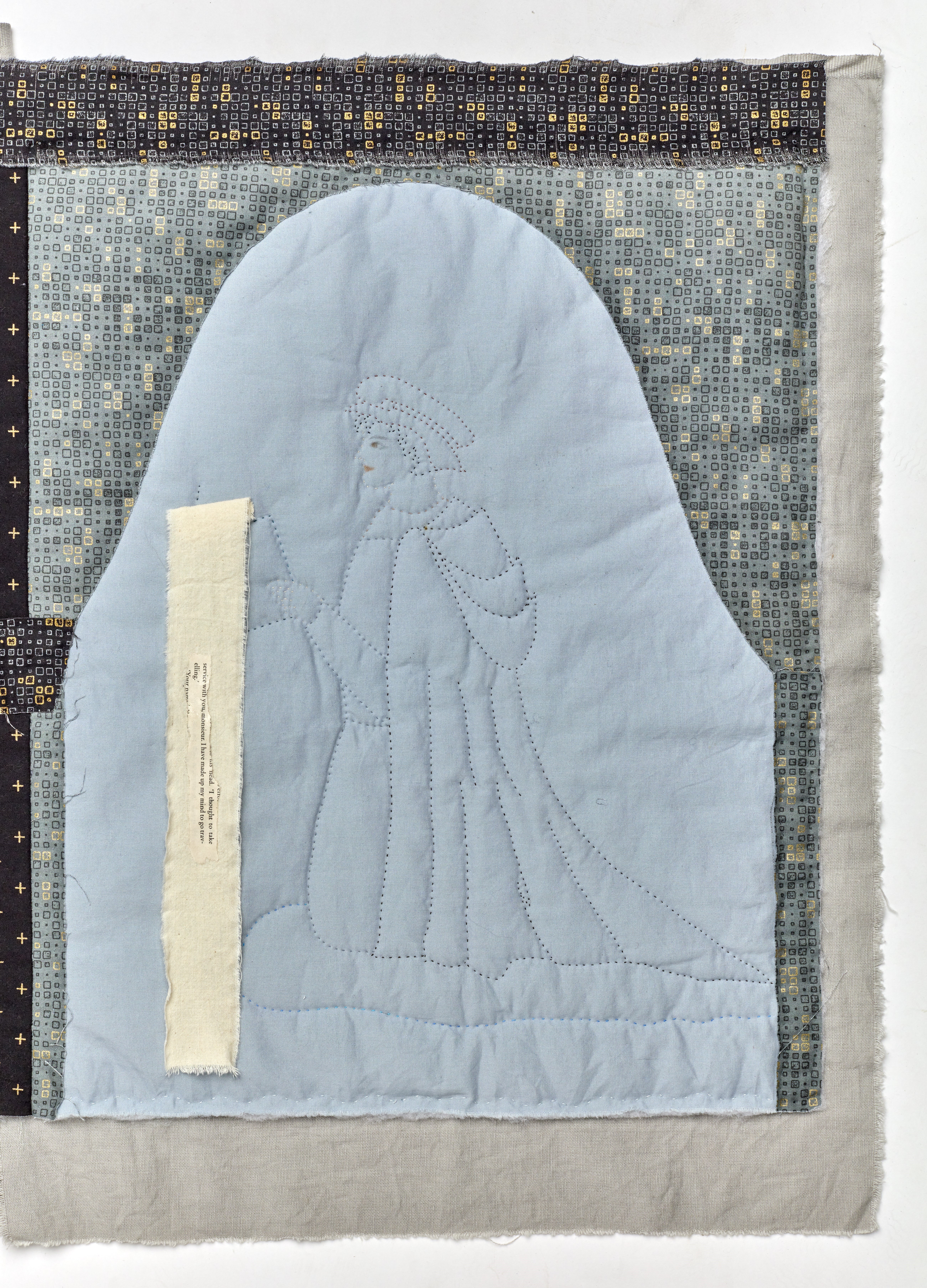
A quilted picture of Helen Barre, kneeling under an arch and holding a book. A strip of fabric with text attached falls from the book.
The Weepers: Helen
A quilted picture of Rafe Sadler, kneeling under an arch and holding a book. A strip of fabric with text attached falls from the book.
The Weepers: Rafe
A quilted picture of Jenneke, kneeling under an arch and holding a book. A strip of fabric with text attached falls from the book.
The Weepers: Jenneke
A quilted picture of Christophe Cremuel, kneeling under an arch and holding a book. A strip of fabric with text attached falls from the book.
The Weepers: Christophe Cremuel

All photographs © Michael Wicks

Stitching the Evidence Together

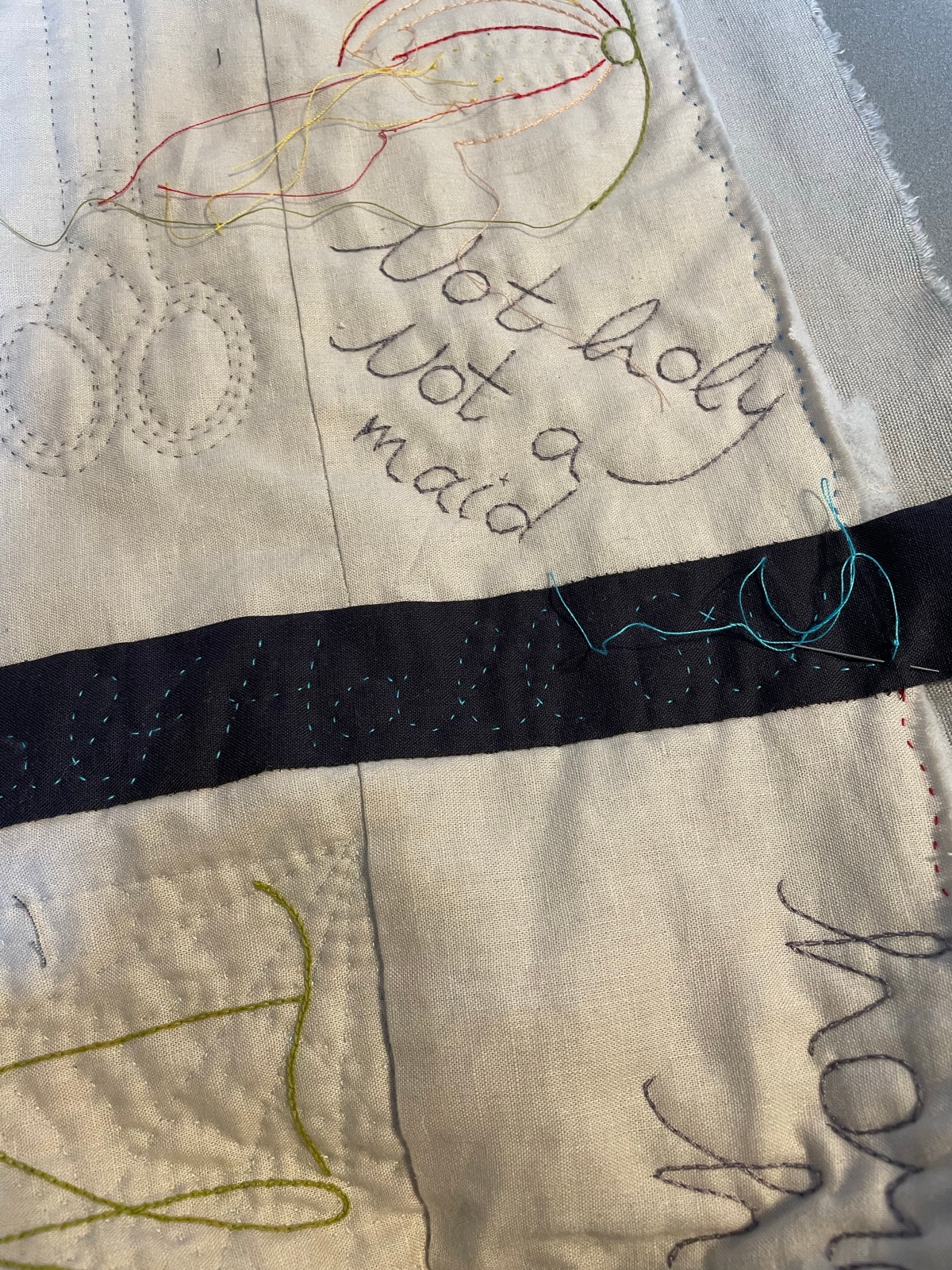
A quilted piece with the words “Not holy Not a maid” visible. Some turqouise stitching on black fabric shows words that are not entirely clear but read “Wolf Hall Six”. A needle and thread at the end of the word “Six” is pushed half way into the fabric.
The last stitch in the first Wolf Hall quilt

Twenty five months ago today – on 19 August 2021 – I put the last stitch into the First Wolf Hall Quilt. I’d spent a very uncomfortable few hours joining all the sections together to make forty six feet of quilting, and had struggled while wrestling the writing and coiling length into one long roll.

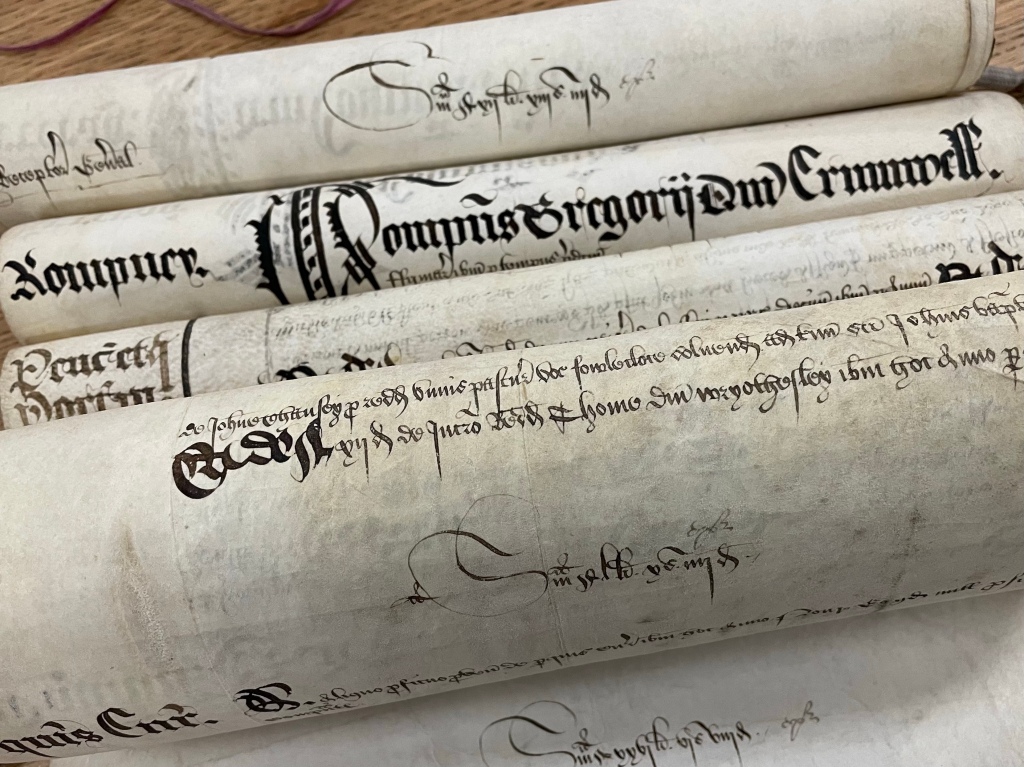
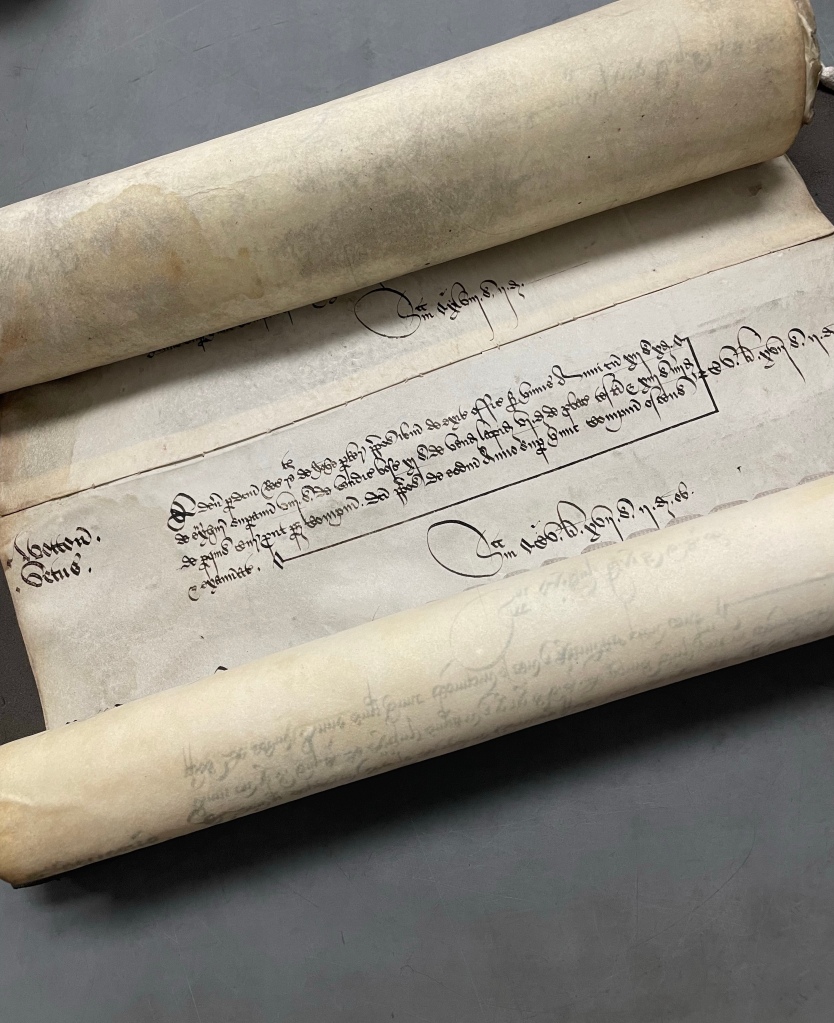
More recently, I have been regularly visiting the National Archives at Kew, just outside London, looking at Sixteenth Century documents relating to Thomas Cromwell. Such documents – especially those that take the form of rolls – are often stitched together. This gives me a feeling of continuity – these old parchments and my quilting are hand-sewn together with needle and thread, joining narratives and the historical record.

A rolled document with long stitches showing where different pages are joined together.

Many documents are stitched together at the top – or the end that eventually forms the core of the roll. And, having been rolled up for centuries, contents can be challenging to untangle. On numerous occasions, I haven’t dared unroll very far for fear of damage. Sometimes, I can’t find the end and struggle to unroll in such a way to avoid different membranes springing back.

Four sheets of parchment, which have been rolled since the 16th century, sprung back into individual roles.The words “Gregory Cromwell” are visible on the second roll down.
Where is the end of this document that refers to Gregory Cromwell?

Despite the frustrations of working with these rolls, I love them. I love seeing the stitches, and I love the act of unrolling bit by bit, an inch at a time, and not being able to see the whole document at once. It reminds me of my rolled quilted interpretation of Wolf Hall, which cannot and should not be seen all at once.

Some invaluable surviving documents are not rolled, but preserved flat, boxed carefully under lock and key. These are King’s Bench documents from 1536 – and they are from the trial of Queen Anne Boleyn and the men accused of treason alongside her.

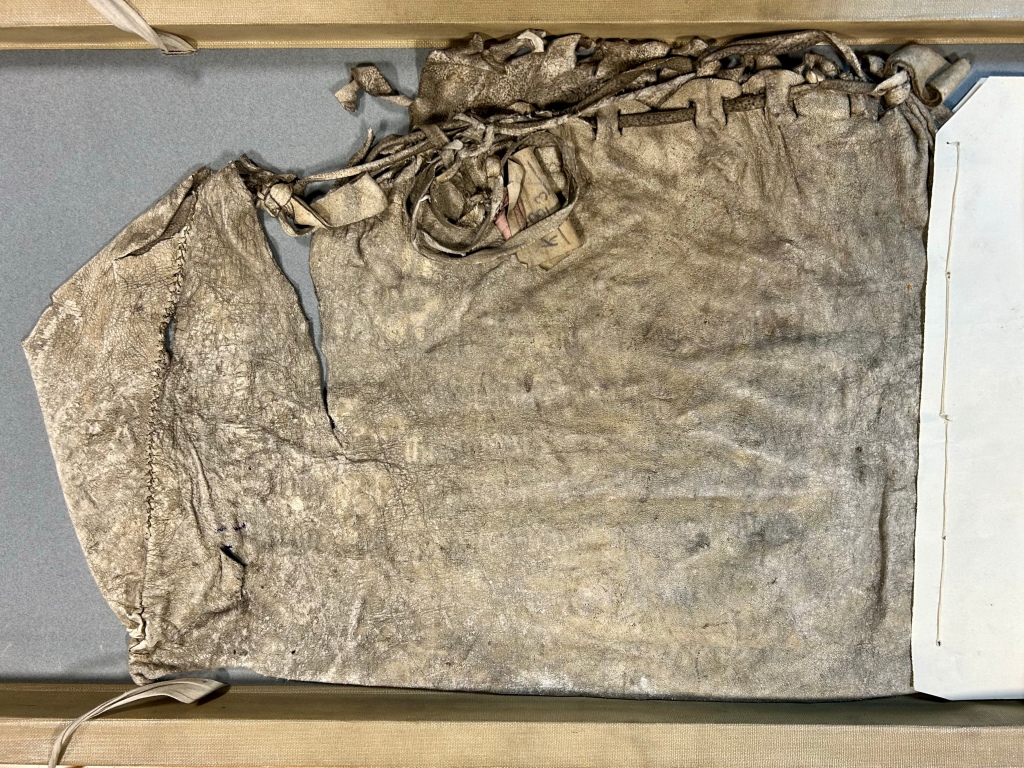
Today, I saw documents listing the names of George Boleyn, William Brereton, Francis Weston, Henry Norris, and Mark Smeaton – the men accused with the queen. Their names are clearly readable in beautiful script – but there’s something very unsettling about carefully controlled handwriting when it documents death sentences. I have never had such a strong visceral reaction when looking at documents before. These papers carry a weight of pain, grief, fear, death, and betrayal. I felt shaken just brushing my hand against them, and against the remains of the leather bags in which the documents were once carried.

A pale brown gathered pouch made of leather, ripped and decaying.
What remains of the leather bag that held the trial documents that condemned Anne Boleyn

These papers remind me of the stage play of Bring up the Bodies. Gregory asks his father whether the executed men are guilty. And he clarifies, “I didn’t mean, ‘Did the court find them guilty?’ Father. I meant, ‘Did they do it?’” Thomas replies: “Who knows?”

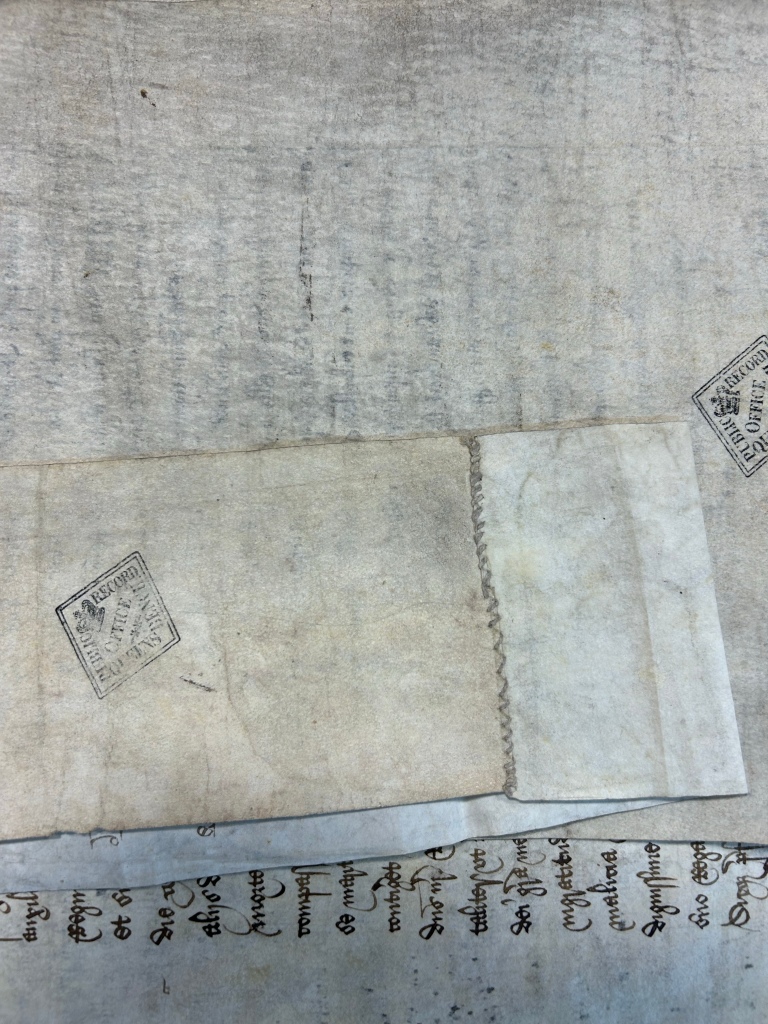
The trial papers include documents that were extended by the careful use of herringbone stitch. As Hilary Mantel wrote in The Mirror and the Light, “it’s useful to have the evidence stitched together”. But even today, this stitched together evidence is controversial, contested, unreliable, shifting. The stitches don’t strengthen the evidence, but they strengthen its documentation.

Parchments stitched together with herringbone stitch, pictured from the back
Herringbone stitch, stitching the evidence together

In the Weave in Worcester

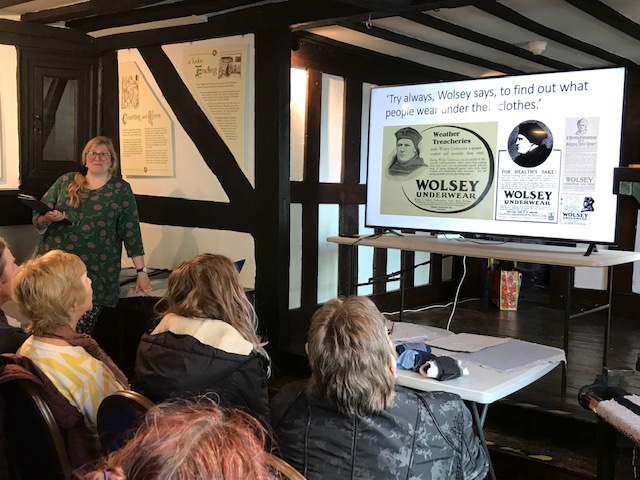
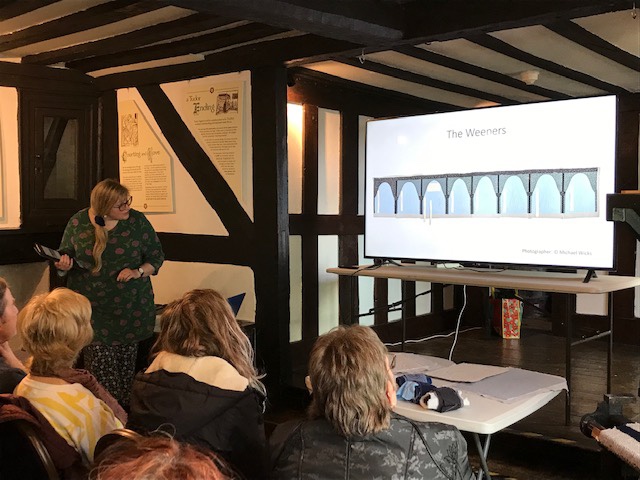
A woman in a green flowered top smiles at an audience looking at a screen featuring advertising images for Wolsey Underwear, and the Quixote “Try always, Wolsey says, to find out what people wear under their clothes.”
Talking Text, Textiles, Thomas Cromwell, and Thomas Wolsey

I recently spent a very enjoyable few days out of London, having been invited by Hilary Mantel scholar Dr Lucy Arnold and the Tudor House Museum in Worcester to take part in a public event at the Museum entitled “In the Weave”. We are both fascinated by the role that textiles play in Hilary Mantel’s Cromwell Trilogy, and we were delighted to share our enthusiasm with an engaged audience, many of whom left planning to read or re-read Wolf Hall. Lucy talked about the role of textiles and the textile trade in the Cromwell Trilogy, and how these appear in the text, while I shared my analysis of who stitches and what they stitch across the Trilogy, and talked about some my textile work.

A long piece of quilting, on cream, black and gold fabric, reading Wolf Hall, sits on a dark brown antique chest, in a half timbered interior. A vase of lavender rests on a window ledge above the chest
The first Wolf Hall quilt visits a 16th Century setting

I have written before about the complex relationship I have with the first Wolf Hall quilt, the circumstances in which it was made, and how I feel it doesn’t really work as a piece. However, taking it out for the first time in nearly a year, laying it out, folded loosely, and watching people handle it and photograph it made me start to question my relationship with it. Does it in fact work? And does it have potential for further development?

This time last year, I put aside the stitched chapter titles I made back in 2020 for Bring Up the Bodies and The Mirror and the Light. I didn’t want to use them then. But I’m now wondering if that 46 feet of Wolf Hall quilt might like to grow further? I had completely forgotten that I left the end unfinished, open to further work should I choose to add to it.

A woman bends to look round at a screen, showing a piece of textile art work described on screen as The Weepers.
The Weepers in Worcester – completed just a few days earlier

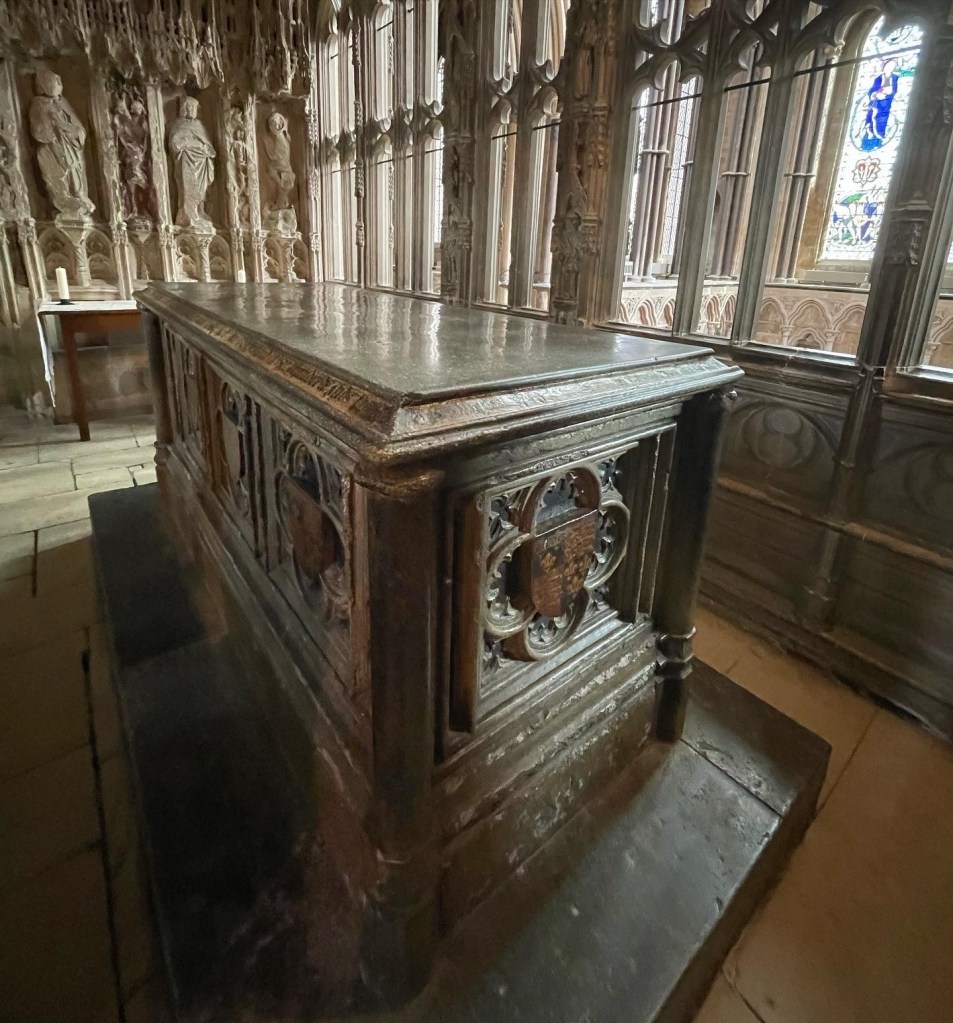
While in Worcester I took the opportunity to visit the Cathedral. There was something particular I wanted to see – the tomb of Prince Arthur and his Chantry Chapel. I was very fortunate to visit at a quiet time, so I had the Chantry to myself and thus an ideal opportunity to look closely at carvings and symbols. The Chantry was vandalised during the reign of Edward VI, and some visible scars from axes and swords can still be seen, scars I found unexpectedly upsetting.

A Sixteenth Century rectangular tomb surrounded by carved walls, sixth some figures carved into the walls.
Prince Arthur’s Chantry at Worcester Cathedral

I had assumed that the Chantry was Prince Arthur’s burial place and that it a mourning Henry VII and Elizabeth of York had been involved in its design and construction, but according to this wonderful piece by Lucy Arnold, it seems that we don’t actually know exactly how the Chantry was built, where Prince Arthur was/is buried, or how much the memorial cost. Interpreting material items left to us from centuries ago is often challenging, partial, and ambiguous.

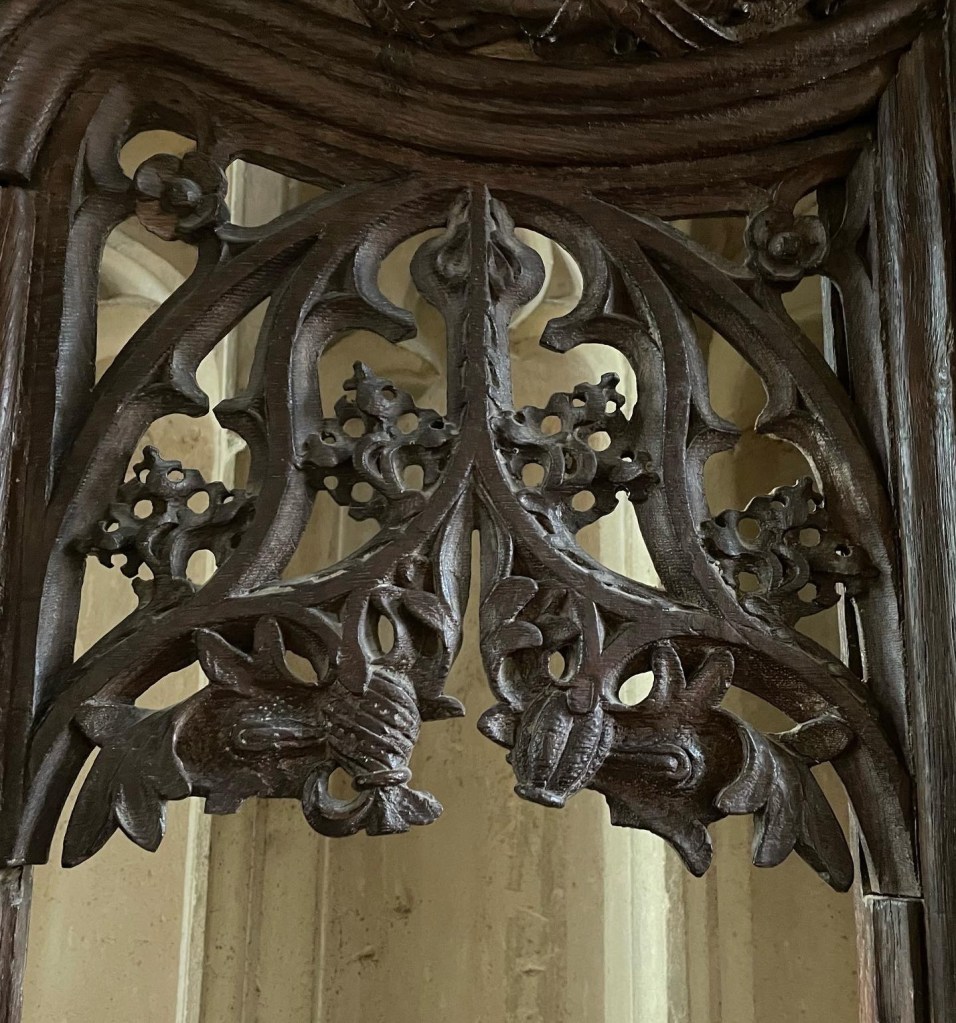
Pomegranates carved on the door to Prince Arthur’s Chantry
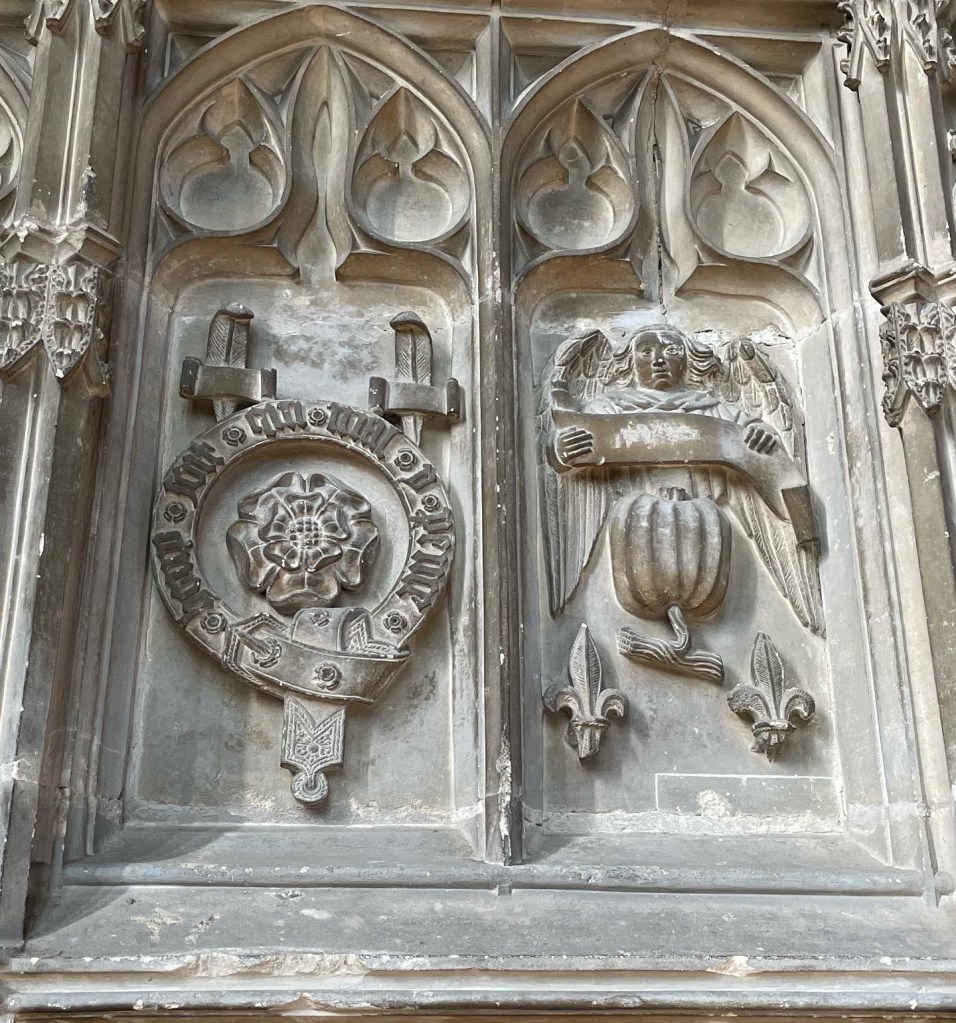
A Pomegranate symbol on the exterior Chantry wall

I was interested to see pomegranate symbols both inside and outside the Chantry – the symbol of Katherine of Aragon, Prince Arthur’s widow. These symbols are survivors of destruction – both during the reign of Henry VIII and Edward VI:

They search out and obliterate any trace of Katherine, the queen that was, smashing with hammers the pomegranates of Aragon, their splitting segments and their squashed and flying seeds.

Hilary Mantel, Bring Up the Bodies – Falcons

But far more unexpected than the surviving pomegranates, was Master Secretary Cromwell himself. Walking in the Cloisters, I looked in detail at the stained glass and, to my surprise, there was Thomas Cromwell, his hand over his mouth. What is he doing?

Stained glass windows featuring Henry VIII, Thomas Cromwell, Thomas Cranmer and Hugh Latimer

Perhaps Henry can tell us:

He is better than you at keeping his face straight. I see you, when we sit in council, with your hand before your mouth. Sometimes, you know, I want to laugh myself.

Henry VIII to Thomas Cromwell: Hilary Mantel, Wolf Hall – Anna Regina

The Weepers – Christophe Cremuel

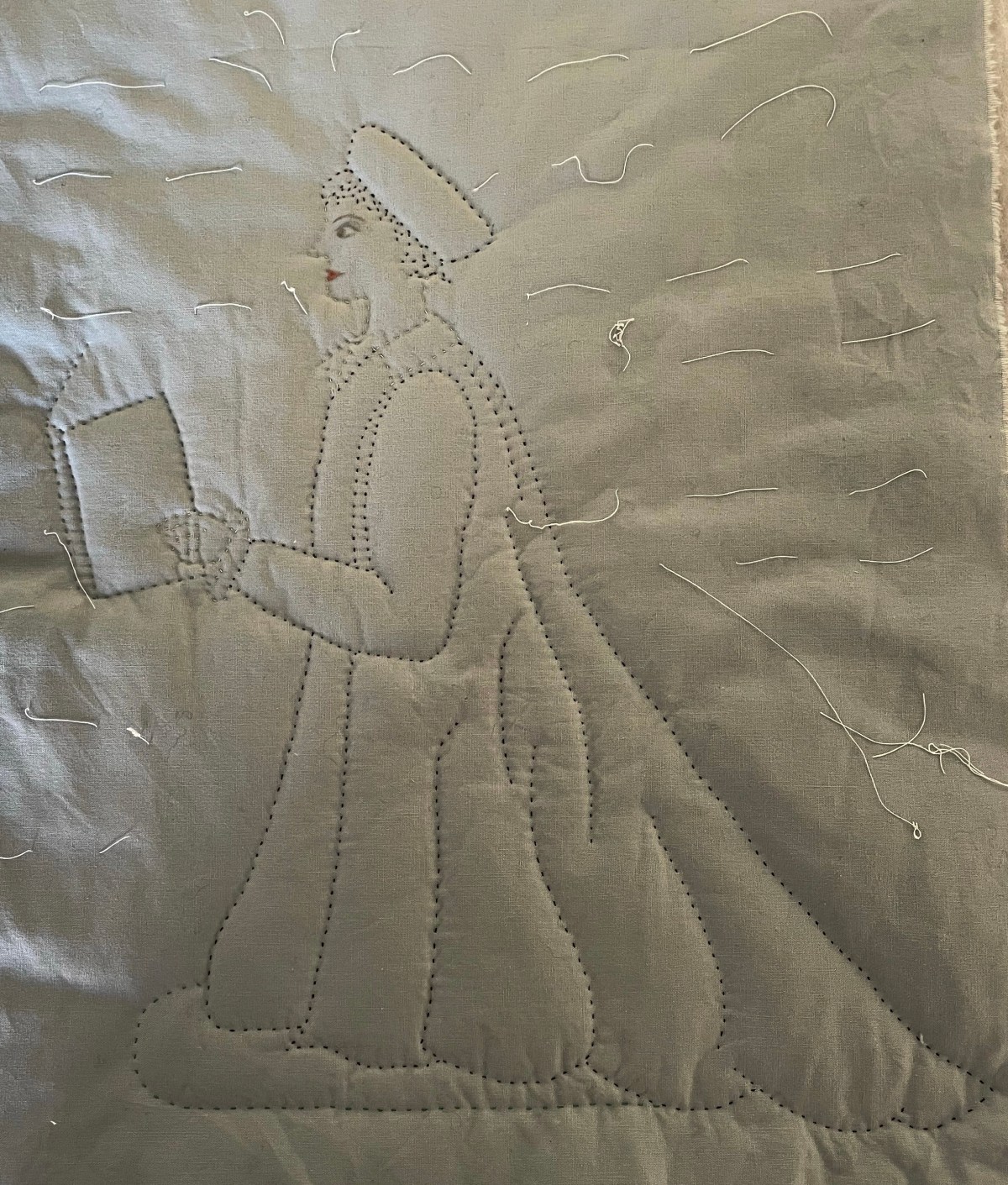
A young man stitched and quilted on grey fabric, wearing a cap and kneeling on a cushion.
Christophe Cremuel – “I thought to take service with you Monsieur.” Photographer © Michael Wicks

Christophe might just be my favourite character in Hilary Mantel’s Cromwell Trilogy – apart, of course, from He, Cromwell. The young ruffian meets Cromwell in Calais, and makes a life-changing decision: “I thought to take service with you, monsieur. I have made up my mind to go travelling.” (Wolf Hall, Anna Regina).

At his new home in London, Christophe soon becomes indispensable to Cromwell, “supposedly to look after his clothes, but really to make him laugh.” Cromwell sees in Christophe something of his younger self – his fighting, his troublemaking, his survival as a runaway, his irreverence. But slowly, slowly we see that Christophe loves Cromwell, and increasingly becomes the person who cares deeply for his wellbeing.

Christophe’s Cornflower on The Wolf Hall Quilt

At the end of Wolf Hall, Cromwell goes to his office and finds that “someone – probably not Christophe – has put on his desk a shining silver pot of cornflowers.” (Wolf Hall, To Wolf Hall) I have always believed that the person who left the cornflowers was in fact Christophe, and I included a cornflower in my first Wolf Hall quilt, as a tribute.

He is capable of doing violent, dirty work on Cromwell’s behalf. But Christophe is present at one of the defining moments of Cromwell’s story – his visit to Dorothea at the convent at Shaftesbury in 1536. And he knows something has changed, that a crisis has occurred. And he now wishes to ease Cromwell’s grief, with moments of care and concern:
Sir, do not weep any more. You said you would not.

Are you sitting up writing your king book tonight?

I think my master ought to have a holiday.

Christophe caring for Cromwell in The Mirror and The Light

On the last night of his life, Cromwell teachers Christophe the Three Card Trick, so that if he is ever without food or money he can earn his living through sleight of hand. Loyal to the very end, Christophe tries to give Cromwell his mother’s holy medal to carry to his death. In the name of Christophe Cremeul he curses the king who has destroyed his beloved master. He breaks my heart.

Christophe is one of the few fictional characters in the Trilogy. Hilary Mantel made him so vital and vibrant that he lives off the page. Just before the Museum of London closed prior to its relocation, I visited and was pleased to see a woollen hat, which could have belonged to him. In fact, some part of me is convinced that it did. So when I came to sew him, I stitched it on to his head.

A brown knitted woollen cap dating from the 1500s, as part of a museum display.

The Weepers – Jenneke

A quilted figure of a woman holding a book. She has long skirts and cloak on, and she is kneeling on a cushion pad.

Warning:

This post contains spoilers relating to Jenneke’s identity, as revealed in The Mirror and the Light.

A quilted figure of a woman holding a book. She has long skirts and cloak on, and she is kneeling on a cushion pad.
The Weepers – Jenneke: ‘I have come from over the sea.’

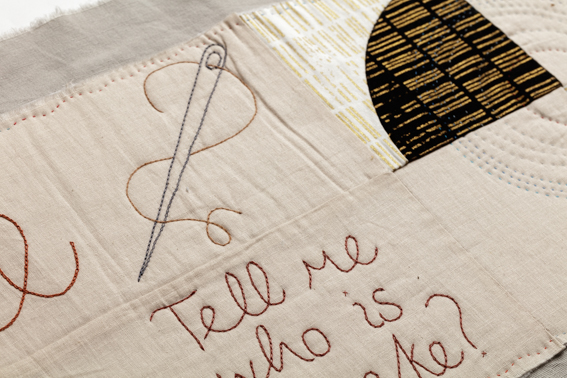
In Hilary Mantel’s Wolf Hall, Thomas Cromwell welcomes home his protégé Thomas Avery, who has travelled from Antwerp carrying a woollen jerkin. The jerkin conceals a letter from Bible translator and religious scholar William Tyndale who is in hiding in Europe. Tyndale’s letter is hidden in the lining – stitched in behind a seam. Cromwell slits the seam with scissors, and asks ‘Neat stitching… Who did this?’ Avery answers ‘Jenneke’. The unknown Jenneke is clearly a proficient stitcher (Wolf Hall – Arrange Your Face).

When I first read Wolf Hall back in 2009, I noted Cromwell’s interest in this neat stitching, and also noted his implied knowledge of the skill involved in creating a neat seam, strong enough to hide smuggled paperwork. The exchange with Thomas Avery still fascinates me – Cromwell looking at the sewing, admiring it, and still destroying the work to get to the information he wants. And, at the same time, appreciating that the unknown stitcher had taken the trouble to produce good work, in the full knowledge that it would soon be ripped out.

From my first reading, I fell in love with the idea that Cromwell knows that neat stitching isn’t just something that happens. He recognises that there is a person (usually a woman) behind it, and that neat stitching has to be a deliberate act on the part of the person who plies the needle. He knows this because he recognises the vital importance of the cloth trade to England’s economy and he values the people who work within it.

The first Wolf Hall quilt: ‘Tell me who is Jenneke?’ Photography: © Michael Wicks

Jenneke remains an unknown and unseen stitcher until some years later, in The Mirror and the Light , a young woman appears at Cromwell’s door. She looks familiar, so he invites her inside, offers her wine and an apple, and conversation. She has come ‘from over the sea’, from Antwerp. And when he asks her who her father is, her reply is direct:

‘You are.’

Hilary Mantel, The Mirror and the Light – The Bleach Fields

Jenneke has come to England to see her father. She knows he is an important figure, a rich man, but that he is now in some danger politically. But until her revelation, Cromwell has no idea of her existence – although when he looks back on certain conversations, with certain individuals, he realises that some of his friends and acquaintances knew of her, and kept her a secret. ‘How could I have a daughter and not know it?’ he asks her.

She unsettles him. She asks him questions – about women, about his dead daughters, about his work, about his religion. She is blunt, and employs no artifice. He tries to take control of the situation; asks her to stay in England; says he will arrange a marriage for her; he will arrange a house for her. But Jenneke is independent. She has not come to stay. She has come to meet her father briefly, to tell him of her life, of how she has lived and what she has seen. And in an echo of the letter she once stitched into a seam, to tell him of the death of Tyndale. She then returns over the sea to Antwerp. And although Cromwell writes to her, he receives no reply.

Her visit marks her place in the book of his life – a book which falls back into loose leaves. Printers can read as if through a mirror. It is their trade. Their fingers are nimble and their eyes keen. But examine any book and you will see that some characters are upside down, some transposed.

Hilary Mantel, The Mirror and the Light – Corpus Christi

Jenneke is a fictional character, but as Hilary Mantel notes in the afterword to The Mirror and the Light, Cromwell might indeed have had an illegitimate daughter, who was possibly called Jane. Who Jane Cromwell’s mother was is unknown. According to Tracy Borman, Jane ‘appears in the archives of the county of Chester…. [but] here is little other than the girl’s surname to suggest that she might have been his daughter.’ (Tracy Borman: Thomas Cromwell: The Untold Story of Henry VIII’s Most Faithful Servant: ‘Not without sorrow’, 2014). And a cautious Diarmaid MacCulloch notes that ‘her chronological place in his story is a matter of back-projecting much later facts with the aid of a fairly generous dose of supposition’ (Diarmaid MacCulloch, Thomas Cromwell: A Life – ‘Managing Failure 1528-1529’, 2018).

From such tiny fragments and her magnificent imagination, Hilary Mantel created a memorable fictional character to be Cromwell’s unknown daughter. And in his admiration of her neat stitches, Mantel’s Cromwell demonstrated his interest in and knowledge of textiles, an interest that sparked neat stitches of my own.

The Weepers – Helen Barre

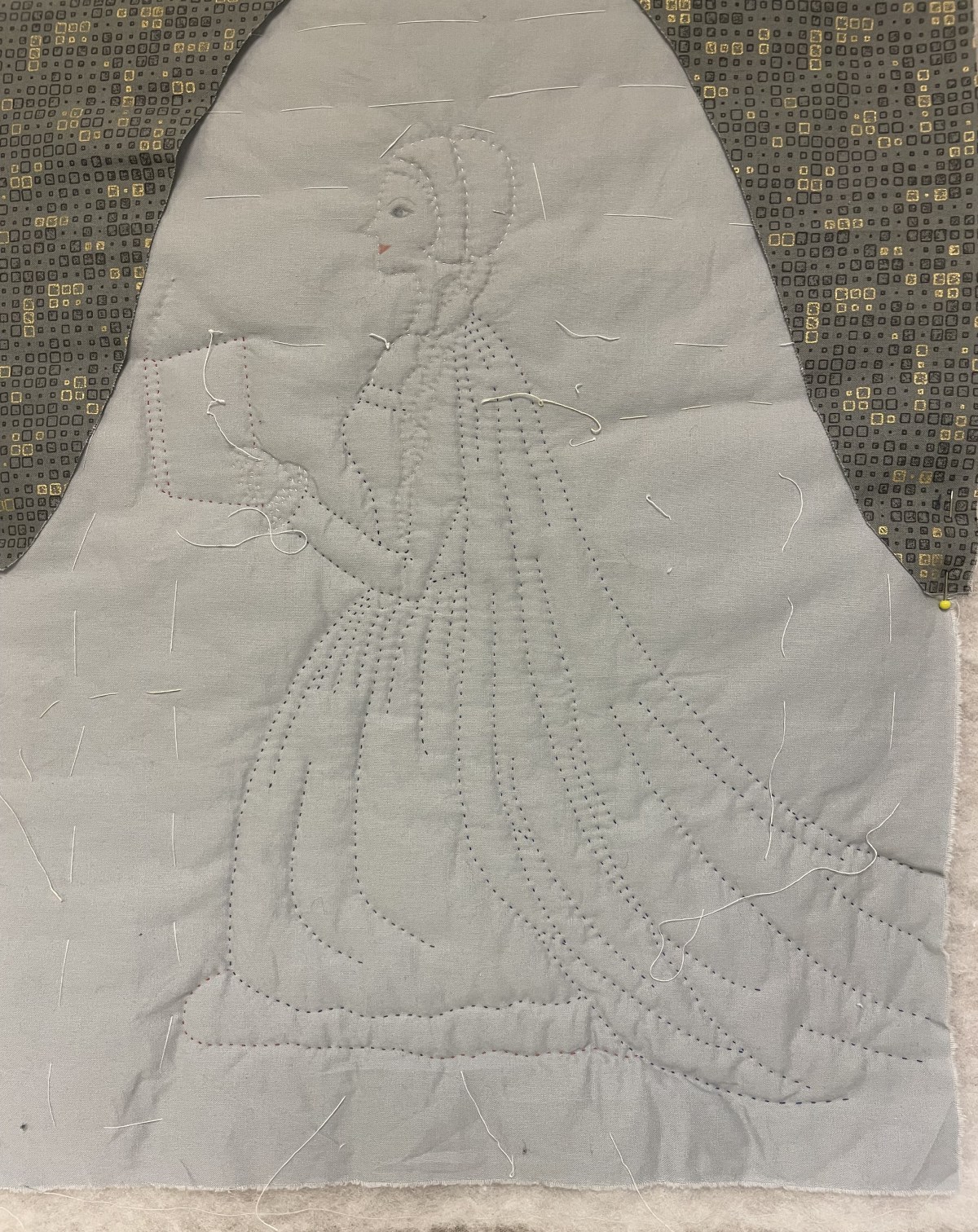
A hand quilted figure of a kneeling woman, wearing a cloak, long skirts, and holding a book.
The Weepers – Helen Barre

When I gave my paper about stitching in the Cromwell Trilogy at the Huntington Library in October 2021, I called it She is embroidering her thoughts with Helen Barre’s Needle. Why Helen’s needle? Why not Liz’s? Or Jenneke’s? Because Helen’s needle was, for me, central to understanding the significance of stitchery in Hilary Mantel’s Cromwell Trilogy.

Helen is a beautiful young woman with two children who comes to Thomas Cromwell for help in 1533 after being abandoned by her husband. She becomes part of his household, and, within a few months, marries Rafe Sadler in secret. She is a stitcher of some talent, and can turn her hand to markedly different types of needlework.

In Mantel’s words, Helen ‘unwinds the thread of her tale’ to Cromwell, and is therefore inextricably linked – to a reader interested in textiles – to needlework tools and techniques. When he first meets her, she explains that, when her husband first left her in about 1530, she was ‘stitching for a sailmaker’ somewhere in Essex. Cromwell notes that Helen’s hands are ‘skinned and swollen from rough work’ (Wolf Hall, Anna Regina). The state of Helen’s hands is not surprising: while I am not an expert in antique sailmaking tools, I can confirm that, from a 21st century stitcher’s perspective, sailmaking continues to be rough work. Sailmakers’ needles are terrifying things: long, thick, and lethal. You would not want to get on the wrong side of one.

A green notebook with a packet of sail makers' needles resting on it. The needles are out of the packet and can be seen to be large and thick,
Sail Makers’ Needles

And then there is the question of how to get such a needle through through heavy sail canvas. A finger thimble would be useless; you need a Sailmaker’s Palm – a leather strap that goes around your hand with a metal pad that fits in your palm. That way, you can employ all your strength to push your needle through the canvas. I have a Sailmaker’s Palm in my sewing basket, but it is far too big for my hand. I suspect such tools are designed for larger and stronger hands than mine, and indeed Helen’s. No wonder her hands are battered.

A hand inside a large leather strap which has a hard surface resting against the palm.
Too big for my hand…

But once her hands are healed, Helen is destined for finer fabrics. When he first sees her, Cromwell ‘mentally… takes her out of cheap shrunken wool and re-dresses her in some figured velvet he saw yesterday, six shillings the yard.’ Some years later, when Helen prepares a room for a visit of the Princess Mary, Cromwell watches her pleasure at the opportunity ‘to handle the fine stuff and have a brigade of cushions at her command’ (The Mirror and the Light, Salvage).

And as Helen learns to ‘handle the fine stuff’, the nature of her stitching changes. As Rafe’s wife, a sailmaker’s needle is now no tool for her gentlewoman’s hands. By 1536, she is working on fine embroidery; her thread is now fine silk rather than coarse twine or rope, her needle is thinner, shorter, and sharper. She sews for Dorothea Wolsey ‘a kerchief of fine linen […] worked with the three apples of St Dorothea, and with wreaths, sprigs and blossoms, the lily and the rose’, in ‘loving stitches… to give pleasure to a stranger’. (The Mirror and the Light, The Five Wounds).

In Mantel’s telling, Helen’s needlework tools change with her marital status. But, as she asks Cromwell on first meeting him, ‘which am I – wife or widow?’ (Wolf Hall, Anna Regina). The real Helen – or Ellen – Barre was indeed abandoned by her first husband before appealing to Cromwell for help, and going on to marry Rafe Sadler when her husband was presumed dead. But after Cromwell’s death (and therefore outside the timing of Mantel’s trilogy, and my stitching), Helen and Rafe received bad news:

In 1545, after fifteen years of marriage and with seven children by Sadler (three sons, the eldest of whom was named Thomas in honour of the master, and four daughters), Ellen discovered to her horror that her estranged first husband was still alive. She was therefore guilty of bigamy. A drunken Barre had been over heard by one of Thomas Wriothesley’s servants boasting that he was Lady Sadler’s husband.

Tracey Borman, Thomas Cromwell: The Untold Story of Henry VIII’s Most Faithful Servant, ‘The suddaine rising of some men’ (London: Hodder and Stoughton, 2014)

Ralph Sadler was able to petition Parliament to have his children legitimised, and, in a private Act of Parliament, had his marriage to Helen confirmed. The thread of Helen’s and Rafe’s tale thus outlasted Cromwell himself. But for my purposes, and for my Weepers series, Helen is depicted as the young woman with whom Rafe Sadler fell in love, and who was a talented needleworker, adapting her skills to her circumstances, and plying her needle with loving stitches.

The Weepers – Rafe Sadler

A quilted figure of a young man kneeling and wearing a Tudor-style coat and hat, and holding a book
Rafe Sadler: work in progress

In Hilary Mantel’s Cromwell trilogy, Rafe Sadler is a key support to Thomas Cromwell: his chief clerk, his confidante, his protégé, his ideal son. Rafe has been with Cromwell since childhood (‘Heaven direct me, boy or hedgehog?’), brought up at Fenchurch Street and Austin Friars, one of the very few people for whose good opinion Cromwell cares.

Rafe sometimes acts as Cromwell’s conscience, sometimes as his advisor, sometimes as his ally. He is not afraid to challenge Cromwell, and to warn him when he thinks he is taking unnecessary risks. Most of all, ‘ he is a tribute to the man who brought him up: dogged, sardonic, quick on the uptake’. (Wolf Hall, An Occult History of Britain).

When Cromwell’s wife Elizabeth is dying, it is Rafe who tries to find him. In the month after her death, it is Rafe who is there for him. The pair play chess together until they reach stalemate. During Anne Cromwell’s short life, she hopes that she will be able to marry Rafe when she is older. This idea gives Cromwell comfort, albeit briefly:

For a minute, for two minutes together, he feels his life might mend.

Wolf Hall, An Occult History of Britain

But Anne does not live long enough to fulfil her hope. And Rafe later does the one thing that disappoints Cromwell. As they travel home together by river in Master Secretary’s river barge, Rafe confesses a secret:

‘I have been married half half a year,’ Rafe says, and no one knows, but you know now. I have married Helen Barre.’

Wolf Hall, Supremacy

Cromwell is initially aghast, wondering how this relationship could have developed under his roof (and he recalls a specific occasion when he could perhaps have guessed). He says that, in marrying the beautiful but penniless Helen, Rafe will be ‘held up as a prime example of how to waste your connections’. But Rafe replies that he is ‘violently in love’ with Helen, and Cromwell is quickly reconciled to their marriage. After all, he reflects, he has not brought Rafe up without feeling, and he is witness to the happiness that Helen and Rafe share.

When Cromwell fell from power, Rafe Sadler remained loyal to him. Mantel gives us scenes of Rafe visiting Cromwell, imprisoned in the Tower of London, and taking his final letter begging for mercy to the King. And her imagining of the last meeting of Rafe and Cromwell is heartbreaking. The stage play of The Mirror and the Light ends with Rafe weeping at Cromwell’s death, until he is pressured by Cromwell’s enemies to shout ‘Long live the King!’

Years before, when he first brought the child Rafe home to Fenchurch Street in the pouring rain, Cromwell cheered him by declaring that ‘We drowned men will stick together’. And Rafe sticks to Cromwell, the man who brought him up, the man he loves, until the very end.

A digression, and an unexpected link…

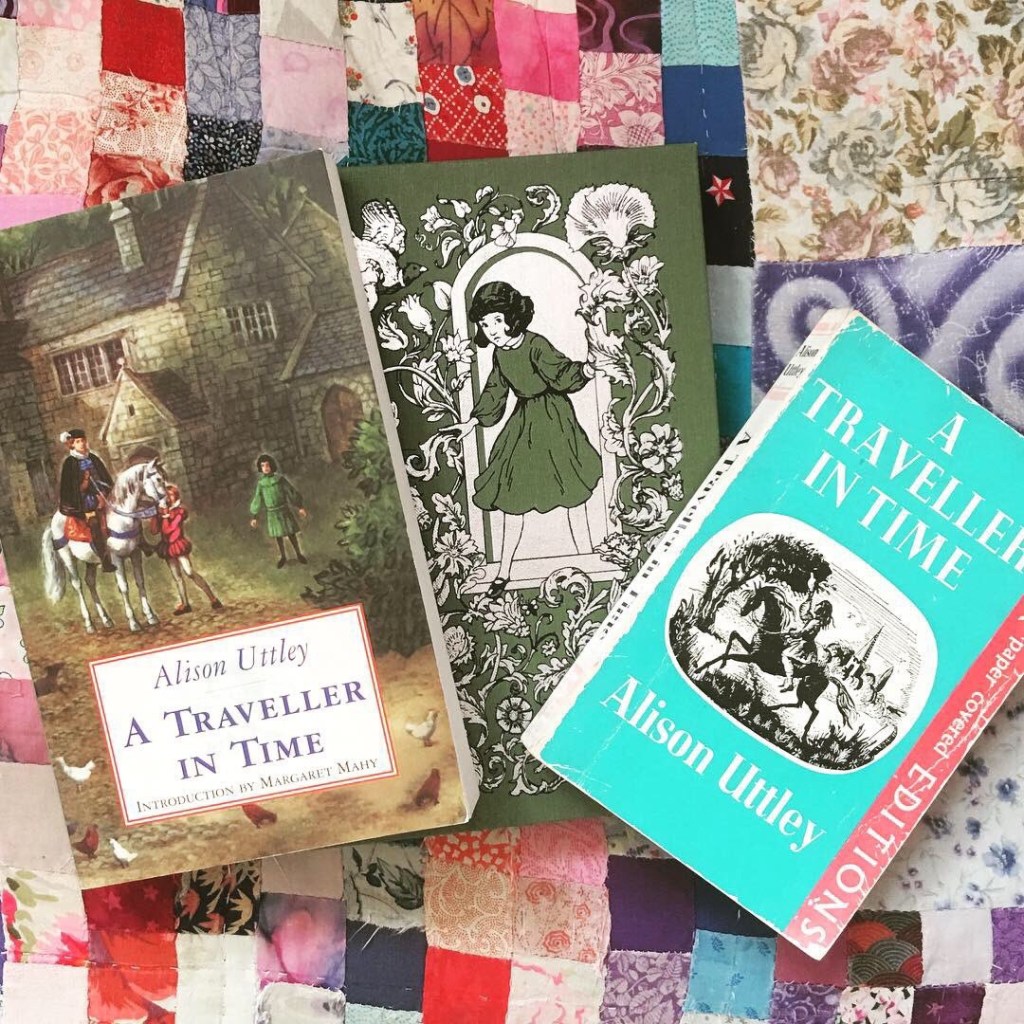
Three copies of A Traveller in Time by Alison Uttley resting on a patchwork cushion.

When I was eight years old, I read Alison Uttley’s A Traveller in Time, a story of Mary Queen of Scots and the Babington Plot. I loved that book and read it over and over. It includes wonderful textile descriptions including some magnificent patchwork quilts, and I always dreamt of making a quilt just like those Uttley describes. But until this week, I hadn’t noticed that A Traveller in Time contains four references to one ‘Sir Ralph Sadleir’, the custodian of the imprisoned Queen at Wingfield Manor, Derbyshire, in 1584-85.

This is, of course, Cromwell’s Rafe in later life. During his long career, he was briefly in charge of the imprisonment of Mary Queen of Scots. A Traveller in Time awakened my early interest in history and planted the seeds of all sorts of study choices when I was older. Decades later, I am delighted to find a link between my favourite childhood book, and the magnificent trilogy that has played such a central role in my life since Wolf Hall was first published in 2009.

The Weepers – Gregory Cromwell

A delicate looking youth, kneeling and holding a book, is stitched on to light grey fabric
Sweet Gregory

Thomas Cromwell’s son Gregory is a delightful character in Hilary Mantel’s Cromwell Trilogy. He is one of my favourite people in the books: I am like the servants at Austin Friars, who ‘cluster round Gregory, admiring him from hat to boots; all servants love him for his pleasant ways.’ (Bring Up the Bodies, Crows).

His pleasure in reading tales of King Arthur; in believing tall stories to give pleasure to the tellers; his uninformative letters (‘And now no more for lack of time’); his kindness to and concern for poor Anna of Cleves – Gregory’s innocent good nature runs through the Trilogy. I see him as a delicate youth, finely dressed in black velvet.

Accordingly to Professor Diarmaid MacCulloch’s excellent biography of Thomas Cromwell, the real Gregory was younger than has long been assumed thanks to the long-ago misdating of some of his and Cromwell’s letters. MacCulloch argues that Gregory was born in either 1519 or 1520, ‘not 1516 as many commentators have asserted since the early nineteenth century. Much patronising nonsense has been written about Gregory based on that persistent miscalculation of his age. He has frequently been denigrated for not having the educational attainments of a teenager at a time when he was in fact ten years old or less.’ (Diarmaid MacCulloch, Thomas Cromwell: A Life, 2018)

When writing her Cromwell trilogy, Hilary Mantel had a suspicion that this might be the case, but didn’t have the archival evidence to challenge these long-held views. During a discussion between Mantel and MacCulloch in the summer of 2019, held at Launde Abbey where Gregory Cromwell lived in the 1540s, Mantel remembered:

So what I did was I very surreptitiously started reducing his age. But I didn’t quite have the courage of my convictions – I didn’t reduce it enough. If I had had the good fortune that Diarmaid had written before my novels, that would have been a big change, because I would then have had chapter and verse for my strong feeling that we were getting Gregory all wrong.

Church Times, ‘Make something of me’: creating Thomas Cromwell, 2 August 2019. This discussion can also be heard on the Church Times podcast.

In the trilogy, one of Cromwell’s major preoccupations is to protect Gregory from the realpolitik of the Court of Henry VIII. Prior to the fall of Anne Boleyn, he sends Gregory to stay with a friend out of London, because ‘if he is to place all in hazard, and he thinks he is, then Gregory should not have to go through the pain and doubt, hour by hour. Let him hear the conclusion of events; he does not need to live through them.’ (Bring up the Bodies, The Black Book). Gregory’s tougher cousin Richard, or Cromwell’s chief clerk Rafe Sadler are always with his father, always taking action and supporting Cromwell’s actions and negotiations – while Gregory is shielded from the harsher aspects of life.

But in seeking to protect Gregory, Cromwell also fails to understand him. In Wolf Hall we learn that ‘little about Gregory is clear to him. “What is it,” he asks him, “what’s wrong?” The boy won’t say. With other people,he is sunny and lively, but with his father guarded and polite, as if to keep a formal distance between them.’ (Wolf Hall, An Occult History of Britain). Gregory wants to be recognised as Cromwell’s son, he wants to be useful to him like Richard or Rafe. And eventually, Cromwell’s underestimation is a source of tension and bitterness. As Gregory tells his father, ‘You do everything. You have everything. You are everything. So I beg you, grant me an inch of your broad earth, Father.’ (The Mirror and the Light, The Image of the King)

When I started working on my Weepers, I asked myself who would weep for Cromwell. Would Gregory? At his arrest, Cromwell imagines Gregory ‘inconsolable, crying like a child’, but is told that Gregory is simply ‘pensive’ (The Mirror and the Light, Mirror).

Protective of him to the end, Cromwell decides ‘it is time for Gregory to write a letter repudiating me. He should speak ill of me. Say he does not know how he comes to be related to such a traitor.’ (The Mirror and the Light, Mirror). Gregory’s wife writes the letter for him. Poor Gregory. His whole world has been rocked, the protection he has always known, the stability of Austin Friars, has gone. And so, at the age of just 20, he is one of my weepers.

The Weepers – Anne and Grace Cromwell

CW: This post contains references to the deaths of children.

Thomas Cromwell’s daughters, Anne and Grace, are included in the Weepers series; and I felt that, as children, they should share a panel rather than be placed alone.

We know that Anne and Grace were once alive; they are both mentioned in the will Cromwell’s made in 1529. But Cromwell had to cross out the references to ‘my littill Doughters Anne and Grace’. They both died, young, later that same year. He had planned to leave them both money, to be passed to them when they reached ‘lawfull age or be maryed’. Poignantly, his will anticipated their deaths – the sweating sickness, the recent death of his wife Elizabeth, and high rates of child mortality being perhaps on Cromwell’s mind. The will therefore makes provision for the bequests to be passed on to his son Gregory, should his daughters be already dead at the time of his death.*

Hilary Mantel fictionalised Anne and Grace in the Cromwell Trilogy, and in so doing, she left a moving picture of Cromwell as father. In Mantel’s version, Anne is ‘a tough little girl […] she is no respecter of persons and her eyes, small and steady as her father’s, fall coldly on those who cross her.’ (Wolf Hall: An Occult History of Britain).

We learn that Anne has no interest in stitching, and that when she ‘applies to her needle, beads of blood decorate her work’. (The Mirror and the Light: The Bleach Fields). Anne is more interested in learning Greek, studying Latin, working with numbers. After her death, Cromwell would like her to be buried with the copybook in which she has written her name – Anne Cromwell, Anne Cromwell – over and over, but ‘the priest has never heard of such a thing. [Cromwell] is too tired and angry to fight.’ (Wolf Hall: An Occult History of Britain).

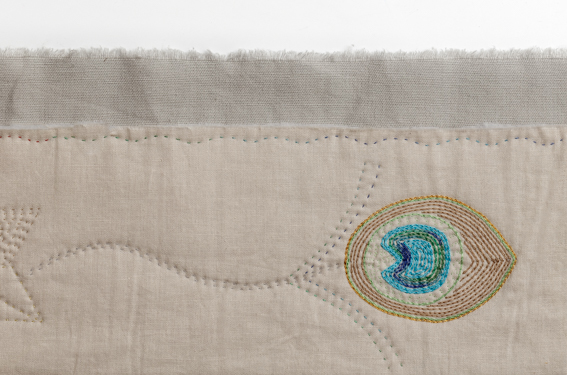
Grace’s wings made of peacock feathers

Because we are seeing events through Cromwell’s eyes, we know less about little Grace. When she dies, he thinks ‘I never knew her. I never knew I had her.’ (Wolf Hall: An Occult History of Britain).

Grace is a beautiful child, leading Cromwell to wonder whether she is actually his – after immersing himself in the flirtations and accusations of adultery at Court, he speculates that Lizzie, now dead, might have been with another man. Lizzie’s sister says no – Grace was his child. ‘But he cannot escape the feeling that Grace has slipped further from him. She was dead before she could be painted or drawn.’ (Bring Up the Bodies: Spoils).

But during her short life, he makes wings out of peacock feathers for Grace to wear during the parish Christmas play, and she loves them. She doesn’t want to take them off, and he watches her, standing glittering in the firelight. And Cromwell keeps the wings for ten years after she has died, until they become ‘shabby, as if nibbled, and the glowing eyes dulled.’ (Bring Up the Bodies: Spoils).

An embroidered and quilted peacock feather on cream fabric
Peacock feather on the first Wolf Hall Quilt.
Photography: ©Michael Wicks

And when Cromwell reads his dead wife’s prayer book, it is the dead Grace’s hand he can see, reaching out to touch it. In life, she liked to look at the pictures; in death she does the same. As he turns a page, ‘Grace, silent and small, turns the page with him’. (Wolf Hall: Make or Mar).

A quilted hand reaching for blue letters that read Matins, Lauds, Prime, Sext, None, Vespers, representing the canonical hours,
Anne’s hand reaches for her mother’s book of hours

I realise now that I included references to Grace twice in the first Wolf Hall quilt – her peacock feather and her hand reaching for her mother’s prayer book – but there is no representation of Anne. Anne has the stronger personality on the page, we hear the noise of her feet, admire her determination, watch her assertive intelligence. Her family wonder ‘what London will be like when our Anne becomes Lord Mayor’. (Wolf Hall: An Occult History of Britain.

Anne’s omission from the first quilt now feels like a mistake. I can only explain it as a response to the grief in the text: listening to parts of An Occult History of Britain and Make or Mar while making the quilt was so painful that I had to move on from them. I expect I intended to return to them and add Anne at a later point. And now perhaps Anne’s absence from the quilt now represents her absence from Cromwell’s life.

Anne is now presented as a weeper, wearing the cap with seed pearls that she liked to take off. Grace has not been painted or drawn, but she has been now stitched. Wearing her peacock feather wings.

* Cromwell’s will, including notes of the deletions, can be read in Life and Letters of Thomas Cromwell by Roger Bigelow Merriman, in two volumes, first published in 1902.