
Photographer: © Michael Wicks
When I was working on the first Cromwell Trilogy Quilt back in 2020-2021, we were in lockdown in England, and all my research was home based. Museums were closed and I relied on online catalogues and images for both reference and inspiration.
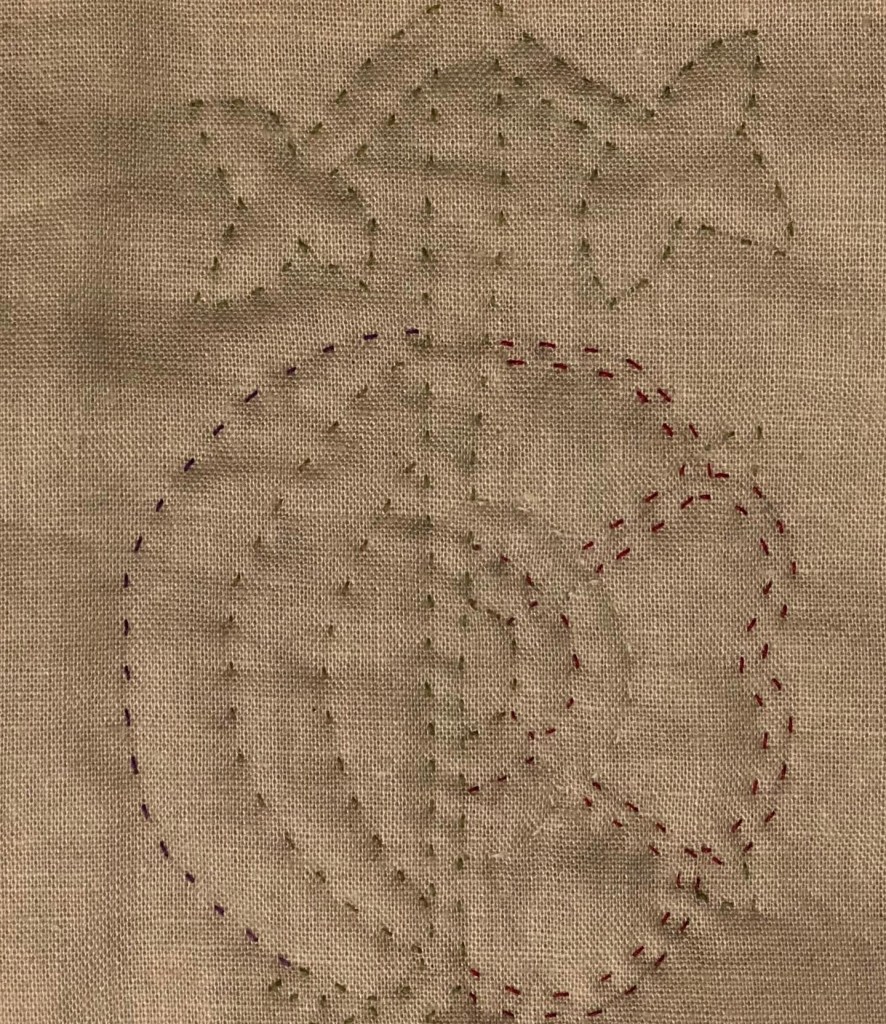
One of the first motifs I stitched into the quilt – in the Paternity section – was a symbol representing Katherine of Aragon, based on a livery badge held in the collection of the Museum of London. The badge represents a pomegranate (Katherine’s emblem) combined with the Tudor Rose.

At this stage in the project, I was still working out my approach, and I used this badge to start thinking about the way in which the emblems of Henry VIII’s queens needed replacing, a theme that Hilary Mantel returned to throughout the Cromwell trilogy, and which I have returned to repeatedly in my stitching.
Yesterday I had the opportunity to go into the Museum of London for the first time since lockdown (and the last time I will do so until the Museum reopens in its exciting new home in due course). In the Medieval Gallery, I found that the actual livery badge was on display – so I saw the real, tiny thing for the first time. And in its display case, it is presented the other way up to my interpretation, and indeed in the catalogue photograph.

So is it the “wrong” way up in my quilt? As an image, the leaves appear more natural sitting at the bottom like a flower; but as an object, could there be the remains of a clip, a pin, a fastener to indicate it was worn with the leaves at the top? Would I have approached it differently had I seen the object first, or not even looked at the online catalogue at all?
It’s one of those unanswerable questions that result from the first Cromwell Trilogy Quilt being made in a situation of restriction, with no access to actual objects. And access is still restricted for me personally: I am currently living with the after effects of Covid-19 – fatigue meant that I spent most of my visit sitting down whenever and wherever I could and reserving my energy for looking at this one object.
Whether the livery badge should have been worn this way or that, Wolf Hall describes the way in which Katherine and her supporters found themselves the “wrong” way up once their stability was upended by the rise of Anne Boleyn. So there is an additional layer of meaning in its representation in my quilt – however unintended it might have been when I picked up my needle.
 Stitching Thomas Cromwell
Loving your watch your work unfold as I “read/listen” to Wolf Hall (as well as reviewing past images). Such focus and resolve. Amazing.
LikeLike
Thank you Ruth. I am glad you are enjoying it – while you are reading/listening too! I’m always listening to one of the books while I work on this project.
LikeLike
This reminds me very much of one of the pieces Mary described at the beginning o Nefertiti Lived Here, which I knew I wanted to depict,, but of course there was no accession number in the text, no hint of where the piece might have ended up…!
We get so many extra things to think about and so many extra layers of storytelling with this sort of inspiration, don’t we!
LikeLiked by 1 person
Gosh, I love that – you have given this little motif so much extra meaning than if you had seen it first before stitching.
LikeLike
Not specifically relevant, but I hope you saw these incredible survivals of Tudor work that emerged on Antiques Roadshow last week…… https://www.bbc.co.uk/iplayer/episode/m001drlv/antiques-roadshow-series-45-6-wollaton-hall-2
LikeLiked by 1 person
Thank you Mark – I haven’t yet seen this programme so it was very kind of you to send the link!
LikeLike
I’ll have to wait for the release of this episode to Canada. Sadly i don’t have access to BBC in Canada.
LikeLike