
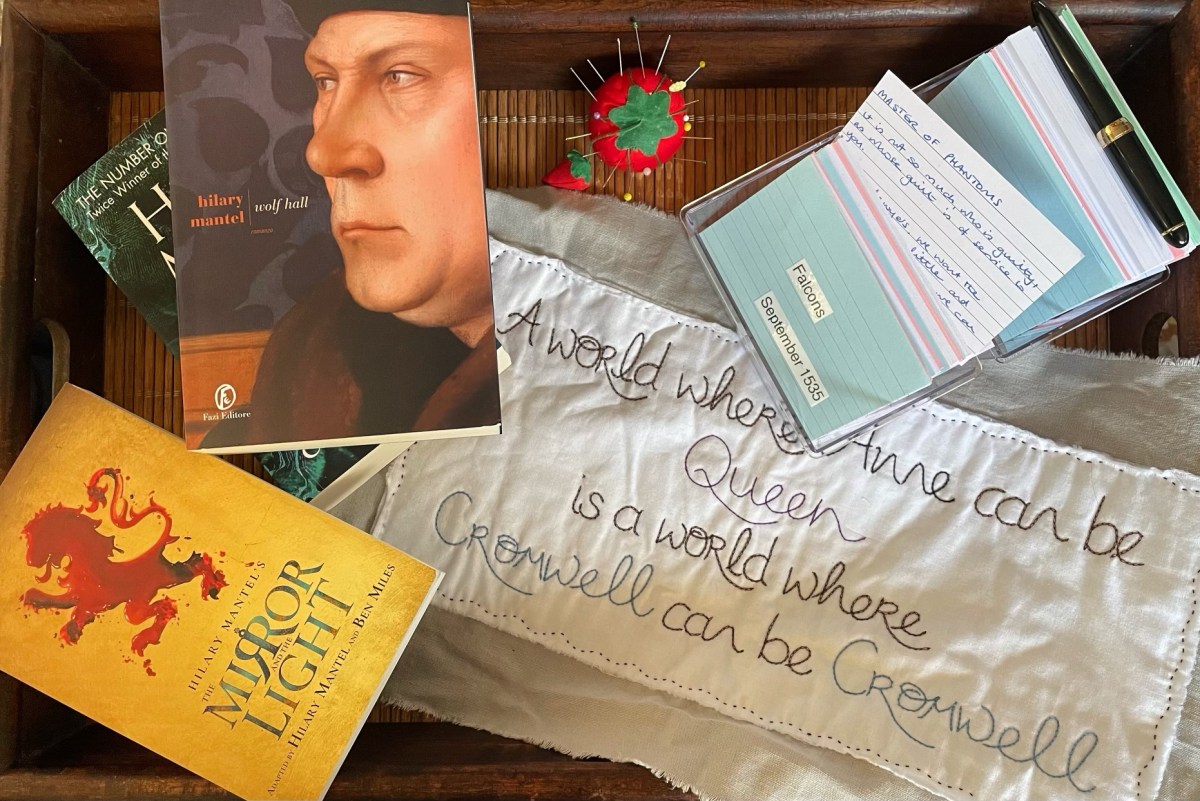
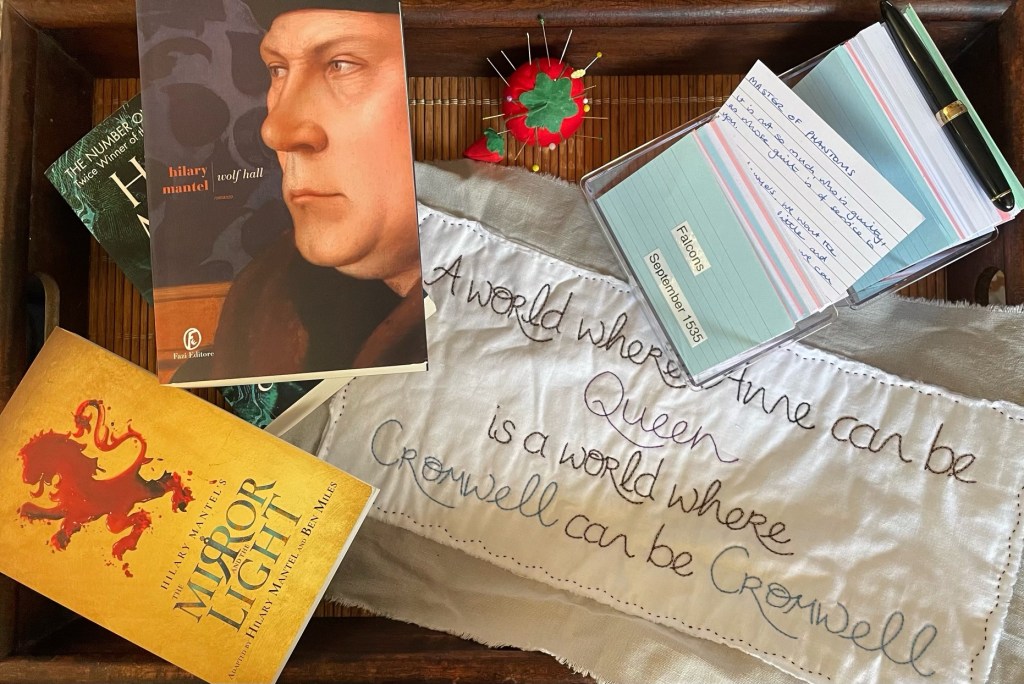
In the summer of 2020, when I started embroidering the chapter titles from Hilary Mantel’s Wolf Hall, Bring Up the Bodies, and The Mirror and the Light, there was a distinct absence of planning. Yes, I made sure there was some regularity about the lettering I stitched, but I didn’t have any sort of scheme for how the pieces would fit together or how they would be quilted. It is unsurprising therefore that once I got into working out the quilting design, this presented challenges.
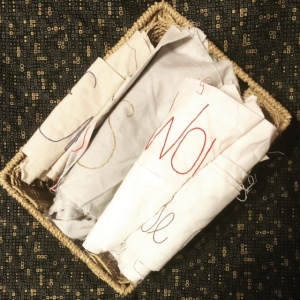
There were two main issues. Firstly, once I started putting the pieces together, I wondered why I hadn’t simply quilted the chapter titles from the start. I often quilt using chain stitch, so why had I chosen to embroider the words on to just one layer of fabric, thus necessitating a whole separate quilting exercise that ultimately led to a distortion of the lettering? The answer, of course, lay in the fact that I had never really intended to stitch all this text at all – I just intended to sew Mirror and Light but carried on stitching for five months until the chapter titles from the whole trilogy were done, and my left thumb ached from gripping the thread.
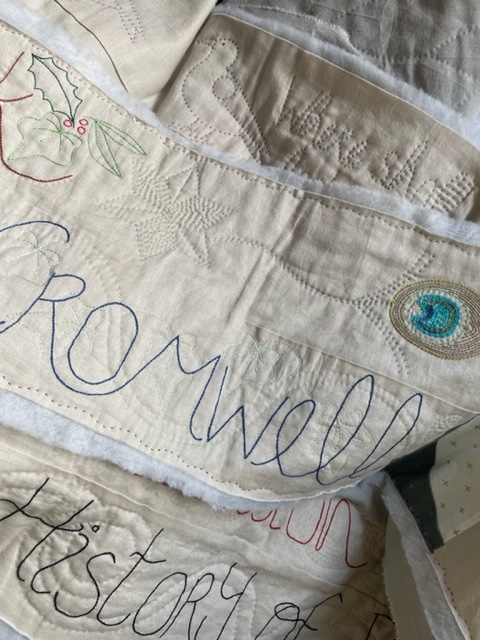
The second issue was one of design. Some of the trilogy’s chapter titles are short – Early Mass, Angels, Wreckage, Salvage – and the text, as it was sewn on to the fabric, provided space for prominent quilting designs before or after the words in question. Other chapter titles, however, were almost as long as the fabric strips on which they were stitched – An Occult History of Britain; Alas, What Shall I Do for Love?; The Image of the King – so adding very prominent quilting would have both confused the eye and detracted from the text.

The trick with these longer titles was to come up with a quilting design that faded into the background while still conveying meaning. For An Occult History of Britain, for example, I spent hours studying pictures of snakes so I could design a serpent to sit behind the lettering, in homage to the snake that slithers through the trilogy (I picked up a snake in Italy) after biting Cromwell. I enjoy the appearances that snake makes on the page, so I wanted to add him to the quilt.

And for The Dead Complain of their Burial I was inspired by a description of Cromwell and George Cavendish watching Cardinal Wolsey’s possessions being ransacked at York Place:
“He and George Cavendish stood by as the chests were opened and the cardinal’s vestments taken out. The copes were sewn in gold and silver thread, with patterns of golden stars, with birds, fishes, harts, lions, angels, flowers and Catherine wheels.”
Hilary Mantel, Wolf Hall (London Fourth Estate, 2009), p.282.
That gave me my start. I designed fishes, stars, and a Catherine wheel; and for bird designs I consulted a book of sixteenth and seventeenth century sewing patterns: Richard Shorleyker’s A Schole House for the Needle. That book tells its readers to ‘compose its patterns into beautifull formes, as will be able to give content, both to the workers, and wearers of them’. So I quilted these background designs in silver and gold thread – subtle enough not to detract from the chapter title, but occasionally catching the light.


The unplanned nature of this project had ramifications for the overall design and look of the finished piece, and while I was sewing it, I had various thoughts along the lines of “If I were starting again, I wouldn’t start from here”. But I also reflected on the fact that the Cromwell Trilogy stitching project has its own history – it is a long term project started in lockdown. The finished Wolf Hall piece carries that timing with it. Now I am sewing other pieces inspired by Hilary Mantel’s trilogy, I’m working with less constraint. And I haven’t tried to do anything with the restrictive lockdown stitched chapter titles from Bring Up the Bodies and The Mirror and the Light. Yet.



 Stitching Thomas Cromwell