I have a very complex relationship with the first Wolf Hall quilt. Ten months after putting the last stitch in place, I am still not sure what I think of it. I think I am reaching the conclusion that it isn’t a discrete piece of work in its own right but it is a jumping off point for other work – and I am happy with that conclusion.
The first Wolf Hall Quilt: at this point I didn’t know how it would turn out.
Because of lockdown restrictions in 2020 and 2021, no-one apart from me was in the same space as this piece until it was almost complete. I didn’t show the work in progress to anyone face to face; and I didn’t have the space to see the whole thing. In fact I didn’t actually see the piece as a whole myself until May 2022 when I was finally in a space that could accommodate the whole unrolled length of 46 feet.
Before that, the only way I could see the quilt in its entirety was to have it photographed.
Michael Wicks, the marvellous photographer who produced a great set of pictures of the work, did a great job in taking detail shots. Before we met, we talked about the shape of the project and its length; I drew him out a map of each section on index cards so he could match them up with the photographs I had commissioned. At his studio we tried to lay the piece out flat but it was actually too long, being longer than the width of the building, and so it ended up being folded back on itself. But within 24 hours of dropping it off, I had an image of how the first Wolf Hall quilt looked thanks to Michael’s photographic magic.
The piece didn’t look as I had expected, and I had some difficulty working out what I had made until a friend said it reminded her of a piece of code. The significance was in the detail.
And after a couple of weeks, when I looked at the full image again, I realised she was right. I started to view the quilt in that light – as a piece of code that represented my personal response to Wolf Hall; I have detailed notes, sketchbook diagrams, a colour coding system, and a key that unlocks each reference on the quilt, but without these, can the whole code be read? As Cromwell himself wonders, when reading some of Cardinal Wolsey’s letters to the rulers of Europe, could the encryption be more tricky?
In the same way that one can’t see the contents of a book all at once, I realised that one shouldn’t be able to see the whole quilt all at once. It’s meant to be rolled – in a nod to Cromwell being Master of the Rolls – only revealing part of its code at any one time. The encryption should indeed be tricky.
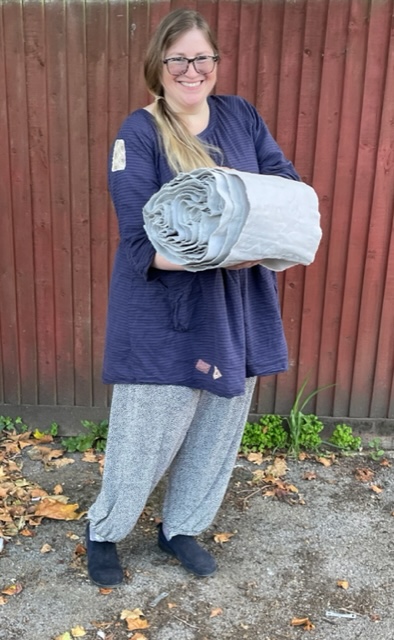
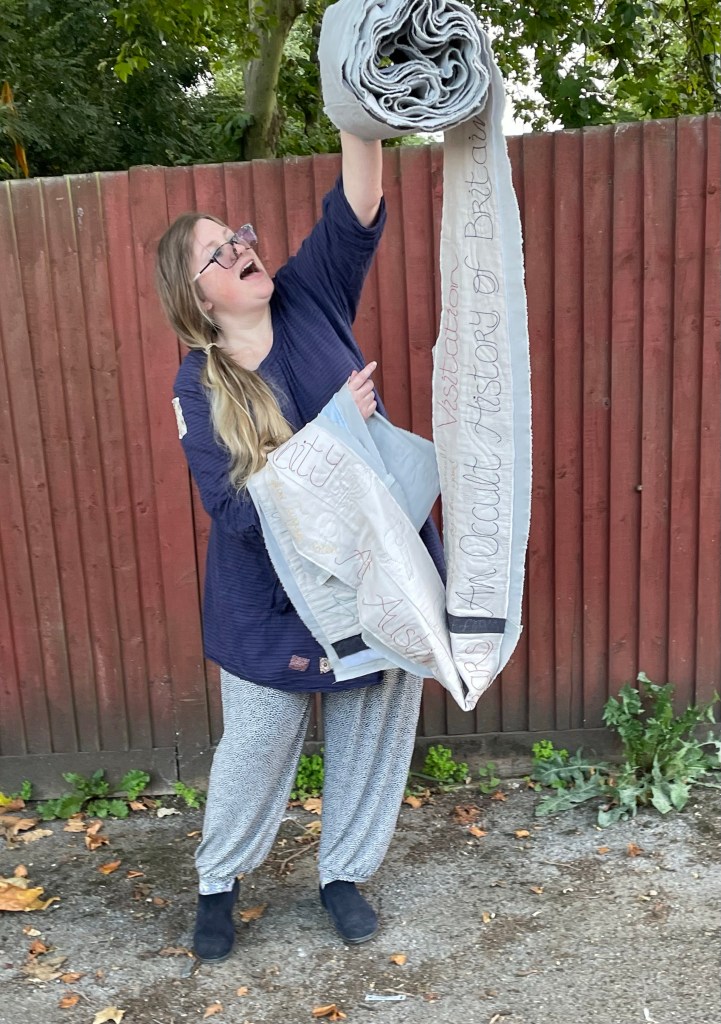
The first Wolf Hall Quilt – completed and rolled, 19 August 2021
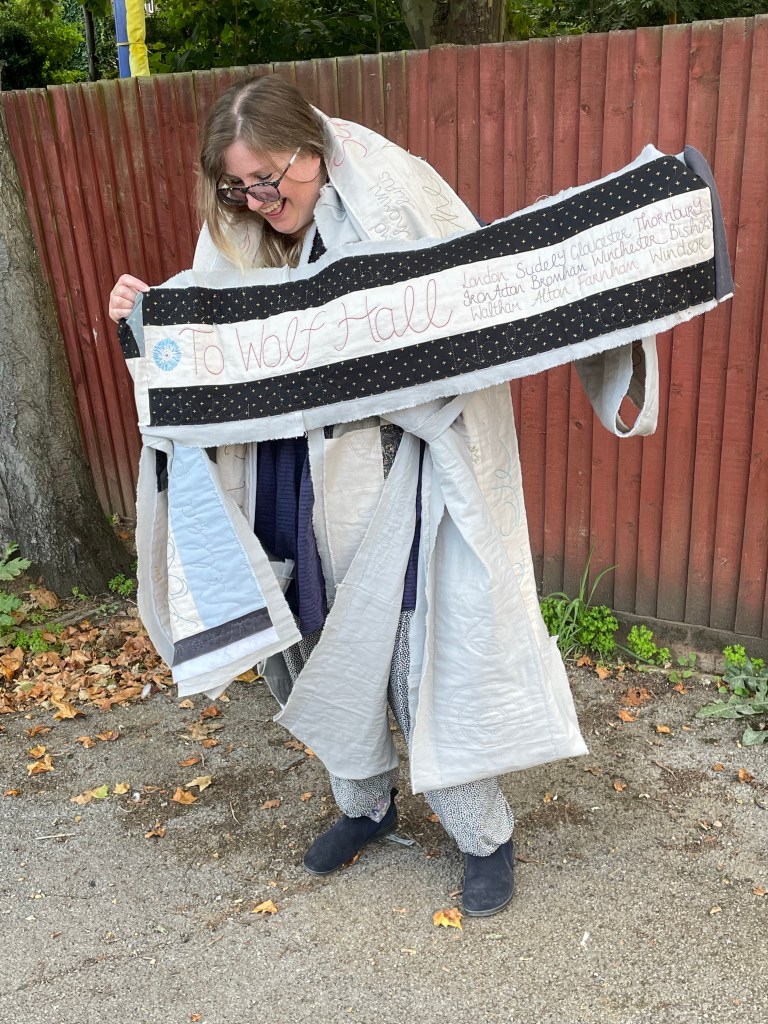
When I finally unrolled the Wolf Hall quilt a couple of weeks ago, as the guest of a very welcoming quilting group, I was in a space large enough to accommodate it, and eight quilters held it up along its length. It was a very intense experience: even though I made it, I hadn’t appreciated the scale of it before that. I am still not sure what I think of it, but I have now been able to see what the entire piece looks like all at once.
And now, once again, it is rolled up, hiding its codes and its tricky encryption.
When I started working on the Cromwell Trilogy Quilt project, I had the intention of making one single piece to convey my interpretation of the whole of Hilary Mantel’s trilogy. But – best laid plans and all that – I didn’t realise how long the Wolf Hall section alone would turn out. Forty six feet of quilting later, and having faced the difficulties inherent in managing such a long textile piece, I have revised my plans.
Parts One and Two, still in separate sections, 14 August 2021
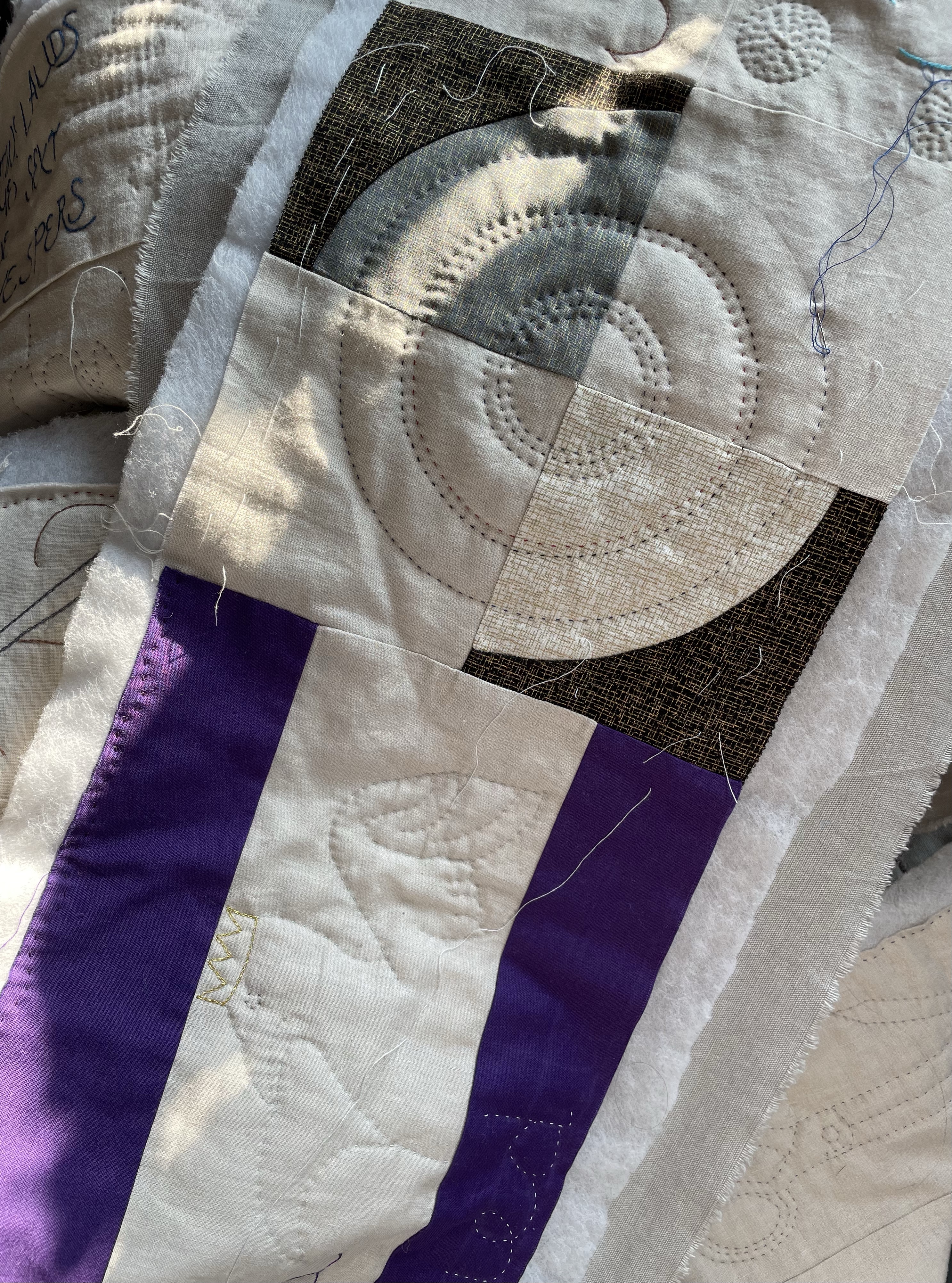
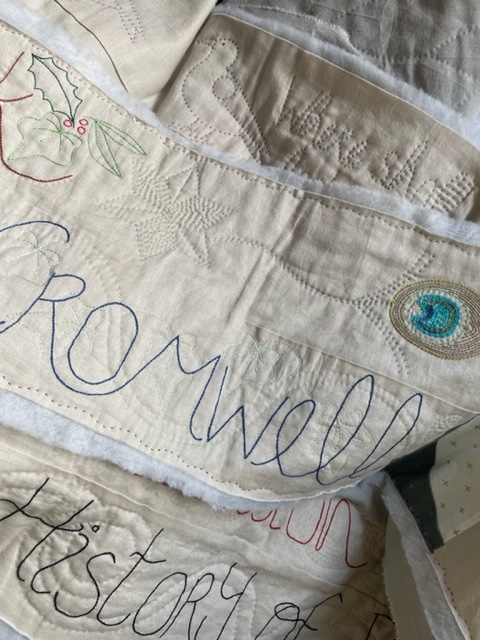
I stitched the Wolf Hall quilt in sections – one section for each of the six parts of the book. As each section was stitched, I drew myself a key to show the elements I had included. Once that was ready – at the very end of the making – I had the slightly nightmarish job of joining the sections together to make a single piece.
The Wolf Hall Quilt key – parts Five and Six
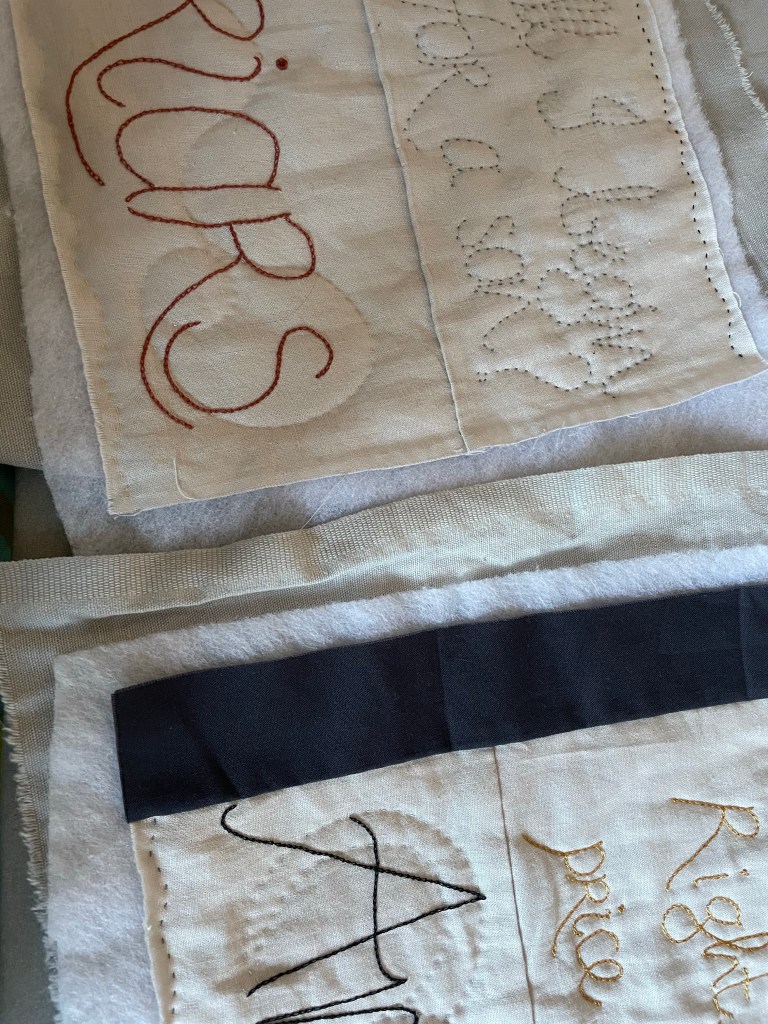
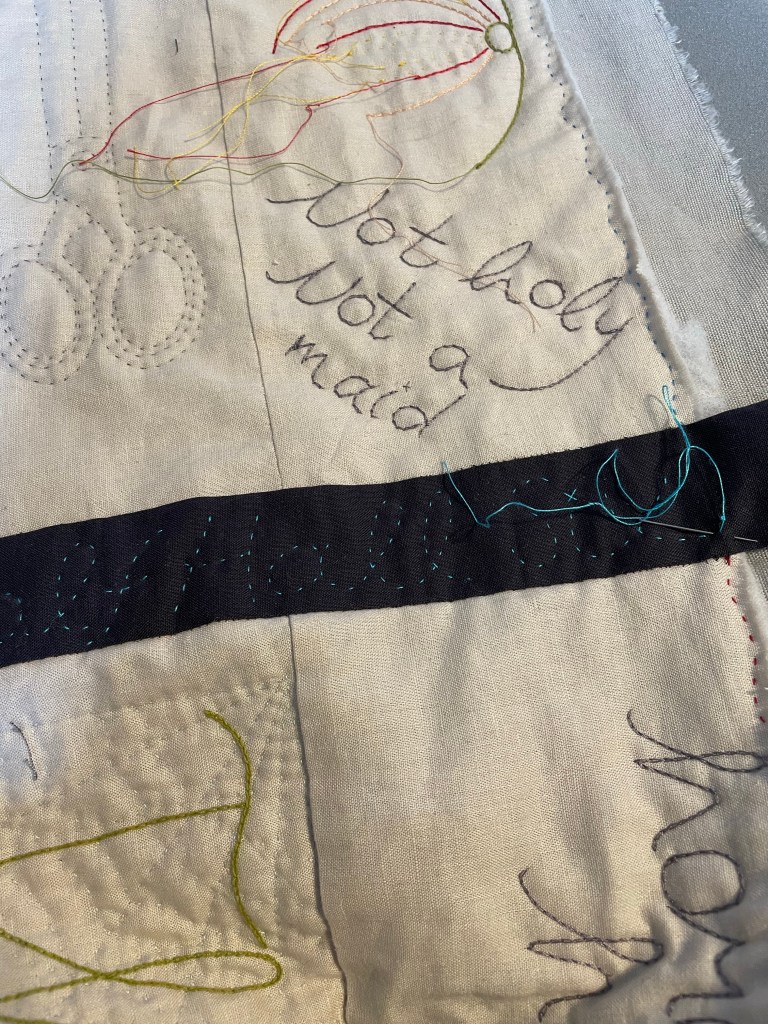
I joined each section with a placefinder bar, quilting the book title and part number at each join. As the piece got longer and longer and heavier and heavier, I found I was grappling with something that twisted and writhed like the snake that bit Cromwell in Italy. And as it grew, I became increasingly afraid to move in case I twisted it further.
The day that I finished the Wolf Hall quilt was odd. I was very tired, and my hands and wrists hurt from manipulating 46 feet of quilt. It had taken five days to join the sections together, and hours were spent just trimming off excess wadding. On the last day, I sat for hours ploughing on, which was very bad for the hands and the back. But finally, it was done.
The very last stitch going in, 19 August 2021
I finished all the joins at 3 minutes past 1 on 19 August 2021. I was exhausted but also exhilarated as I rolled it up as one piece. This all-consuming project had reached a significant milestone – the first large piece was complete.
Last week, for the first time in months, I unrolled all 46 feet of the Wolf Hall quilt. I was giving a talk about the project, and the audience of quilters was keen to see the stitching close up – and to experience the scale of this unwieldy textile piece. Given that I rarely get a chance to see the quilt in one go – its length makes it difficult to view – it was very exciting.
I had completely forgotten that I’d left an unfinished grey placefinder bar at the end – after “To Wolf Hall” – thus leaving my options open. In August 2021, I clearly intended to join similar quilted pieces interpreting Bring Up the Bodies and The Mirror and the Light to the Wolf Hall piece. But the challenges of 46 feet of quilting made me rethink this idea. Now I am pleased that the ending of the first Wolf Hall quilt is still open to further possibilities. As Hilary Mantel writes at the very end of Bring Up the Bodies:
There are no endings. If you think so you are deceived as to their nature. They are all beginnings. Here is one.
In the summer of 2020, when I started embroidering the chapter titles from Hilary Mantel’s Wolf Hall, Bring Up the Bodies, and The Mirror and the Light, there was a distinct absence of planning. Yes, I made sure there was some regularity about the lettering I stitched, but I didn’t have any sort of scheme for how the pieces would fit together or how they would be quilted. It is unsurprising therefore that once I got into working out the quilting design, this presented challenges.
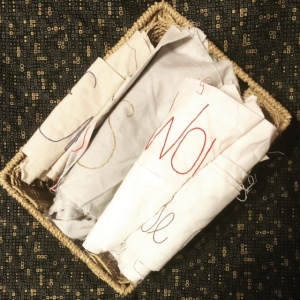
A basket of embroidered chapter titles waiting to be quilted
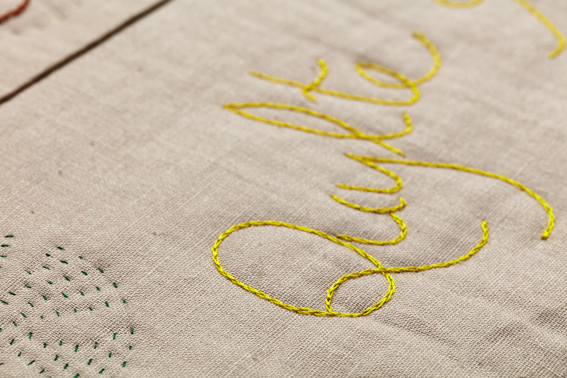
There were two main issues. Firstly, once I started putting the pieces together, I wondered why I hadn’t simply quilted the chapter titles from the start. I often quilt using chain stitch, so why had I chosen to embroider the words on to just one layer of fabric, thus necessitating a whole separate quilting exercise that ultimately led to a distortion of the lettering? The answer, of course, lay in the fact that I had never really intended to stitch all this text at all – I just intended to sew Mirror and Light but carried on stitching for five months until the chapter titles from the whole trilogy were done, and my left thumb ached from gripping the thread.
The second issue was one of design. Some of the trilogy’s chapter titles are short – Early Mass, Angels, Wreckage, Salvage – and the text, as it was sewn on to the fabric, provided space for prominent quilting designs before or after the words in question. Other chapter titles, however, were almost as long as the fabric strips on which they were stitched – An Occult History of Britain; Alas, What Shall I Do for Love?; The Image of the King – so adding very prominent quilting would have both confused the eye and detracted from the text.
A shorter title – Anna Regina – gives space for prominent quilting motifs
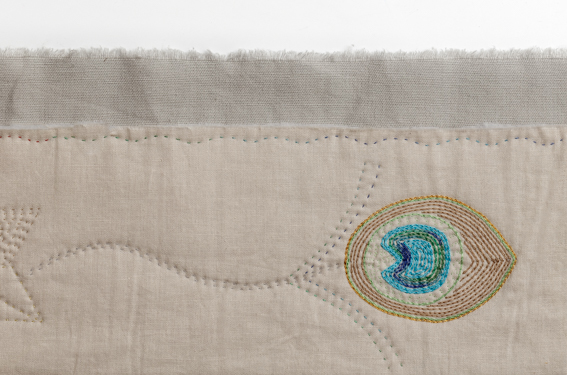
The trick with these longer titles was to come up with a quilting design that faded into the background while still conveying meaning. For An Occult History of Britain, for example, I spent hours studying pictures of snakes so I could design a serpent to sit behind the lettering, in homage to the snake that slithers through the trilogy (I picked up a snake in Italy) after biting Cromwell. I enjoy the appearances that snake makes on the page, so I wanted to add him to the quilt.
Entirely Beloved Cromwell – Lettering takes up the entire length of the fabric
And for The Dead Complain of their Burial I was inspired by a description of Cromwell and George Cavendish watching Cardinal Wolsey’s possessions being ransacked at York Place:
“He and George Cavendish stood by as the chests were opened and the cardinal’s vestments taken out. The copes were sewn in gold and silver thread, with patterns of golden stars, with birds, fishes, harts, lions, angels, flowers and Catherine wheels.”
Hilary Mantel, Wolf Hall (London Fourth Estate, 2009), p.282.
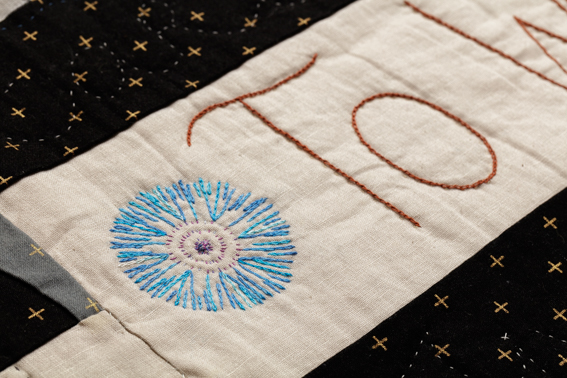
That gave me my start. I designed fishes, stars, and a Catherine wheel; and for bird designs I consulted a book of sixteenth and seventeenth century sewing patterns: Richard Shorleyker’s A Schole House for the Needle. That book tells its readers to ‘compose its patterns into beautifull formes, as will be able to give content, both to the workers, and wearers of them’. So I quilted these background designs in silver and gold thread – subtle enough not to detract from the chapter title, but occasionally catching the light.
Fishes and StarBirdsStar and Catherine WheelThe Dead Complain of Their Burial: quilting in progress
The unplanned nature of this project had ramifications for the overall design and look of the finished piece, and while I was sewing it, I had various thoughts along the lines of “If I were starting again, I wouldn’t start from here”. But I also reflected on the fact that the Cromwell Trilogy stitching project has its own history – it is a long term project started in lockdown. The finished Wolf Hall piece carries that timing with it. Now I am sewing other pieces inspired by Hilary Mantel’s trilogy, I’m working with less constraint. And I haven’t tried to do anything with the restrictive lockdown stitched chapter titles from Bring Up the Bodies and The Mirror and the Light. Yet.
In 2020, I started stitching the chapter titles in Hilary Mantel’s Cromwell Trilogy with no coherent thought about what this stitching might become. It was just a way of passing some lockdown time and processing what I had read (I have written more about the origins of the project here). But as the pile of stitched chapter titles grew and grew, I knew I would ultimately want do something more purposeful with them. And given that I love handquilting, and I take great pleasure in sewing tiny stitches to make tightly controlled patterns, or lettering, or pictures, it made sense to make use of this technique.
The embroidered chapter titles waiting to be quilted
I took some time deciding on a format for a quilted piece. There was no plan, no overall design in my head. I had embarked upon the stitched chapter titles with a vague idea that I might make a traditionally shaped quilt based on The Mirror and the Light. But I was never quite satisfied with that concept. I kept thinking there was something inappropriate about a bed-shaped item based on these novels: how could one sleep under the story of an execution?
The plan unfolded itself at an event for the Women’s Prize for Fiction that I watched online in September 2020. Mantel was interviewed, and said:
All of the stories are borne along on the River Thames and the river has its deeps and its mysteries, and although the book is pegged very firmly to the historical record, there are still subterranean depths within the hearts of the people whom the record concerns and we swim around below the surface.
I liked the idea of creating something long, snaking out like the river, in a single strip. I had visions of a deconstructed set of the novels, pages rearranged chronologically in a lengthy horizontal timeline. And so I started to think about working a quilt in the shape of a long strip. At that point, I didn’t know how big it would be. I had a vision of joining together multiple strips so that all three books would be represented in one long piece, starting and ending with So Now Get Up. Given that the Wolf Hall quilt alone ended up being 46 feet long, I have since revised this idea.
Quilting and listening to Wolf Hall Part One, Chapter One: Across the Narrow Sea
When I decided to put all the embroidered chapter titles together into one handquilted piece, I knew that the quilting had to be approached in a considered way – partly because I knew it would be the most pleasurable part of the stitching, but mainly because I wanted the experience of quilting this piece to be as immersive as possible. That meant establishing a tight practice for working on each section of the quilt. I decided from the start of the quilting process that I would work incrementally, and sew each section in a strict order – I would not dot back and forwards throughout the Trilogy, and I wouldn’t piece the whole thing together in one go. I wanted to be very intentional about what I was doing, which meant reading and listening to the chapter I was stitching as I quilted it.
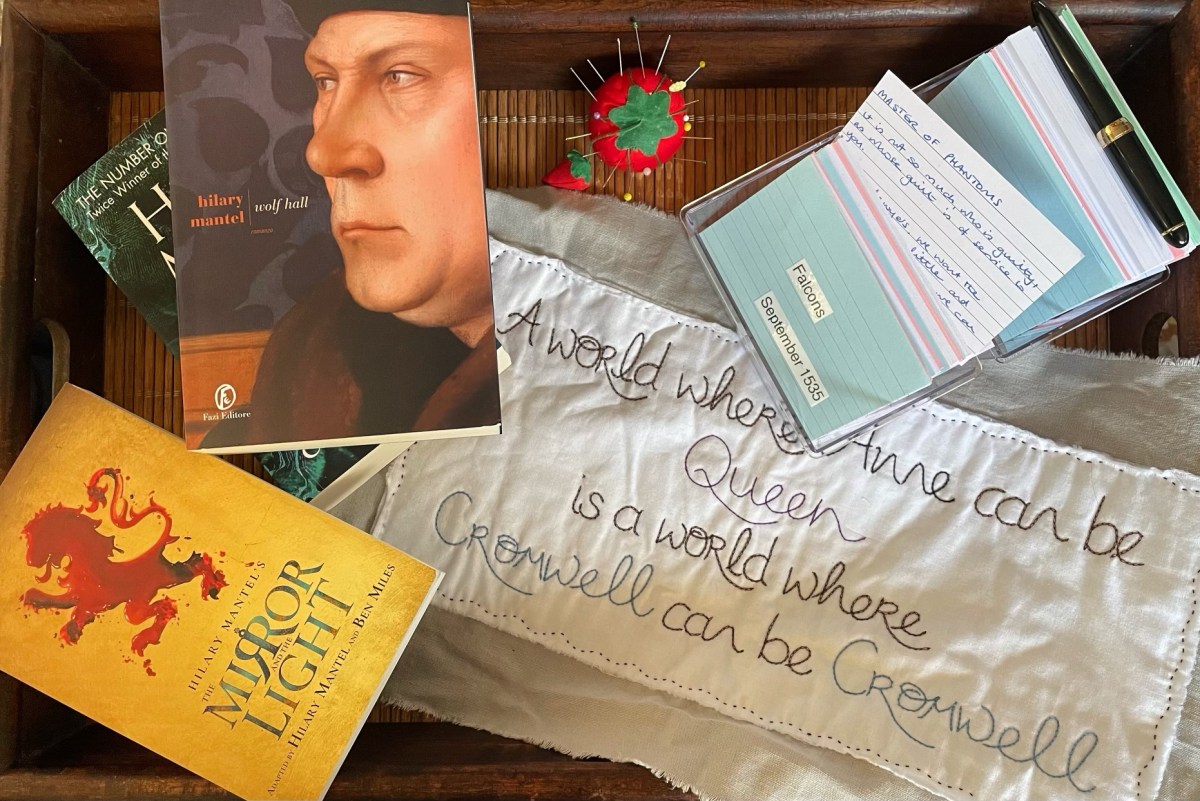
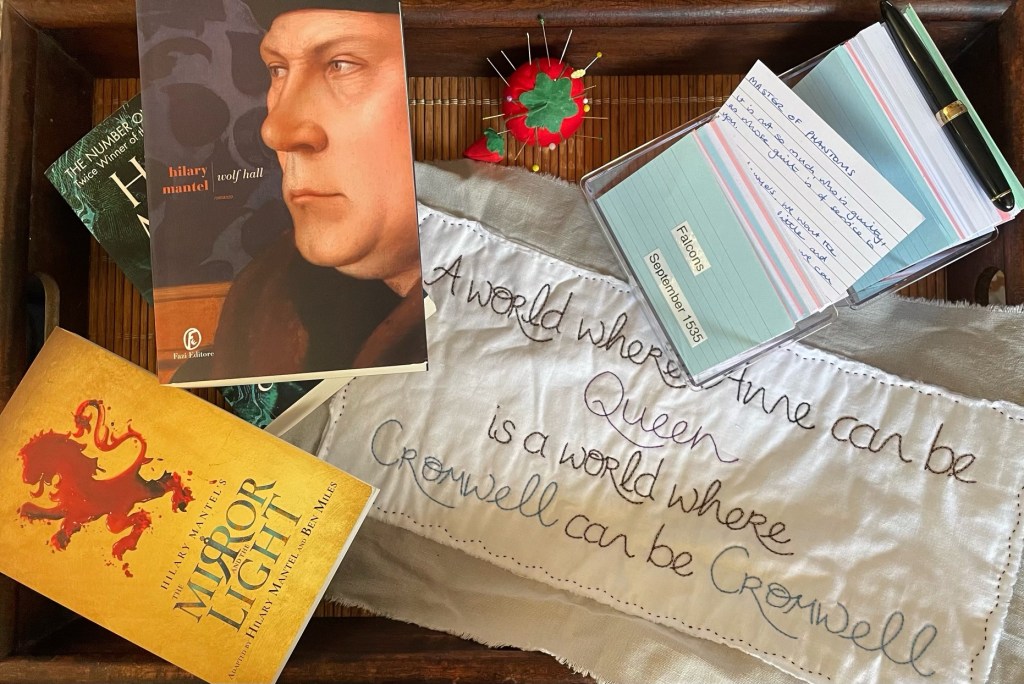
I worked out a process to support this way of working: although I know the three books very well, I wanted to reacquaint myself with the text before starting quilting each chapter title. So when a section was pressed and basted ready for quilting, the first step was to re-read the relevant chapter. I then made notes on index cards as prompts for the stitching. I drew up three sets of index cards: anything that might inspire me to draw a quilting motif, or phrases that might spark an image went onto white cards; I made a note of the colours that are prominent in the chapters on pink cards; and finally, references to anyone who actually engages in an act of stitching went onto green cards.
Index Cards: An Occult History of Britain
I then started the quilting process. I listened to the audiobook of the relevant chapter as I worked, and the act of listening brought out other ideas, almost without me realising it. Hearing Mantel’s words sometimes highlighted an element to be sewn into to the quilt, so I usually listened to the chapter on repeat. Sometimes I listened to it in the German translation – I know the original English so well that I can follow it even though my German isn’t really up to it. I didn’t move forward with reading and listening to the book until each individual section was quilted.
The decision to work in this way had an impact on the way the quilt developed. I didn’t have an overall plan worked out for the entire piece, with each section evolving as I read and listened. And sometimes it was a difficult process; some chapters contained almost unbearable levels of loss and pain and I had particular problems when I came to An Occult History of Britain and Make or Mar when Cromwell’s grief overwhelms him. I actually had to leave part of that section unsewn as it was too distressing to continue, thereby breaking my own rules. And I foresee problems with this process once I approach the end of the Trilogy in The Mirror and the Light, but that’s a worry for another day.
This contrasts strongly with my stitching of the chapter titles in 2020. That was very unfocused, with no sense of a larger project to come. That presented some significant design challenges which I can see in the finished piece.
Planning out a shattered emerald for Wolf Hall – Part One, Chapter Three: At Austin Friars
It’s interesting to reflect on how the first Wolf Hall quilt was made. A year on, looking back on the tight practice and the self imposed rules I put in place, I wonder how much these were a subconscious reflection of the restrictions of the pandemic. When I look at the finished piece, I can see how its rigid shape was influenced by the time in which it was made. As the project evolves into 2022, its form is rather more fluid – although the immersive reading and listening remains.
I’ve been working on my Cromwell Trilogy stitching project for nearly two years now. During that time, my approach to the project and the techniques I am using have changed, the format of the piece has altered, and I am in no doubt that these will evolve further. One thing remains constant however: the inspiration I find in the three novels by Hilary Mantel – Wolf Hall, Bring Up the Bodies, and The Mirror and the Light – which makes me want to stitch my response.
I’m writing this post in April 2022: a time at which I have already completed a large scale quilted piece based on Wolf Hall, presented a paper about both stitching in and stitching the Cromwell trilogy to a conference about Hilary Mantel, held at the Huntington in October 2021, made some smaller standalone pieces, and have started work on stitchery related to The Mirror and the Light.
Now that time has passed, I can see that the approach I took to my first Wolf Hall quilt was very specific to the time and conditions in which it was made: it was sewn during the Covid-19 pandemic while I was isolating. I realise that the form of the piece itself is very restricting: a long and narrow quilted strip, giving equal space to all the chapters regardless of length or complexity. I put various rules in place for the project: working in strict order according to the novel, not skipping ahead, deliberately limiting stitch choice. No-one saw the piece in progress until the very final stages, and I was working in a small space, so I couldn’t really see what I had produced until I had it photographed. And it was not what I had expected. I am still not quite sure what I have made.
Piles of Wolf Hall quilting, August 2021
That experience has informed the project going forward. I felt a sense of achievement at having completed work on the Wolf Hall quilt, but I soon realised it was a studio piece, an experiment, a trial run. I was happy with individual elements of it, but not the whole thing.
Thomas Cromwell’s Cornish Choughs
So I am currently at a really interesting stage of the project. I have been reflecting on methods, process, and form. When I started preparatory work for my stitchery of Bring Up the Bodies and The Mirror and the Light I knew I needed a different format. Maybe a stitched book? Maybe a series of smaller individual pieces? Maybe they didn’t all need to be quilted? And – a big question – should I continue working book by book, chapter by chapter? Or should I work thematically across all three books? I haven’t quite decided yet, but I keep remembering how the River Thames runs through the entire Cromwell Trilogy, and I think there’s a hint there.











 Stitching Thomas Cromwell