In the Weave in Worcester

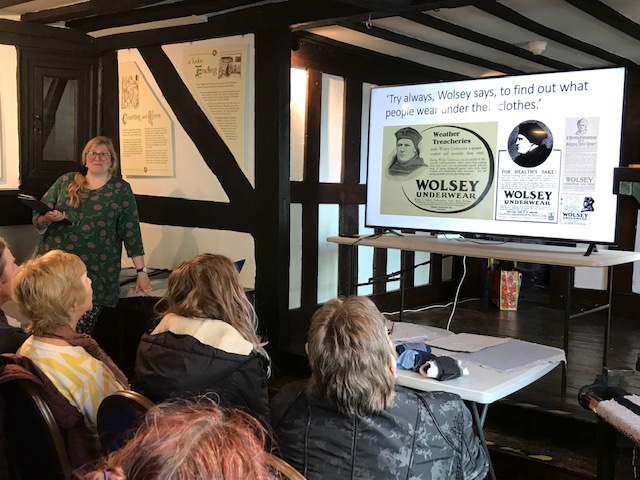
A woman in a green flowered top smiles at an audience looking at a screen featuring advertising images for Wolsey Underwear, and the Quixote “Try always, Wolsey says, to find out what people wear under their clothes.”
Talking Text, Textiles, Thomas Cromwell, and Thomas Wolsey

I recently spent a very enjoyable few days out of London, having been invited by Hilary Mantel scholar Dr Lucy Arnold and the Tudor House Museum in Worcester to take part in a public event at the Museum entitled “In the Weave”. We are both fascinated by the role that textiles play in Hilary Mantel’s Cromwell Trilogy, and we were delighted to share our enthusiasm with an engaged audience, many of whom left planning to read or re-read Wolf Hall. Lucy talked about the role of textiles and the textile trade in the Cromwell Trilogy, and how these appear in the text, while I shared my analysis of who stitches and what they stitch across the Trilogy, and talked about some my textile work.

A long piece of quilting, on cream, black and gold fabric, reading Wolf Hall, sits on a dark brown antique chest, in a half timbered interior. A vase of lavender rests on a window ledge above the chest
The first Wolf Hall quilt visits a 16th Century setting

I have written before about the complex relationship I have with the first Wolf Hall quilt, the circumstances in which it was made, and how I feel it doesn’t really work as a piece. However, taking it out for the first time in nearly a year, laying it out, folded loosely, and watching people handle it and photograph it made me start to question my relationship with it. Does it in fact work? And does it have potential for further development?

This time last year, I put aside the stitched chapter titles I made back in 2020 for Bring Up the Bodies and The Mirror and the Light. I didn’t want to use them then. But I’m now wondering if that 46 feet of Wolf Hall quilt might like to grow further? I had completely forgotten that I left the end unfinished, open to further work should I choose to add to it.
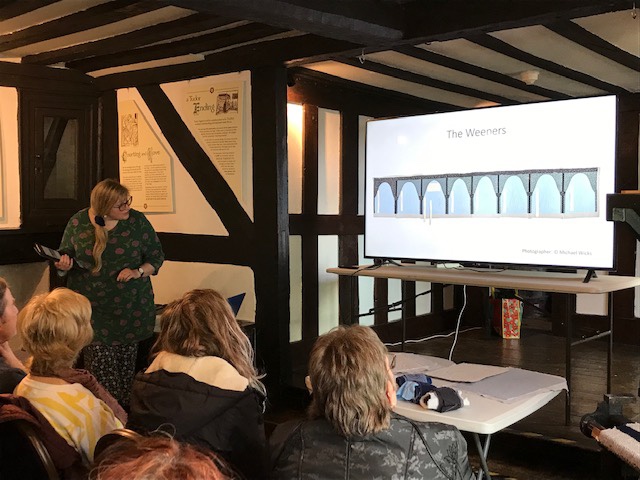
A woman bends to look round at a screen, showing a piece of textile art work described on screen as The Weepers.
The Weepers in Worcester – completed just a few days earlier

While in Worcester I took the opportunity to visit the Cathedral. There was something particular I wanted to see – the tomb of Prince Arthur and his Chantry Chapel. I was very fortunate to visit at a quiet time, so I had the Chantry to myself and thus an ideal opportunity to look closely at carvings and symbols. The Chantry was vandalised during the reign of Edward VI, and some visible scars from axes and swords can still be seen, scars I found unexpectedly upsetting.
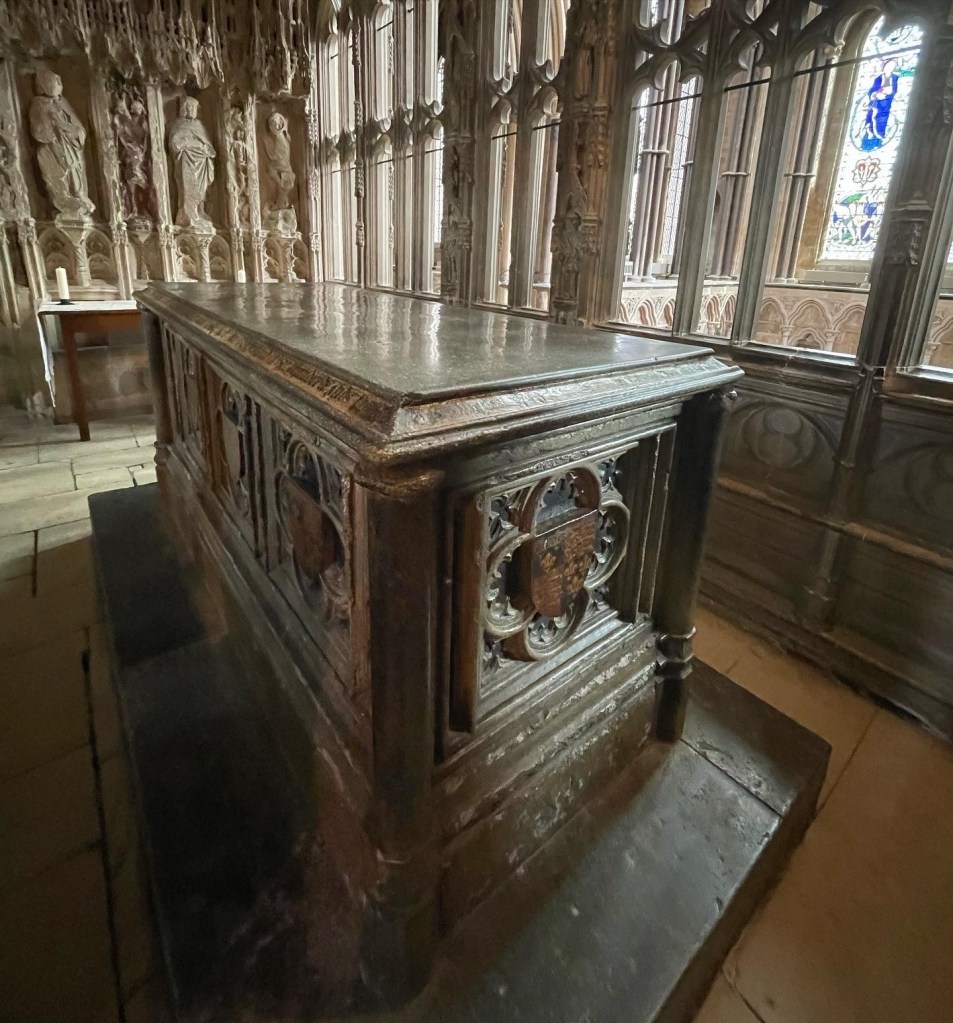
A Sixteenth Century rectangular tomb surrounded by carved walls, sixth some figures carved into the walls.
Prince Arthur’s Chantry at Worcester Cathedral

I had assumed that the Chantry was Prince Arthur’s burial place and that it a mourning Henry VII and Elizabeth of York had been involved in its design and construction, but according to this wonderful piece by Lucy Arnold, it seems that we don’t actually know exactly how the Chantry was built, where Prince Arthur was/is buried, or how much the memorial cost. Interpreting material items left to us from centuries ago is often challenging, partial, and ambiguous.
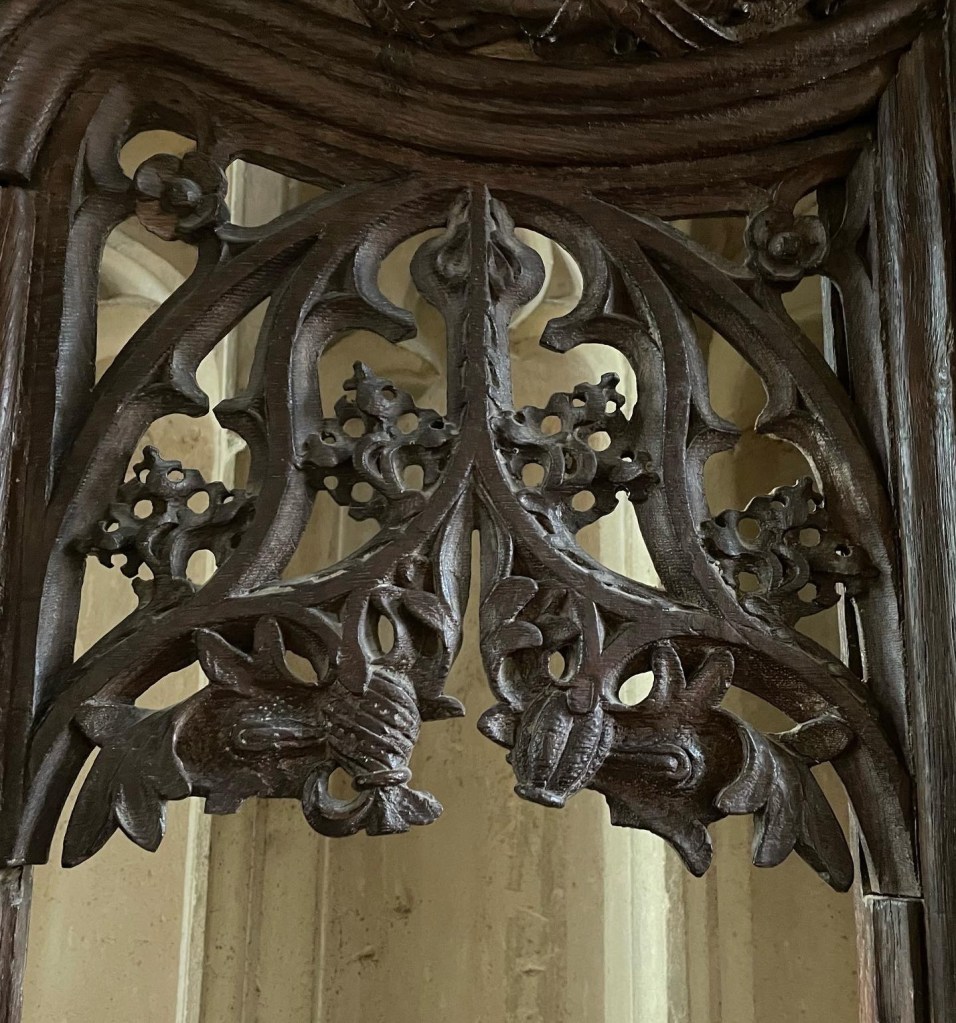
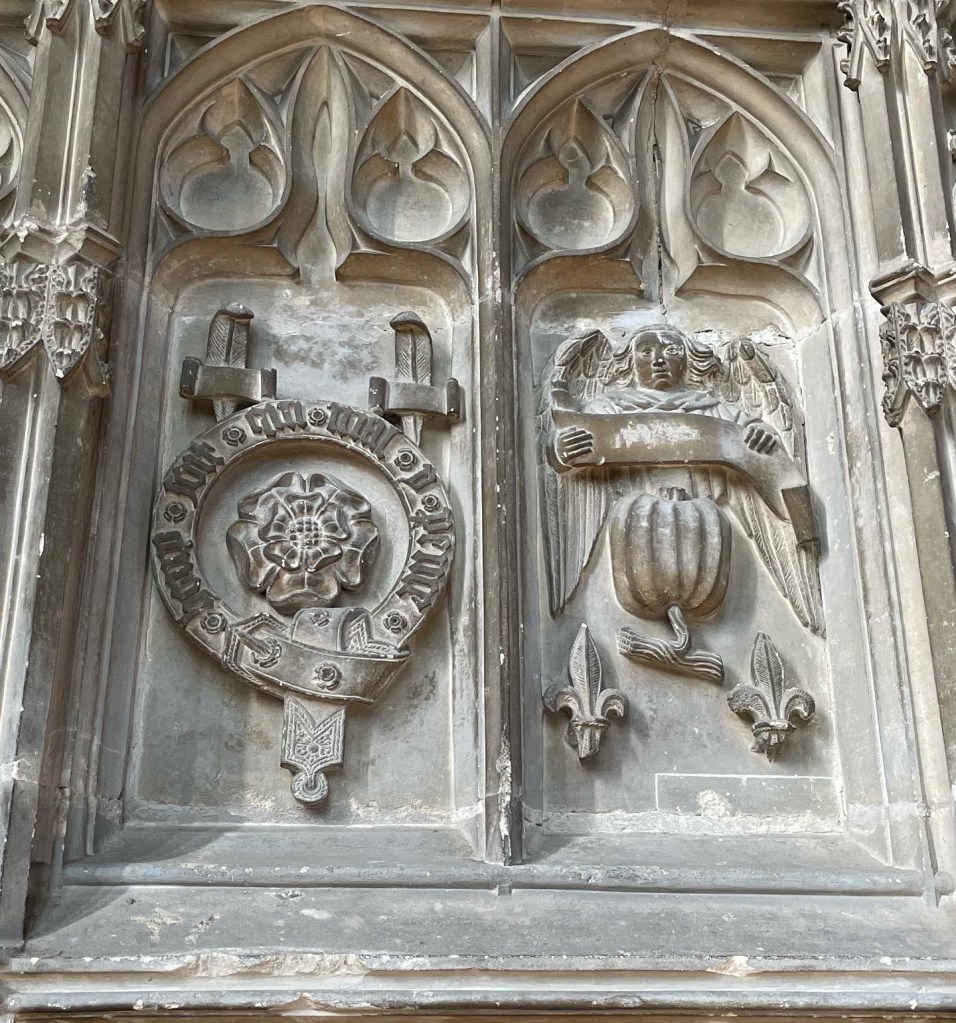
Pomegranates carved on the door to Prince Arthur’s Chantry
A Pomegranate symbol on the exterior Chantry wall

I was interested to see pomegranate symbols both inside and outside the Chantry – the symbol of Katherine of Aragon, Prince Arthur’s widow. These symbols are survivors of destruction – both during the reign of Henry VIII and Edward VI:

They search out and obliterate any trace of Katherine, the queen that was, smashing with hammers the pomegranates of Aragon, their splitting segments and their squashed and flying seeds.

Hilary Mantel, Bring Up the Bodies – Falcons

But far more unexpected than the surviving pomegranates, was Master Secretary Cromwell himself. Walking in the Cloisters, I looked in detail at the stained glass and, to my surprise, there was Thomas Cromwell, his hand over his mouth. What is he doing?

Stained glass windows featuring Henry VIII, Thomas Cromwell, Thomas Cranmer and Hugh Latimer

Perhaps Henry can tell us:

He is better than you at keeping his face straight. I see you, when we sit in council, with your hand before your mouth. Sometimes, you know, I want to laugh myself.

Henry VIII to Thomas Cromwell: Hilary Mantel, Wolf Hall – Anna Regina

The Object and the Image

Cream fabric quilted with a motif of a Tudor rose combined with a pomegranate, leaves and a stem at the bottom. To the right of the motif is a quilted bird with large feet
The Pomegranate and the Tudor Rose combined
Photographer: © Michael Wicks

When I was working on the first Cromwell Trilogy Quilt back in 2020-2021, we were in lockdown in England, and all my research was home based. Museums were closed and I relied on online catalogues and images for both reference and inspiration.

One of the first motifs I stitched into the quilt – in the Paternity section – was a symbol representing Katherine of Aragon, based on a livery badge held in the collection of the Museum of London. The badge represents a pomegranate (Katherine’s emblem) combined with the Tudor Rose.

A hand stitched image of a rose and pomegranate combined, the leaves at the bottom of the stem. The image is displayed in a rounded format.
Katherine of Aragon’s Livery Badge, stitched

At this stage in the project, I was still working out my approach, and I used this badge to start thinking about the way in which the emblems of Henry VIII’s queens needed replacing, a theme that Hilary Mantel returned to throughout the Cromwell trilogy, and which I have returned to repeatedly in my stitching.

Yesterday I had the opportunity to go into the Museum of London for the first time since lockdown (and the last time I will do so until the Museum reopens in its exciting new home in due course). In the Medieval Gallery, I found that the actual livery badge was on display – so I saw the real, tiny thing for the first time. And in its display case, it is presented the other way up to my interpretation, and indeed in the catalogue photograph.

Part of a display case featuring a dark grey rose and pomegranate design with the leaves and stem at the top of the object. In the case there is also a gold and silver belt buckle on a clear Perspex block, and a round object is also just visible.
The livery badge in its display case

So is it the “wrong” way up in my quilt? As an image, the leaves appear more natural sitting at the bottom like a flower; but as an object, could there be the remains of a clip, a pin, a fastener to indicate it was worn with the leaves at the top? Would I have approached it differently had I seen the object first, or not even looked at the online catalogue at all?

It’s one of those unanswerable questions that result from the first Cromwell Trilogy Quilt being made in a situation of restriction, with no access to actual objects. And access is still restricted for me personally: I am currently living with the after effects of Covid-19 – fatigue meant that I spent most of my visit sitting down whenever and wherever I could and reserving my energy for looking at this one object.

Whether the livery badge should have been worn this way or that, Wolf Hall describes the way in which Katherine and her supporters found themselves the “wrong” way up once their stability was upended by the rise of Anne Boleyn. So there is an additional layer of meaning in its representation in my quilt – however unintended it might have been when I picked up my needle.

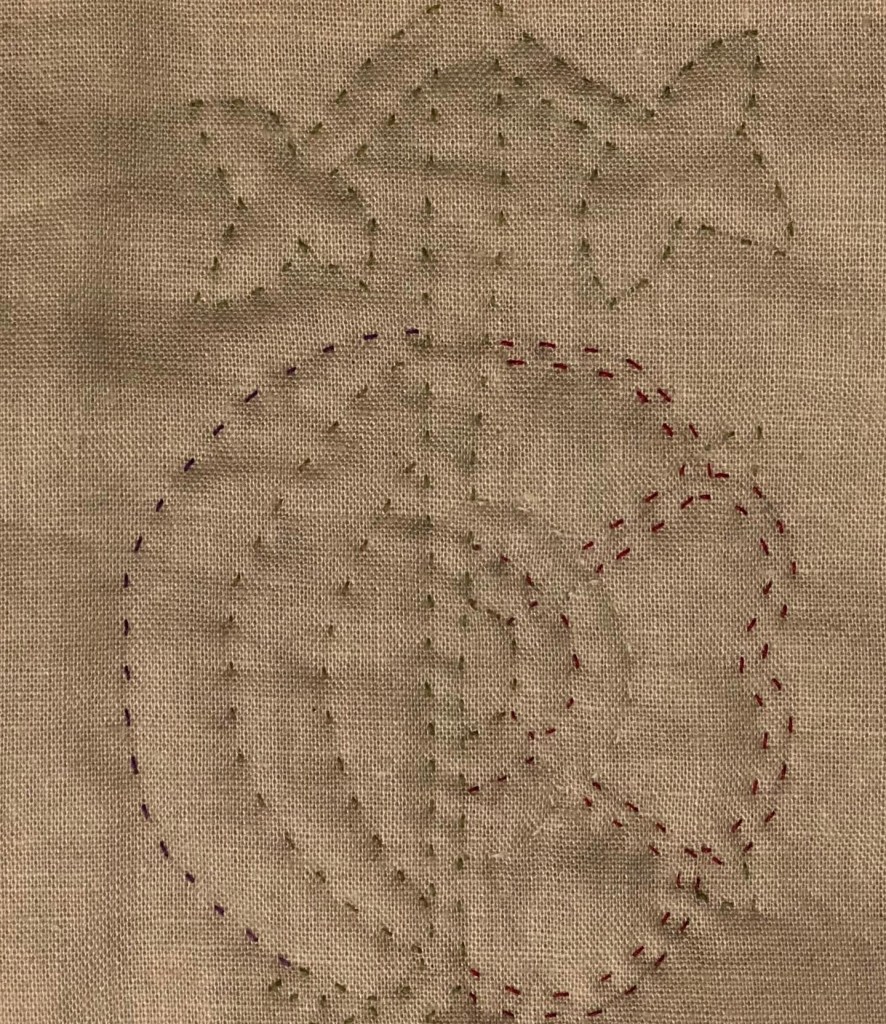
The stitched rose and pomegranate motif again, this time the “wrong” way up with the leaves and stem at the top of the motif.
Upended